

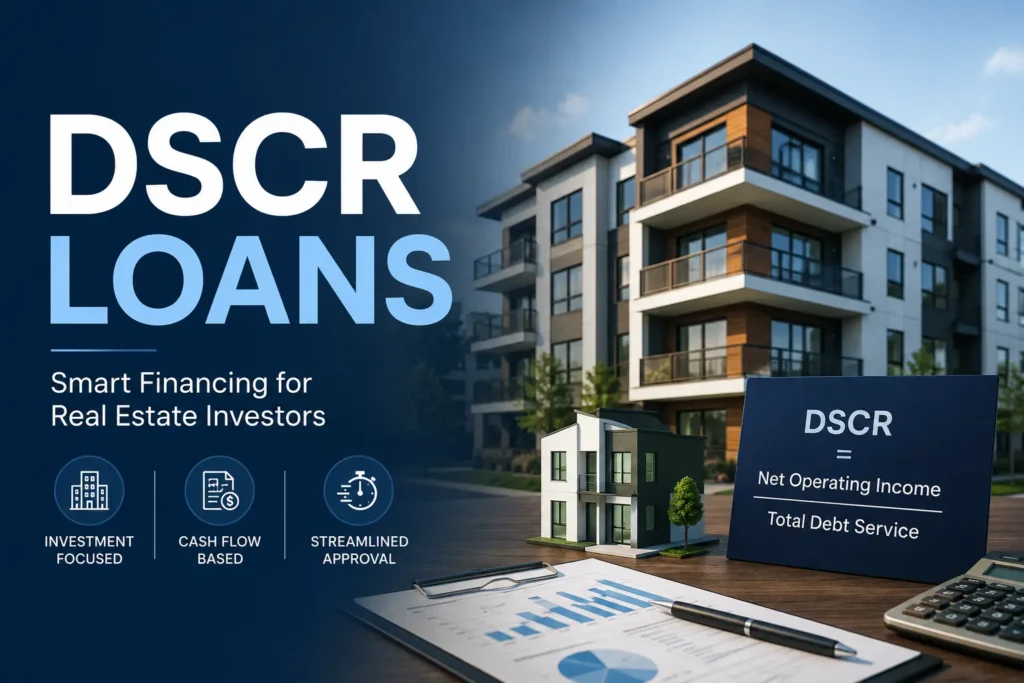
A DSCR loan is a non-qualified mortgage (non-QM) that lets real estate investors qualify based on a rental property’s cash flow rather than their personal income. In 2026, most lenders require a minimum DSCR ratio of 1.0 to 1.25, a credit score of 620 or higher, and 20% to 25% down. No tax returns, W-2s, or personal income verification required. This guide explains how DSCR loans work, who qualifies, what rates to expect, and how to use them to grow a rental portfolio.
Introduction
You found a rental property that pays for itself. The numbers work. The cash flow is strong. But your personal tax return shows low income after write-offs, and a conventional lender just turned you down.
This is exactly the situation DSCR loans were designed to fix.
A DSCR loan does not care how much you personally earn. It cares how much the property earns. If the rental income covers the mortgage payment, you have a strong shot at qualifying. For real estate investors who build portfolios through cash-flowing properties, this changes everything.
This guide breaks down how DSCR loans work in 2026, what the requirements look like, how rates compare, and how to use this loan type to scale your investment strategy faster than conventional financing allows.
What Is a DSCR Loan?
DSCR stands for Debt Service Coverage Ratio. A DSCR loan is a type of non-qualified mortgage that qualifies borrowers based on the income a rental property generates rather than the borrower’s personal wages, tax returns, or employment history.
The DSCR ratio is a simple calculation:
DSCR = Monthly Rental Income divided by Monthly Debt Obligations
If a property generates $2,500 per month in rent and the mortgage payment plus taxes and insurance totals $2,000 per month, the DSCR is 1.25. That means the property earns 25% more than it costs to carry. Most lenders consider that a healthy ratio.
A DSCR below 1.0 means the property does not fully cover its own costs. Some lenders still approve loans at a DSCR of 0.75 or higher for strong borrowers, but most conventional non-QM programs prefer 1.0 as the floor.
How DSCR Differs From a Bank Statement Loan
Both are non-QM mortgage products, but they serve different borrowers. A bank statement loan verifies your personal or business cash flow to qualify you as a borrower. A DSCR loan ignores your personal income entirely and focuses only on the property’s ability to generate rent. Investors who want to scale without constantly re-proving their personal income prefer DSCR financing for exactly that reason.
Who Are DSCR Loans For?
DSCR loans are built for real estate investors, not primary home buyers. They work best when the property itself produces enough rental income to cover the loan payment.
The ideal DSCR loan borrower looks like one of these:
- Buy-and-hold rental property investors building a long-term portfolio
- BRRRR strategy investors (Buy, Rehab, Rent, Refinance, Repeat)
- Short-term rental operators using Airbnb or VRBO income to qualify
- Real estate investors with multiple properties who cannot keep proving personal income at every purchase
- Self-employed investors whose personal tax returns understate income
- Foreign national investors with no US income documentation
If you are buying a primary residence, a DSCR loan is not the right tool. This product is strictly for income-producing investment properties including single-family rentals, multi-unit properties up to four units, and in some programs, small apartment buildings.
DSCR Loan Requirements in 2026
Before you apply, understand the full qualification picture. DSCR loan requirements in 2026 are more investor-friendly than conventional investment loans, but lenders still have clear minimum standards.
| Requirement | Typical Range | Notes |
| Minimum DSCR | 1.0 to 1.25 preferred; 0.75 on exception | Higher ratio improves rate and terms |
| Credit Score | 620 minimum; 680 preferred | Better pricing above 700 |
| Down Payment | 20% to 25% standard | Some programs allow 15% with strong DSCR |
| Loan Amount | $100,000 to $5 million or more | Jumbo DSCR programs available |
| Property Type | Single-family, 2 to 4 units, condos, short-term rentals | Some lenders cover small multi-family |
| Cash Reserves | 3 to 12 months of mortgage payments | Larger reserve requirement for multiple properties |
| Income Verification | None required | No W-2s, tax returns, or pay stubs needed |
| Appraisal | Required including rent schedule | Lender uses market rent to confirm DSCR |
The rent schedule attached to the appraisal is critical. The appraiser estimates what the property would rent for on the open market. Lenders use that figure, not just your current lease, to calculate the DSCR. If your actual tenant pays below market rent, it can lower your qualifying ratio.
How Do DSCR Loan Rates Compare in 2026?
DSCR loan rates are higher than conventional investment property loans, which themselves already carry a rate premium above primary residence mortgages. Planning for this layered difference is important before you run your investment numbers.
In 2026, conventional investment property loans price roughly 0.5% to 0.75% above primary residence rates. DSCR loans price an additional 0.5% to 1.5% above that. In practical terms, DSCR loan rates in 2026 typically range between 6.5% and 8.5% depending on credit score, loan-to-value ratio, DSCR ratio, and loan size.
Here is a comparison of how DSCR loans stack up against other investment financing options:
| Feature | DSCR Loan | Conventional Investment Loan | Hard Money Loan |
| Income verification | None (property cash flow only) | Personal income required | None typically |
| Interest rate (2026) | 6.5% to 8.5% | 6.0% to 7.5% | 10% to 14% |
| Loan term | 30-year fixed, 40-year IO available | 15 or 30-year fixed | 6 to 24 months |
| Down payment | 20% to 25% | 15% to 25% | 20% to 35% |
| Credit score minimum | 620 | 620 to 680 | Varies widely |
| Portfolio scaling | Easy, no income cap | Hard, DTI limits apply | Short-term only |
| Best for | Buy-and-hold rental investors | W-2 investors with strong income docs | Fix and flip only |
The key advantage DSCR loans hold over conventional investment loans is scalability. Because no personal income verification is required, you can theoretically finance as many properties as each one qualifies for on its own cash flow. Conventional loans limit you based on your personal debt-to-income ratio, which caps out quickly for investors with multiple mortgages.
How Is the DSCR Ratio Calculated?
Understanding the math helps you evaluate deals before you ever contact a lender.
The formula is straightforward:
DSCR = Gross Monthly Rental Income divided by Total Monthly Housing Expenses
Total monthly housing expenses typically include the principal and interest payment, property taxes, homeowners insurance, and any HOA dues. Some lenders also factor in vacancy allowance or property management costs.
Here is a practical example:
A single-family rental in a mid-size market rents for $2,200 per month. The mortgage payment is $1,400, property taxes are $250, and insurance is $120. Total monthly obligations equal $1,770. The DSCR is $2,200 divided by $1,770, which equals 1.24. That comfortably meets most lender minimums.
If the same property only rented for $1,700 per month, the DSCR would be 0.96. That falls below the 1.0 threshold at most lenders, and you would either need to bring a larger down payment, find a lender with a 0.75 DSCR exception program, or move on to a better-performing property.
Smart investors use a mortgage calculator to test multiple rent and payment scenarios before committing to a deal. Running the DSCR math at different purchase prices and interest rate assumptions helps you understand exactly how much rent coverage you need to qualify.
DSCR Loans vs. Conventional Investment Loans: Which Is Right for You?
The choice between a DSCR loan and a conventional investment loan comes down to two things: your personal income documentation and how many properties you plan to buy.
If you have clean W-2 income, strong tax returns, and you are buying your first or second investment property, a conventional investment loan may give you a slightly lower rate. Fannie Mae and Freddie Mac guidelines allow investors to finance up to 10 properties conventionally, though the requirements become stricter after the fourth property.
If you are self-employed, your tax returns understate your income, or you are already at or near the conventional financing limit, a DSCR loan removes the income documentation barrier entirely. You can keep buying properties as long as each one cash-flows well enough to meet the DSCR minimum.
For investors using a BRRRR strategy or building a portfolio of five or more properties, DSCR loans typically become the better long-term scaling tool even if the rate is slightly higher.
Types of Properties That Qualify for DSCR Loans
Not every property type qualifies under standard DSCR programs. Understanding what lenders will and will not finance helps you target the right deals from the start.
Most lenders accept the following property types:
- Single-family rentals (1 unit)
- Duplexes, triplexes, and fourplexes (2 to 4 units)
- Planned unit developments (PUDs)
- Warrantable and non-warrantable condominiums
- Short-term rentals (Airbnb and VRBO eligible at some lenders using projected income)
Properties that typically do not qualify include owner-occupied homes, commercial properties above four units, land, raw construction projects, and properties in significant disrepair. Some specialty non-QM lenders offer DSCR-adjacent products for small apartment buildings above four units, but those programs carry different underwriting standards.
Pros and Cons of DSCR Loans
Before you commit to a DSCR loan, make sure the full picture fits your investment strategy.
Pros:
- No personal income verification required at any stage
- No tax returns, W-2s, or employment history needed
- Loan amounts up to $5 million or more including jumbo programs
- Portfolio-friendly scaling with no hard cap on number of properties
- Available for short-term rentals including Airbnb and VRBO
- 40-year interest-only terms available at some lenders to maximize cash flow
- Fast approvals compared to conventional investment loans
Cons:
- Interest rates 0.5% to 2% above conventional investment loans
- Down payment minimum of 20% to 25%, higher than some conventional programs
- Property must generate sufficient rental income to meet DSCR minimum
- Cash reserve requirements can be significant for multiple-property investors
- Fewer lenders offer competitive DSCR programs compared to conventional options
- Short-term rental income calculations vary widely by lender
How to Apply for a DSCR Loan
Applying for a DSCR loan is more streamlined than a conventional mortgage precisely because the property does the qualifying work. Here is how the process unfolds in 2026.
Step 1: Identify a cash-flowing property
Before you contact a lender, run the DSCR math yourself. Estimate market rent, calculate your expected mortgage payment at current rates, add taxes and insurance, and see if you hit a 1.0 or higher ratio. If the numbers work, you have a qualifying candidate.
Step 2: Get prequalified with a non-QM specialist
Contact a lender who specializes in non-QM investment loans. Provide the property address and your estimated purchase price. The lender will pull a preliminary DSCR calculation using current market rent data and give you a rate quote. Lenders experienced in Griffin non-QM lending programs and similar non-QM platforms use automated property analysis tools that can generate a prequalification in hours rather than days, which matters in competitive investment markets.
Step 3: Order an appraisal with rent schedule
Once you have a signed purchase agreement, the lender will order an appraisal that includes a rent schedule. The appraiser will determine market rent for the property. This is the figure the lender uses to calculate your DSCR, not your current lease or your projected rent estimate.
Step 4: Review and compare loan offers
Just as you would with any mortgage product, request loan estimates from at least two non-QM lenders. Compare rates, origination fees, prepayment penalties, and reserve requirements. If you plan to refinance later or add more properties, understand the prepayment terms before you sign.
Step 5: Close and collect
DSCR loan closings typically happen within 21 to 30 days at specialist lenders. Once you close, the rental income services the debt and your personal income stays completely off the loan file.
If you are still building your investment strategy and want to understand your overall borrowing capacity first, using an SBA loan calculator can help you map out different financing scenarios across business and investment loan types before you commit to a single path.
Pros of Using DSCR Loans to Scale a Rental Portfolio
The real power of DSCR loans shows up when you try to buy your fourth, fifth, or tenth property.
With conventional financing, every new mortgage increases your personal debt-to-income ratio. At some point, your DTI maxes out and no conventional lender will approve another loan regardless of how strong the properties cash-flow. DSCR loans break that ceiling. Each property stands on its own financial performance, meaning you can keep buying as long as you keep finding cash-flowing deals.
Investors using the BRRRR method benefit particularly well here. After the rehab and rent-up phase, the property is refinanced using a DSCR loan based on the new appraised value and market rent. The investor pulls out equity, repeats the cycle, and builds the portfolio without hitting a personal income wall.
Understanding how personal loans and business credit fit alongside a real estate investment strategy is also worth exploring. Our guide on how to get a personal loan covers alternative borrowing options that complement an investment portfolio approach, particularly for covering rehab costs or reserve requirements between property closings.
Top Lenders Offering DSCR Loans in 2026
Not every lender offers competitive DSCR programs. Here are well-known non-QM specialists with strong DSCR offerings in 2026:
- Griffin Funding: Offers DSCR loans with no income verification, loan amounts up to $5 million, and AI-assisted underwriting for faster approvals. Covers short-term rentals with projected income calculations.
- Angel Oak Mortgage Solutions: A leading non-QM lender with DSCR programs for single-family rentals and small multi-family properties. Accepts DSCR ratios as low as 0.75 for strong credit profiles.
- Newfi Lending: Offers DSCR loans alongside other non-QM products with loan amounts up to $3.5 million and flexible underwriting for portfolio investors.
- New American Funding: Named by Forbes as one of the best non-QM lenders in 2026 with a dedicated investor loan team and strong DSCR program structure.
- HomeAbroad: Specializes in DSCR loans for foreign national investors who have no US income or US credit profile, filling a gap most domestic lenders cannot serve.
When evaluating lenders, ask specifically about their short-term rental income policy, their minimum DSCR threshold, and whether they allow interest-only terms. These three factors vary significantly between lenders and can meaningfully affect which deals pencil out for your portfolio.
Final Thoughts: Is a DSCR Loan the Right Tool for Your Portfolio?
If you invest in rental real estate and want to scale without being handcuffed by your personal income documentation, a DSCR loan is one of the most powerful financing tools available in 2026.
The rate is higher than conventional. The down payment requirement is real. But the ability to qualify an unlimited number of properties based purely on their own cash flow performance is a capability that no conventional mortgage product can match.
Run your numbers honestly. Target properties that hit a DSCR of 1.25 or higher for the most flexibility. Work with a specialist non-QM lender who understands investment property underwriting. And compare at least two loan offers before you commit.
The investors who build durable portfolios are not the ones who found the lowest rate. They are the ones who found the right financing structure for each deal and kept buying.
Ready to see if a DSCR loan fits your next investment property? Connect with a licensed non-QM mortgage specialist to run your DSCR calculation and get a real rate estimate based on your target property’s cash flow.