

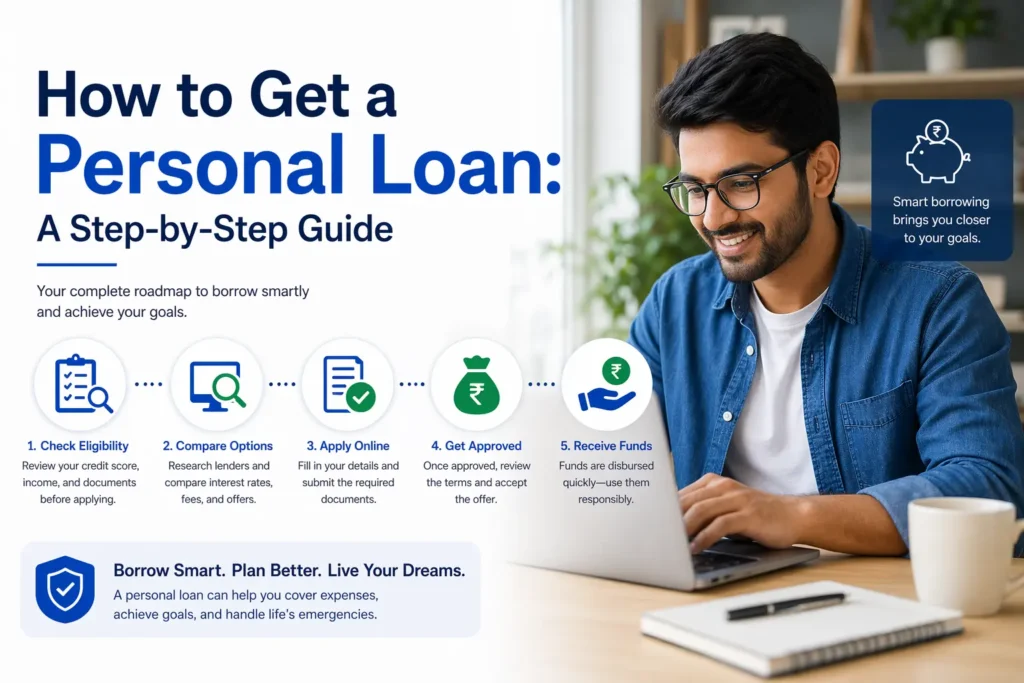
Getting a personal loan means going through eight clear steps: checking your credit score, deciding how much to borrow, comparing lenders, pre-qualifying, gathering your documents, submitting the application, reviewing the offer, and accepting the funds. Most lenders approve borrowers with credit scores above 580. Online lenders can fund loans within one to three business days after approval. The key is knowing what to prepare before you apply.
You need money for something important. Maybe it is a medical bill, a home repair, or paying off high-interest credit card debt. You have heard that a personal loan can help, but you are not sure where to start or what the personal loan process actually looks like from beginning to end.
This guide walks you through every step of how to get a personal loan. You will learn what lenders look for, what documents you need, how to compare offers without hurting your credit, and what to do once you are approved. By the time you finish reading, the process will feel much less overwhelming.
What Is a Personal Loan?
A personal loan is money you borrow from a bank, credit union, or online lender and pay back in fixed monthly payments over a set period of time. Most personal loans are unsecured, which means you do not need to put up any property as collateral. You receive a lump sum at a fixed interest rate, and you repay it over a loan term that usually ranges from two to seven years.
People use personal loans for many reasons: debt consolidation, medical expenses, home improvements, weddings, and more. Because the funds can be used for almost any purpose, they are one of the most flexible borrowing options available.
Step 1: Check Your Credit Score First
Before you do anything else, check your credit score. Your credit score is the single biggest factor that determines whether you get approved and what annual percentage rate (APR) you will be offered.
Most lenders require a minimum credit score of 580 to qualify for a personal loan. However, if you want competitive rates, a score of 670 or higher gives you access to much better offers. Borrowers with scores above 740 typically receive the lowest APRs available.
Where to check your score for free:
- AnnualCreditReport.com (official free credit report source)
- Experian’s free credit monitoring tool
- Credit Karma (soft inquiry, no score impact)
Checking your own score is always a soft credit inquiry. It does not affect your credit at all. Only a formal loan application triggers a hard inquiry, which can temporarily lower your score by a few points.
Also review your full credit report for errors. Even a small mistake, like a wrongly reported missed payment, can drag your score down. Dispute any errors with the credit bureaus before you apply.
Step 2: Decide Exactly How Much You Need to Borrow
Once you know your credit score, figure out the exact loan amount you need. Borrowing too much means paying more interest than necessary. Borrowing too little means coming up short.
Write down what the money is for and get a precise number. Then use a personal loan calculator (available free on Bankrate or NerdWallet) to estimate your monthly payment at different loan terms. Make sure the monthly payment fits comfortably in your budget.
A good rule of thumb: your total debt payments, including this new loan, should not exceed 36% of your gross monthly income. This number is your debt-to-income ratio (DTI ratio), and lenders pay close attention to it.
What Documents Do You Need for a Personal Loan?
Having your documents ready before you apply speeds up the entire personal loan application process. Most lenders ask for the same core set of materials.
Standard documents required:
- Proof of identity: Government-issued ID, passport, or driver’s license
- Proof of income: Recent pay stubs, W-2 forms, tax returns, or bank statements
- Proof of address: Utility bill, lease agreement, or credit card statement showing your current address
- Social Security number: Required by all U.S. lenders for credit checks
Self-employed borrowers may also need to provide 1099 forms or recent business bank statements to verify income.
Online lenders tend to require fewer physical documents compared to traditional banks. Many verify income and identity electronically, which can cut the time from application to approval significantly. Keeping all your loan-related documents and correspondence organized, including lender emails, approval notices, and document request messages, helps you respond quickly and avoid delays.
Step 3: Compare Personal Loan Lenders
Not all lenders are the same. The interest rate, fees, and terms you get can vary widely depending on where you apply. This is one of the most important steps in the entire process.
Banks vs. Credit Unions vs. Online Lenders
Traditional banks like Wells Fargo or Chase offer personal loans to existing customers. They tend to have strict credit requirements but may offer relationship discounts if you already have an account with them.
Credit unions are nonprofit financial institutions that often have lower rates than banks. They typically work with members and may be more flexible with borrowers who have less-than-perfect credit.
Online lenders like SoFi, LendingClub, Upstart, and LightStream have streamlined applications and the fastest funding speeds. Many use non-traditional underwriting factors, which can help borrowers who do not have a long credit history.
Lender Snapshot (May 2026 estimates – verify current rates before applying):
| Lender | APR Range | Loan Amount | Min. Credit Score | Funding Speed |
| LightStream | ~6.49% to 25.89% | $5K to $100K | Good to excellent | Same day possible |
| SoFi | 7.74% to 35.49% | $5K to $100K | Not disclosed | Same or next day |
| LendingClub | 6.53% to 35.99% | $1K to $60K | Fair credit OK | 1 to 3 days |
| Universal Credit | 11.69% to 35.99% | $1K to $50K | 580 | 1 to 3 days |
| Upstart | Varies | $1K to $50K | 580 (or none) | 1 to 3 days |
| Avant | Up to 35.99% | $2K to $35K | 580 | 1 to 3 days |
Sources: WSJ Buyside, NerdWallet, Yahoo Finance
What to compare beyond the interest rate:
- APR (this includes fees, so it is the true cost of borrowing)
- Origination fee (some lenders charge 1% to 12% of the loan amount upfront)
- Prepayment penalty (a fee if you pay the loan off early)
- Repayment term options
- Funding speed
Always compare APR, not just the advertised interest rate. A loan with a lower rate but a high origination fee can end up costing more than a loan with a slightly higher rate and no fees.
Step 4: Pre-Qualify Without Hurting Your Credit Score
Does Pre-Qualifying for a Personal Loan Affect Your Credit Score?
Pre-qualifying for a personal loan uses a soft credit inquiry, which does not affect your credit score at all. It gives you an estimated rate and loan amount based on basic financial information. You can pre-qualify with multiple lenders to compare offers before you commit to a formal application.
Pre-qualification is not the same as approval. Think of it as a preview. You fill out a short form with basic information like your income, employment status, and the loan amount you want. The lender runs a soft check and shows you the rates you are likely to qualify for.
Steps to pre-qualify:
- Visit the lender’s website and find the “Check Your Rate” or “Pre-Qualify” option
- Enter your name, address, income, and loan purpose
- Submit (no hard pull happens yet)
- Review the estimated APR, loan amount, and term options
Pre-qualify with at least two to three lenders. This gives you real comparison data without any damage to your FICO score or VantageScore.
Step 5: Submit Your Formal Application
Once you have compared your pre-qualification offers and chosen a lender, it is time to submit a formal application. This step does involve a hard inquiry on your credit report.
How Lenders Evaluate Your Application
Lenders look at five main factors when they review a personal loan application:
- Credit score: Your credit history shows how reliably you have repaid debts in the past
- Income: Stable, verifiable income tells lenders you can afford the monthly payments
- Debt-to-income ratio: Most lenders want your DTI ratio below 36%
- Employment status: Steady employment is a strong positive signal
- Length of credit history: A longer history generally works in your favor
To calculate your DTI ratio, add up all your monthly debt payments (rent, car loans, credit cards), divide by your gross monthly income, and multiply by 100. If the result is above 36%, consider paying down some debt before applying.
Submit your application with accurate information and all required documents. Many online lenders give instant or same-day decisions. Traditional banks may take three to seven business days to review your application.
How Long Does It Take to Get a Personal Loan?
Most people want to know how fast they can have money in their account. The honest answer depends on the type of lender you choose.
| Lender Type | Approval Time | Funding Time |
| Online lender | Minutes to 1 business day | 1 to 3 business days |
| Credit union | 1 to 3 business days | 2 to 5 business days |
| Traditional bank | 1 to 7 business days | 3 to 7 business days |
The single biggest thing that speeds up the process is having your documents ready before you apply. Lenders cannot move forward until they verify your income and identity, so delays almost always come from missing paperwork.
If you need money fast, choose an online lender like LendingClub, which can fund loans as quickly as one business day after approval.
Step 6: Review Your Loan Offer Carefully
Never sign a loan agreement without reading it fully. This is not the time to rush. Once you sign, you are legally bound to the terms.
Your loan offer review checklist:
- APR: Is this the same rate you were quoted during pre-qualification?
- Loan amount: Did you receive the full amount you requested?
- Loan term: How many months or years will you be repaying?
- Monthly payment: Can you afford this payment every month without strain?
- Origination fee: Is the fee deducted from your loan funds upfront?
- Prepayment penalty: Will you be charged for paying the loan off early?
- Payment due date: Mark this in your calendar immediately
A longer loan term lowers your monthly payment but increases the total interest you pay over time. A shorter term costs more per month but saves money overall. Pick the term that best balances your monthly budget with your total cost goals.
If anything in the offer looks different from what you were shown during pre-qualification, ask the lender to explain the change before you sign.
Is It Possible to Get Approved with a Low Credit Score?
Yes, it is possible to get a personal loan with bad credit, though you should expect higher interest rates and stricter terms. Lenders like Universal Credit and Upstart accept credit scores as low as 580. A co-signer or a secured loan can also improve your chances of approval.
Upstart is notable because it uses an AI-powered underwriting model that considers non-traditional factors like your education level and work history, not just your credit score. This approach opens doors for borrowers who have a thin credit file or are rebuilding after financial setbacks.
Tips for getting a personal loan with bad credit:
- Choose lenders that specialize in fair or poor credit (Universal Credit, Avant, Upstart)
- Consider adding a co-signer with strong credit to improve your approval odds
- Look into secured personal loans, where you offer savings or an asset as collateral
- Avoid payday loans and predatory lenders that charge triple-digit APRs
- Improve your score by just 20 to 30 points before applying, which can unlock better rates
Avant, for example, approves borrowers who earn as little as $1,200 per month and accepts scores in the low 600s. LendingClub also works with fair-credit borrowers and offers loan amounts from $1,000 to $60,000 with repayment terms from two to seven years.
What to Do After Your Personal Loan Is Approved
Most articles stop at the approval stage. But what happens next matters just as much as getting approved. Here is how to set yourself up for success after the funds arrive.
1. Set up autopay immediately.
Most lenders offer a 0.25% APR discount when you enroll in autopay. That small discount can save you real money over a multi-year loan term. It also protects your credit score by making sure you never miss a payment.
2. Understand your amortization schedule.
Each payment you make covers both interest and principal. Early in the loan term, more of your payment goes toward interest. Over time, more goes toward the principal balance. Reviewing your amortization schedule helps you understand exactly how much you are paying off each month.
3. Monitor your credit score.
Opening a new personal loan account will temporarily lower your credit score. But if you make on-time payments consistently, your score typically recovers and then improves within three to six months. If you used the loan for debt consolidation, your credit utilization ratio should drop, which helps your score further.
4. Keep your loan correspondence organized.
After your loan is approved, lenders send a steady stream of emails: welcome letters, payment reminders, account statements, and tax documents. Letting those pile up in a cluttered inbox is an easy way to miss something important. Using an AI inbox tool like FreeMail AI helps you keep all your loan-related emails in one organized place so nothing slips through.
Ready to Take the Next Step?
The personal loan process has a lot of moving parts: credit checks, document gathering, lender comparisons, offer reviews, and repayment planning. What makes the process easier is staying organized at every stage.
When you apply to multiple lenders, you will receive a wave of emails with offers, requests, and approval updates. Keeping all of that sorted matters more than most people realize. FreeMail AI gives you a clean, organized inbox powered by AI so you can track every lender communication without losing anything important. Try it free and bring a little calm to your loan application process.