

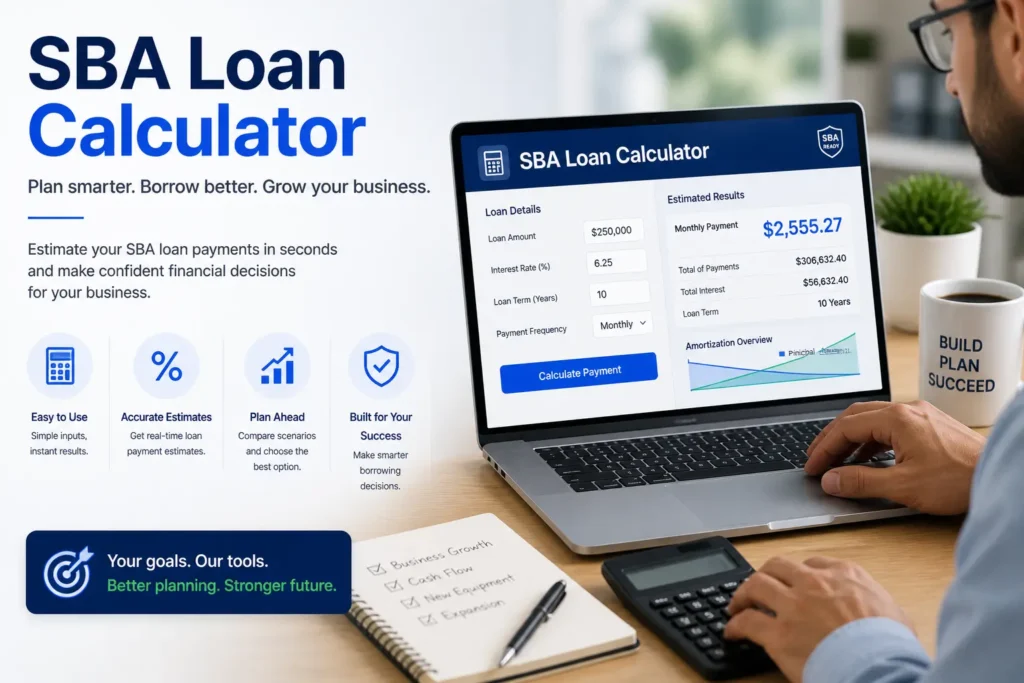
An SBA loan calculator estimates your monthly payment using three inputs: loan amount, interest rate, and loan term. For most SBA 7(a) loans in 2026, interest rates range from 9.75% to 14.75% depending on your loan size, with repayment terms up to 10 years for working capital and 25 years for real estate. Use the scenario table below to estimate your payment instantly. Remember to factor in the SBA guaranty fee, which is a one-time upfront cost that most calculators do not include.
You found the right loan program. Now you need to know if you can afford it.
Before you sit down with a lender, you need one number: your estimated monthly payment. An SBA loan payment calculator gives you that number in seconds. You type in how much you want to borrow, what interest rate to expect, and how many years to repay. The calculator does the rest.
This page gives you a ready-to-use scenario table with real payment estimates, current 2026 SBA interest rate data, a plain-English breakdown of SBA loan fees, and a program comparison for SBA 7(a) vs. SBA 504 loans. By the end, you will know exactly what your SBA loan could cost each month and what the total price tag looks like over the full repayment term.
SBA Loan Payment Scenarios: See Your Estimate Now
Most people searching for an SBA loan payment calculator want one thing fast: a real number. The table below gives you monthly payment estimates for common loan scenarios based on current 2026 interest rate data from the U.S. Small Business Administration and verified lender rate caps.
These are estimates based on standard loan amortization. Your actual rate and payment will be confirmed by your SBA-approved lender.
| Loan Amount | Interest Rate | Repayment Term | Est. Monthly Payment | Total Interest Paid |
| $50,000 | 13.75% | 5 years | ~$1,149/mo | ~$18,940 |
| $100,000 | 11.75% | 10 years | ~$1,413/mo | ~$69,560 |
| $200,000 | 12.75% | 7 years | ~$3,625/mo | ~$104,300 |
| $250,000 | 11.75% | 10 years | ~$3,532/mo | ~$173,840 |
| $500,000 | 11.75% | 10 years | ~$7,063/mo | ~$347,560 |
| $500,000 | 11.75% | 25 years | ~$5,048/mo | ~$1,014,400 |
| $1,000,000 | 9.75% | 25 years | ~$8,846/mo | ~$1,653,800 |
Notice what happens when you stretch a $500,000 loan from 10 years to 25 years. Your monthly payment drops by about $2,000. But your total interest paid jumps by more than $666,000. A small business loan calculator helps you see that trade-off clearly before you sign anything.
How to read this table:
- Find the loan amount closest to what you plan to borrow
- Use the current SBA 7(a) interest rate that matches your loan size (see the rate table in the next section)
- Pick the repayment term that fits your budget
- The estimated monthly payment is your starting benchmark
How Does an SBA Loan Calculator Work?
An SBA loan calculator uses a standard loan amortization formula. It takes your three inputs and calculates how much of each payment goes toward loan principal and how much goes toward interest.
The formula behind every SBA loan payment calculator is:
Monthly Payment = P x [r(1+r)^n] / [(1+r)^n – 1]
Where P = loan principal, r = monthly interest rate (annual rate divided by 12), and n = total number of monthly payments.
You do not need to do that math yourself. The calculator handles it. But understanding what the formula does helps you know why changing one input changes your payment significantly.
What Inputs Do You Need?
You need three pieces of information to use any SBA loan payment calculator:
- Loan amount – How much you plan to borrow. SBA 7(a) loans go up to $5,000,000. SBA 504 loans go up to $5,500,000 for real estate and fixed assets.
- Annual interest rate – The rate your lender will charge. If you do not have a firm offer yet, use the current SBA rate cap for your loan size as a planning estimate.
- Loan term – How many years you have to repay. Working capital and equipment loans are typically up to 10 years. Real estate loans go up to 25 years.
No personal information, credit data, or loan application is needed to get an estimate. You can model as many scenarios as you want, completely anonymously, before contacting any lender.
What Does the Calculator Show You?
Once you enter your three inputs, a good SBA loan monthly payment calculator will show you:
- Estimated monthly payment – Your principal and interest payment amount
- Total interest paid – The full interest cost across the entire loan term
- Total repayment amount – Loan principal plus all interest combined
- Amortization schedule – How your balance decreases with each payment over time
The debt service coverage ratio (DSCR) is sometimes shown as well. DSCR tells you whether your business cash flow is strong enough to cover the loan payment. Most lenders require a DSCR of at least 1.25, meaning your business earns $1.25 for every $1.00 in debt payments.
What Are the Current SBA Loan Interest Rates in 2026?
SBA 7(a) loan interest rates in 2026 range from 9.75% to 14.75%, depending on your loan size. Rates are set by individual SBA-approved lenders but cannot exceed caps set by the U.S. Small Business Administration. Smaller loans carry higher maximum rates. Larger loans carry lower maximum rates.
Here are the current SBA 7(a) maximum interest rate caps as of May 2026:
| Loan Amount | Maximum Allowed Rate |
| $25,000 or less | 14.75% |
| $25,001 to $50,000 | 13.75% |
| $50,001 to $250,000 | 12.75% |
| $250,001 to $350,000 | 11.75% |
| Over $350,000 | 9.75% |
Source: NerdWallet SBA Loan Rate Data, updated April 2026.
These rates are based on the Wall Street Journal Prime Rate plus a lender spread. The Prime Rate changes when the Federal Reserve adjusts its benchmark rate, which means your SBA loan rate can change too if you choose a variable rate.
Fixed vs. Variable Rate SBA Loans: What Changes in Your Calculator?
This is one of the most important things to understand when using an SBA interest rate calculator, and most competitor pages skip it entirely.
Fixed rate loans lock your interest rate for the full loan term. Your monthly payment never changes. This makes budgeting simple and predictable.
Variable rate loans are tied to the Wall Street Journal Prime Rate. If the Prime Rate goes up, your monthly payment goes up. If it goes down, your payment goes down. Variable rate loans often start lower than fixed rates but carry more long-term risk.
When you use an SBA loan calculator, always run two scenarios: one at the current rate, and one at a rate 2% higher. That way you know your payment stays affordable even if the rate rises.
SBA 7(a) vs. SBA 504 Loan Calculator: Which One Applies to You?
Not all SBA loans are calculated the same way. The right calculator depends on which SBA loan program you are applying for.
| Feature | SBA 7(a) Loan | SBA 504 Loan |
| Maximum Loan Amount | $5,000,000 | $5,500,000 (real estate/fixed assets) |
| Loan Term | Up to 10 years (working capital), 25 years (real estate) | Up to 25 years |
| Use of Funds | Working capital, equipment, real estate, refinancing | Commercial real estate, large equipment |
| Rate Type | Fixed or variable | Fixed (CDC portion), variable (bank portion) |
| Calculator Complexity | Simple – single calculation | Complex – two separate loan portions |
| Best Calculator Type | Standard amortization calculator | Two-part calculator (bank + CDC) |
Sources: sba7a.loans, Swoop Funding SBA 504 Calculator
The SBA 504 loan has a two-part structure. Part of the loan comes from a bank or credit union. The other part comes from a Certified Development Company (CDC). Each portion has its own interest rate and term. This means a standard single calculation will not give you an accurate SBA 504 monthly payment estimate. You need a dedicated SBA 504 loan calculator that separates both parts.
SBA Microloan is a third option worth knowing. It covers loans up to $50,000 and is aimed at very small or startup businesses. Terms are typically up to 6 years. Interest rates tend to be higher, between 8% and 13%. Use a standard amortization calculator with a shorter term for Microloan estimates.
SBA Express Loan covers amounts under $500,000 with a 36-hour approval turnaround. The SBA only guarantees 50% of Express loans, compared to up to 85% for standard 7(a) loans. The monthly payment calculation is the same as a standard 7(a) loan.
Does the SBA Loan Calculator Include Fees?
Most SBA loan calculators calculate principal and interest only. They do not automatically include the SBA guaranty fee, which is a separate one-time upfront cost. If you ignore this fee, your true total loan cost will be higher than what the calculator shows.
What Is the SBA Guaranty Fee?
The SBA guaranty fee is charged by the U.S. Small Business Administration, not your lender. It is based on a percentage of the guaranteed portion of your loan. The fee helps fund the SBA loan guarantee program that allows lenders to offer better terms to small business owners.
The FY2026 SBA guaranty fee schedule took effect on October 1, 2025. Fee rates vary based on loan amount, repayment term, and the percentage of the loan the SBA guarantees. You can calculate your exact guaranty fee using the official SBA 7(a) Loan Guaranty Fee Calculator available at sba.gov.
As a general example, the guaranty fee on a $500,000 SBA 7(a) loan with a 75% SBA guarantee can range from approximately $8,250 to $13,125, depending on the loan term. This is paid upfront and is often rolled into the loan amount, which increases your principal and your monthly payment slightly.
Other Fees to Factor Into Your Total Cost
Beyond the SBA guaranty fee, your lender may charge additional fees that the basic SBA loan payment calculator will not include:
- Origination fee – Charged by the lender for processing your loan application, typically 0.5% to 3.5% of the loan amount
- Packaging fee – Charged by some lenders or loan packagers to prepare your SBA application
- Appraisal fee – Required for real estate-backed loans to establish property value
- Closing costs – Legal, title, and settlement fees similar to a mortgage
Always ask your lender for a full cost disclosure before accepting any SBA loan offer. The monthly payment number from your small business loan calculator is a starting point, not the final number.
Using an SBA Loan Calculator for Business Acquisition
Most SBA loan calculator guides focus on startups or expansion. But SBA 7(a) loans are also the most common financing tool for buying an existing business. If you are purchasing a business, the same calculator applies, but your inputs work differently.
Here is a real-world example of how it works:
- Business purchase price: $750,000
- Buyer down payment (10%): $75,000
- Loan amount needed: $675,000
- Interest rate (SBA 7(a) cap for this size): 9.75%
- Loan term: 10 years
- Estimated monthly payment: approximately $8,847/month
Before your loan is approved, your lender will review the debt service coverage ratio of the business you are buying. The business needs to generate enough cash flow to cover that $8,847 monthly payment and still have 25% or more left over. If the business earns $150,000 per year in net operating income, that equals $12,500/month, which gives a DSCR of about 1.41. That is above the typical 1.25 minimum, so the numbers work.
Using an SBA loan calculator during your business acquisition search helps you filter out deals that will not qualify before you spend time on due diligence.
How to Get a More Accurate SBA Loan Estimate
Online calculators give you estimates based on the numbers you enter. They do not know your credit history, your business revenue, or the specific terms your lender will offer. Here are the steps to move from an estimate to a real quote.
- Check your personal credit score. Most SBA lenders require a minimum personal credit score of 650 to 680. Your credit score affects whether you qualify and what rate you receive.
- Gather your business financial statements. Lenders review your last two to three years of tax returns, profit and loss statements, and balance sheets to confirm repayment ability.
- Confirm SBA eligibility. Your business must be for-profit, located in the U.S., meet SBA size standards, and be unable to get financing on reasonable terms from a conventional lender.
- Use the SBA Lender Match tool. This free tool at sba.gov connects you with SBA-approved lenders in your area. It takes about two minutes to complete and does not affect your credit.
- Get pre-qualified. Once a lender reviews your basics, they can give you a real rate quote. Plug that rate into the SBA loan interest rate calculator to confirm your payment before you proceed.
When you reach out to multiple lenders online during your research phase, using a temporary email address keeps your personal inbox free from loan solicitation emails while you compare options.