

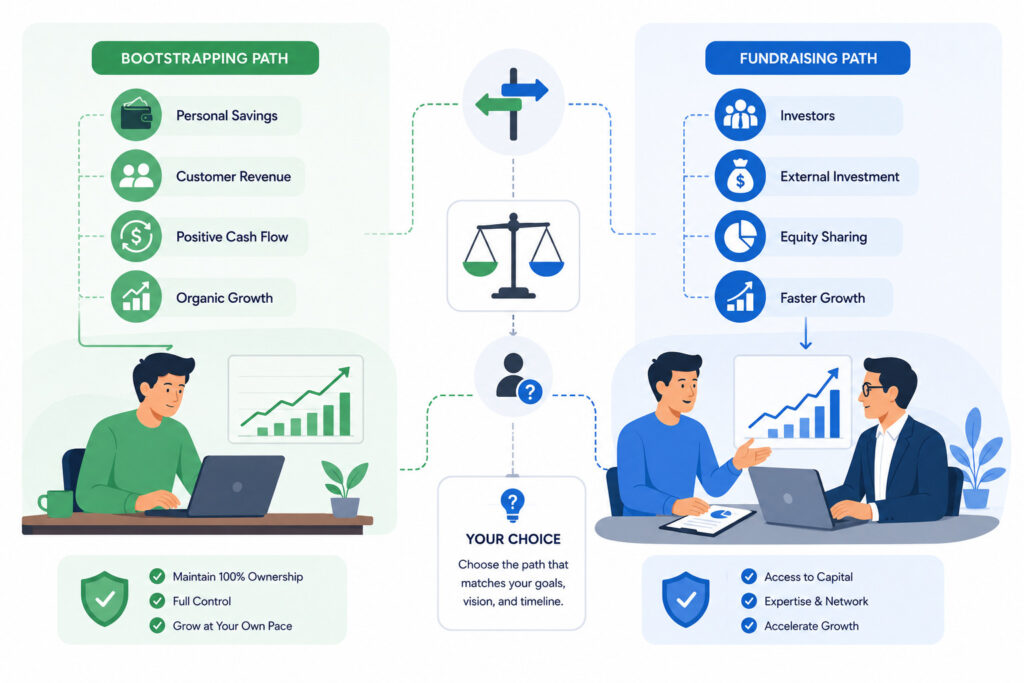
Bootstrapping and fundraising are two different ways to finance a startup. Bootstrapping uses founder savings, customer revenue, and reinvested profits, while fundraising brings in outside capital from investors or other sources. Bootstrapping usually gives founders more ownership and control. Fundraising can provide more capital for hiring, product development, and growth. The better choice depends on your capital needs, market, growth speed, cash flow, and long-term goals.
Introduction
Should you build your startup with your own money and customer revenue, or raise money from outside investors?
That is the core question behind bootstrapping vs fundraising. Both paths can work, but they fit different types of startups.
Bootstrapping can work well when a business can reach customers quickly, keep costs low, and grow from revenue. Fundraising can make more sense when a company needs a large amount of startup capital, must grow quickly, or faces a market where speed matters.
The right choice is not about which funding method sounds better. It is about which one solves your startup’s biggest problem without creating a bigger one.
Bootstrapping vs Fundraising: What’s the Difference?
Bootstrapping means building a startup with the founder’s own resources and the money the business earns. This can include personal savings, customer revenue, and reinvested profits. The U.S. Small Business Administration describes self-funding, also known as bootstrapping, as using your own financial resources to support a business.
Fundraising means getting capital from outside sources. These can include angel investors, venture capital firms, crowdfunding, accelerators, or other financing sources.
The main difference is where the money comes from and what the founder gives up in return.
| Factor | Bootstrapping | Fundraising |
|---|---|---|
| Main funding source | Founder savings and business revenue | Outside investors or other capital sources |
| Founder ownership | Usually higher | Reduced when equity is sold |
| Control | Mostly stays with founders | May be shared with investors |
| Available capital | Limited by savings and cash flow | Can be much larger |
| Growth speed | Usually tied to revenue | Can be faster with more capital |
| Investor pressure | Little or none | Can be significant |
| Financial risk | More of the risk sits with the founder | Some financial risk is shared with investors |
| Best fit | Capital-efficient businesses | Businesses that need significant capital or speed |
There is also a middle path. A founder can bootstrap during the early stage, prove that customers want the product, and raise money later.
How Does Bootstrapping Work for a Startup?
Bootstrapping starts with the resources a founder already has or can generate through the business.
A founder might use personal savings to build a first version of the product. After getting customers, the company can use revenue to pay expenses and fund the next stage of growth.
For example, suppose a founder starts a small SaaS company with $15,000 in savings. The founder builds a basic product, gets the first 20 customers, and uses the monthly revenue to pay for hosting, software, marketing, and part-time help.
The business grows from its own cash flow instead of relying on a seed round.
This approach puts a clear limit on spending. If the company earns $10,000, it cannot safely spend $100,000 every month unless another source of capital is available.
That limit can be hard, but it can also encourage careful spending.
What Are the Benefits of Bootstrapping?
More founder ownership: You do not need to sell equity just to get the first dollars into the business.
More control: You can make most decisions without an outside investor or board.
Customer-focused growth: Revenue becomes a direct signal that customers value the product.
Less fundraising work: You do not need to spend months preparing pitch decks, meeting investors, and negotiating an investment deal.
More flexibility: You can choose a slower growth path if it works for your business.
Bootstrapping is also common among new businesses. Kauffman Foundation research found that at least 83% of entrepreneurs did not access bank loans or venture capital when starting, while nearly 65% relied on personal and family savings.
What Are the Downsides of Bootstrapping?
Bootstrapping has real limits.
The founder may have less money for hiring, product development, marketing, or expansion. Growth can be slower because spending depends on available cash.
There can also be personal financial risk. If a founder puts a large part of their savings into the company, a failed startup can create a direct personal loss.
Another problem can appear when a market moves quickly. A competitor with a large funding round may hire faster, spend more on customer acquisition, or launch in more markets.
So bootstrapping is not always the safer choice. It changes the type of risk the founder takes.
What Does Fundraising Give a Startup?
Fundraising gives a company access to outside capital.
A startup may raise a pre-seed or seed round from angel investors, venture capital firms, or other investors. Other options can include crowdfunding, grants, loans, or revenue-based financing.
The SEC lists several capital-raising routes for small businesses, including Regulation D, Regulation A, and Regulation Crowdfunding.
With more capital, a startup can spend ahead of its current revenue.
For example, a software company may have 1,000 paying customers but see a large opportunity to reach 10,000 customers. Outside funding could allow the company to hire engineers, sales staff, and marketing specialists before current revenue can support those costs.
What Are the Benefits of Fundraising?
More capital: The company can spend more than its current revenue allows.
Faster hiring: Funding can support engineers, sales staff, designers, and other employees.
Faster product development: A larger team can build and test new features sooner.
Market expansion: Capital can help a startup enter new markets or reach more customers.
Investor support: The right investor may bring industry knowledge, contacts, hiring help, or access to future investors.
Fundraising can be especially useful for startups that need large amounts of money before they can generate meaningful revenue.
What Are the Downsides of Fundraising?
The biggest trade-off is often ownership.
When investors receive equity, the founder’s percentage of the company becomes smaller.
Carta’s 2026 Founder Ownership Report found that the median founding team retained about 56% of fully diluted equity after a seed round. At Series A, the median fell to 36%.
This does not mean every startup follows the same pattern. Deal terms, valuation, funding amount, founder structure, and industry all affect ownership.
Fundraising can also bring investor expectations. Investors may want fast growth, regular updates, specific financial targets, or a path toward a large exit.
The fundraising process itself also takes time. Founders may spend weeks or months preparing financial information, meeting investors, negotiating terms, and completing legal work.
What Are the Biggest Differences Between Bootstrapping and Fundraising?
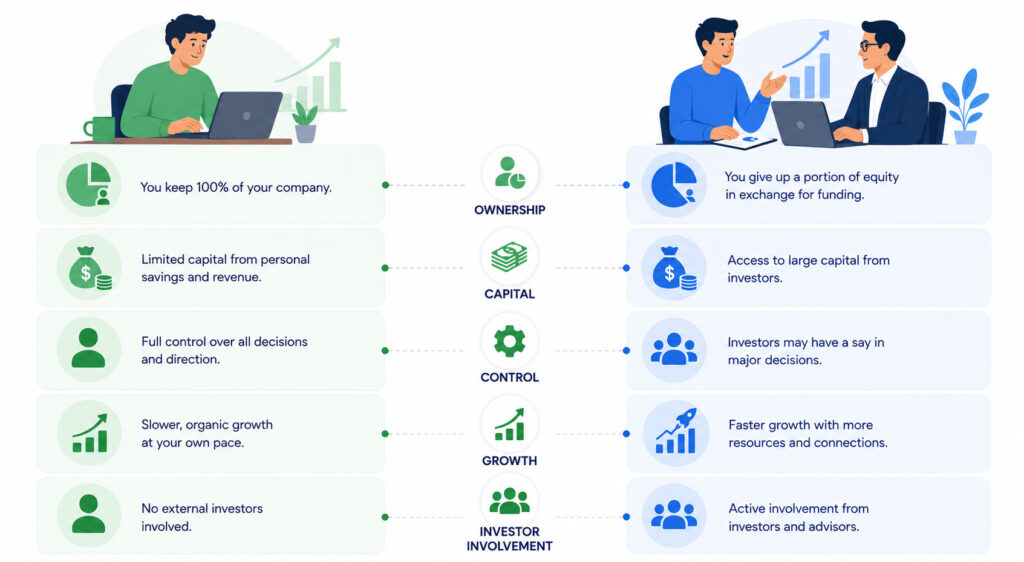
The easiest way to compare the two approaches is to look at what each one gives you and what it asks from you.
| Area | Bootstrapping | Fundraising |
|---|---|---|
| Ownership | Usually higher | Usually lower after equity funding |
| Decision-making | Mostly founder-led | May include investor input |
| Capital | Limited | Larger potential pool |
| Growth | Often slower | Can be faster |
| Cash flow | Very important from the start | Can support growth before profitability |
| Investor involvement | None in most cases | Often present |
| Founder risk | More personal financial exposure | More ownership and investor expectations trade-offs |
| Fundraising time | None | Can take significant time |
| Market speed | Can be a limit | Can help capture fast-moving markets |
| Long-term control | Usually higher | May decrease as funding rounds continue |
Neither approach wins in every situation.
A small SaaS business with strong gross margins and early customers may have little reason to raise millions. A hardware startup may need major capital before it can produce and ship its first product.
The business model matters more than the label.
How Does Bootstrapping Affect Founder Ownership?
Bootstrapping can help founders keep a larger share of their company because they are not selling equity to outside investors.
Suppose you start a company and own 100% of it. If you continue funding it with your own money and business revenue, you can keep that ownership, although co-founders, employees, or other arrangements can still change the cap table.
Now suppose you raise $1 million from investors in exchange for 20% of the company. The founder’s ownership is reduced because the investor now owns part of the business.
Future funding rounds can reduce founder ownership further.
Carta’s 2026 data shows how ownership can change as startups raise capital. The median founding team retained about 56% after seed and about 36% after Series A.
This is why equity dilution should be part of every fundraising decision.
The question is not only:
“How much money can I raise?”
It is also:
“What percentage of my company am I willing to give up for that money?”
Which Is Better for Startup Growth Speed?
Fundraising can provide more money for growth, but money alone does not create a successful startup.
A company with poor product-market fit can spend more money without fixing its core problem.
Consider two startups.
Startup A has 500 paying customers, strong retention, healthy unit economics, and a repeatable customer acquisition channel. An investment could help the company hire more people and reach more customers.
Startup B has a product that few people want. It has no clear customer acquisition channel and weak retention. Raising money may give it more time, but it does not solve the underlying product problem.
This is why founders should ask what the money will change.
If $1 of new capital can reliably help create much more value, fundraising may make sense.
If the main problem is learning what customers want, more money may not be the answer.
When Does Bootstrapping Make More Sense?
Bootstrapping can be a good choice when the business has several of these traits:
- Customers can pay soon after launch.
- The startup has low upfront costs.
- The founder can keep expenses under control.
- The business can grow from customer revenue.
- The target market does not require a rapid land grab.
- The founder values ownership and control.
- The company can reach profitability without a large team.
- Product development does not require years of research.
SaaS, consulting, agencies, digital products, and other capital-efficient businesses can often have more room to bootstrap.
The key question is simple:
Can the business reach meaningful revenue before it needs a large amount of outside capital?
If the answer is yes, bootstrapping deserves serious consideration.
When Does Fundraising Make More Sense?
Fundraising can make more sense when capital is the main limit on growth.
This can happen when:
- The product needs expensive infrastructure.
- The company needs a large team before revenue grows.
- Research and development will take years.
- Inventory or manufacturing costs are high.
- The market rewards speed.
- Competitors already have large amounts of capital.
- Network effects make early scale important.
- The company has strong product-market fit.
- The founder knows exactly how the new money will be spent.
For example, a deep-tech startup may need millions of dollars before it can sell a commercial product. Bootstrapping may not be realistic in that case.
The same can be true for some hardware, biotech, infrastructure, or highly regulated businesses.
Fundraising should have a clear purpose.
A founder should be able to explain:
“We need this amount of capital because we will use it for these specific activities, and those activities should move these business metrics.”
Should You Bootstrap First and Raise Later?
Yes, if the business allows it.
A founder does not have to choose one funding method forever.
A startup can start with personal savings, customer revenue, and reinvested profits. Once the company proves demand and reaches early traction, the founder can decide whether outside capital would help.
This can create a stronger fundraising position.
Instead of telling investors:
“We have an idea and need money to find customers.”
The founder may be able to say:
“We have paying customers, growing revenue, and a repeatable acquisition channel. More capital will help us expand.”
That difference can matter.
A hybrid approach can also reduce the amount of equity sold early in the company’s life.
Still, waiting too long can have a cost. If the market is moving quickly and competitors are gaining ground, a founder may lose a valuable opportunity by refusing outside capital.
The right time to raise is not simply “when the company needs money.” It is when capital can clearly improve the company’s position.
What Should You Consider Before Choosing?
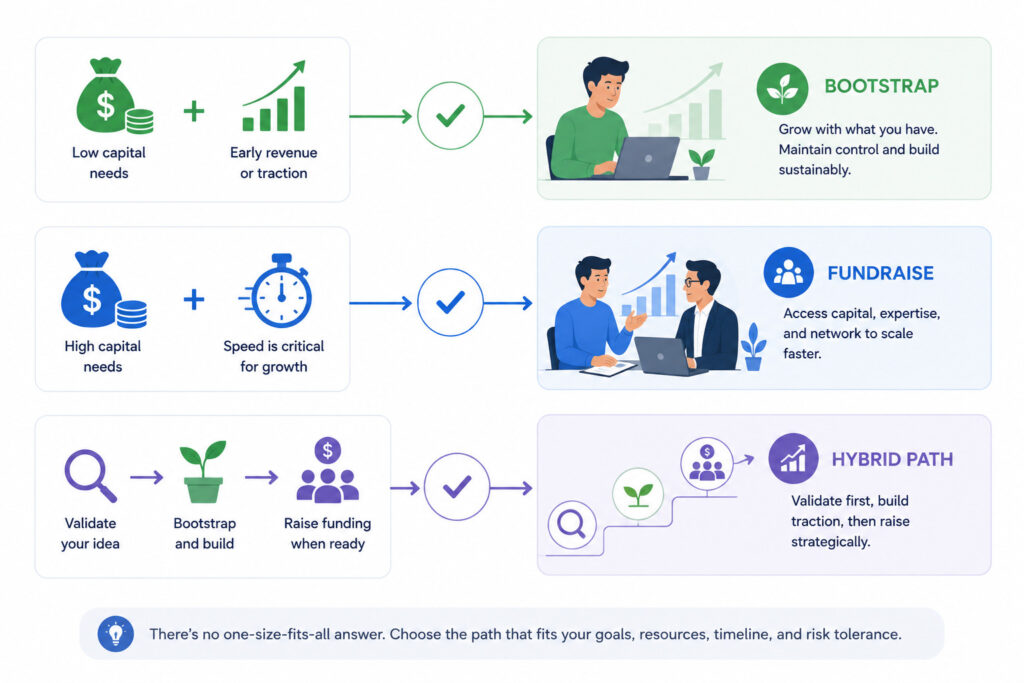
Use these questions to make the decision.
| Question | If the answer is yes | Possible choice |
|---|---|---|
| Can you get paying customers quickly? | Revenue can fund growth | Bootstrap |
| Do you need major capital before launch? | Savings may not be enough | Fundraise |
| Do you need to move faster than competitors? | Speed has real value | Fundraise |
| Is keeping ownership a top priority? | You want more control | Bootstrap |
| Can revenue cover operating costs? | Cash flow can support growth | Bootstrap |
| Does your market have strong network effects? | Early scale may matter | Fundraise |
| Do you already have strong traction? | Capital can support proven demand | Consider fundraising |
| Is your main problem product-market fit? | More money may not fix it | Focus on validation first |
| Do you have a clear plan for the capital? | Funding has a defined purpose | Consider fundraising |
| Would the investment change growth meaningfully? | Capital may have a strong use | Consider fundraising |
This turns the decision from a personal preference into a business question.
What Are the Biggest Risks of Each Approach?
Both paths have risks.
Bootstrapping risks
Running out of cash: Slow revenue growth can leave the company unable to pay its bills.
Slow growth: Limited cash can make hiring and marketing harder.
Personal financial exposure: Founder savings may be at risk.
Under-investment: The company may spend too little on important areas.
Missed market opportunities: A competitor with more capital may move faster.
Fundraising risks
Equity dilution: Founders give up part of the company when they sell equity.
Investor pressure: Investors may expect fast growth and a large future return.
Loss of control: Investors may gain influence over important decisions.
Overspending: A large bank balance can encourage a company to hire or spend before its business model is ready.
Future funding pressure: A company that depends on outside capital may need more funding later.
The broader startup environment also carries real risk. BLS data shows that five-year survival rates for U.S. startups vary by the year in which businesses were born. For startups born in 2018, the five-year survival rate was 57.3%, compared with 49.8% for those born in 2006.
Funding does not guarantee survival. A startup still needs customers, sound unit economics, good cash flow, and a business model that can last.
Is There a Middle Ground Between Bootstrapping and Fundraising?
Yes.
Founders have more options than simply choosing between personal savings and venture capital.
Possible sources include:
- Customer prepayments
- Grants
- Crowdfunding
- Revenue-based financing
- Small business loans
- Angel investors
- Accelerators
- Strategic partnerships
The SEC lists several ways eligible businesses can raise capital, including Regulation D, Regulation A, and Regulation Crowdfunding.
For example, Regulation Crowdfunding allows eligible companies to raise up to $5 million in a 12-month period under the current rules, subject to the applicable requirements.
The right option depends on the company, location, legal structure, funding needs, and terms.
Founders should get professional legal and financial advice before choosing a securities offering or other regulated financing method.
Bootstrapping vs Fundraising: Which One Should You Choose?
There is no universal winner in the bootstrapping vs fundraising debate.
Choose bootstrapping when:
- You can generate revenue early.
- Your startup does not need large upfront capital.
- You want to keep more ownership.
- You prefer founder-led decisions.
- Your market does not require extreme speed.
- Your business can grow from cash flow.
Choose fundraising when:
- You need significant capital before revenue.
- Speed is a major competitive factor.
- Your market is large and time-sensitive.
- You have strong product-market fit.
- You have a clear plan for the money.
- More capital can produce much faster growth.
Consider a hybrid approach when:
- You can validate the idea without much money.
- You can get early customers.
- You expect to need capital later.
- You want stronger evidence before approaching investors.
- You want to delay equity dilution until the company has more value.
A useful rule is:
Choose the funding model that removes your biggest bottleneck.
If cash is not your biggest problem, raising money may add pressure without solving much.
If capital is clearly holding back a proven business, refusing outside funding may slow the company unnecessarily.
Frequently Asked Questions
Is bootstrapping better than fundraising?
Neither is always better. Bootstrapping can be a better fit for capital-efficient startups that can earn revenue early and value founder ownership. Fundraising can be a better fit for businesses that need significant capital or rapid expansion.
What is the main difference between bootstrapping and fundraising?
Bootstrapping mainly uses founder resources and business revenue. Fundraising brings in outside capital from investors or other funding sources. The main trade-off is usually greater founder ownership and control versus greater access to capital.
Should I bootstrap my startup before raising money?
It can make sense when you can validate demand and earn early revenue without large upfront costs. Early traction can give investors stronger evidence that the business has potential. But delaying funding can be costly if your market requires rapid growth.
Does fundraising reduce founder ownership?
Usually, yes, when a startup sells equity to investors. Carta’s 2026 data shows that the median founding team’s ownership falls as startups move through funding stages.
What types of startups are best for bootstrapping?
Businesses that can launch with low upfront costs and reach customers quickly are often better suited to bootstrapping. SaaS, services, agencies, and some digital products can fit this model.
When should a startup raise funding?
A startup should consider raising when outside capital can solve a real constraint or speed up a proven growth opportunity. The founder should know what the money will fund and what business results it is expected to support.
Can a startup bootstrap and fundraise?
Yes. A startup can bootstrap during early validation, generate revenue, and later raise outside capital. This can help founders prove demand before selling equity, though the best path depends on the company’s market and capital needs.
Final Thoughts
Bootstrapping and fundraising are both tools for building a startup.
Bootstrapping can give founders more ownership, control, and freedom. It works best when a company can reach customers early and grow from revenue.
Fundraising can give a startup the capital needed to hire, build, and expand faster. It can be the better choice when the company faces high upfront costs or a market where speed matters.
The key is to look at the business rather than follow a funding trend.
Ask what is holding your startup back. If the answer is lack of customer demand, more money may not help. If the answer is capital needed to scale something that already works, fundraising may be the better path.
The best choice is the funding model that solves your biggest business constraint while keeping the level of ownership, risk, and control you are comfortable with.