

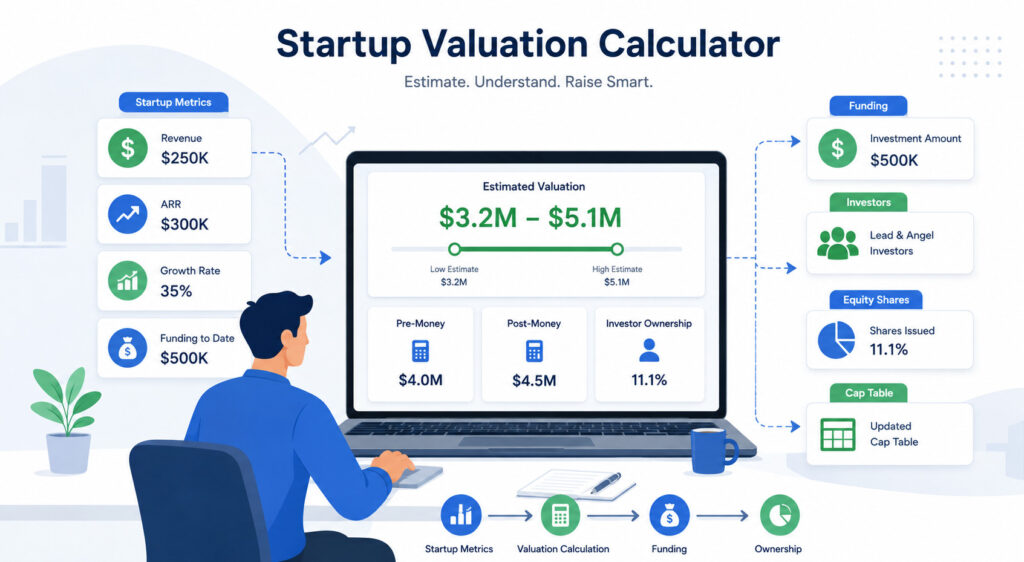
A startup valuation calculator helps founders estimate the potential value of their company before raising capital. The best approach is to compare more than one valuation method because no single formula works for every startup. Use your revenue, growth, traction, market, and funding needs to create an estimated valuation range. You can then compare pre-money valuation, post-money valuation, investor ownership, and founder dilution before talking with investors.
Calculator: Enter your startup details to estimate a valuation range, compare valuation methods, and model a potential funding round.
Startup Valuation Calculator
Use the calculator to estimate your startup valuation based on factors such as:
- Startup stage
- Revenue or ARR
- MRR
- Revenue growth
- Gross margin
- Customer growth
- Market size
- Team strength
- Product stage
- Amount you plan to raise
- Industry
- Investor ownership
The calculator should show a valuation range, rather than one number that looks exact.
A useful result can look like this:
| Valuation method | Estimated value |
| Revenue Multiple | $6.8 million |
| Scorecard Method | $5.9 million |
| Berkus Method | $4.7 million |
| Venture Capital Method | $7.1 million |
| Estimated range | $4.7M to $7.1M |
The range gives you a better starting point for fundraising discussions.
Your actual startup valuation can be higher or lower. Investor demand, market conditions, traction, geography, industry, competition, and deal terms can all affect the final number.
What Does a Startup Valuation Calculator Calculate?
A startup valuation calculator estimates the potential value of a company using financial and business information. Depending on the calculator, it may also estimate pre-money valuation, post-money valuation, investor ownership, and founder dilution.
The result is an estimate, not a guaranteed market value.
For example, a SaaS startup with $500,000 in ARR and strong growth may receive a different valuation from a company with the same revenue but slower growth. A startup with a large market and strong customer retention may also attract more investor interest.
A startup valuation estimator is most useful when it helps you compare different cases.
For example:
- Conservative case
- Base case
- High-growth case
This gives you a clearer view of how your assumptions affect the result.
How Is Startup Valuation Calculated?
There is no single startup valuation formula that works for every company. Founders and investors can use several methods based on the startup’s stage, revenue, growth, market, and risk.
Four useful methods are the Revenue Multiple, Berkus Method, Scorecard Method, and Venture Capital Method.
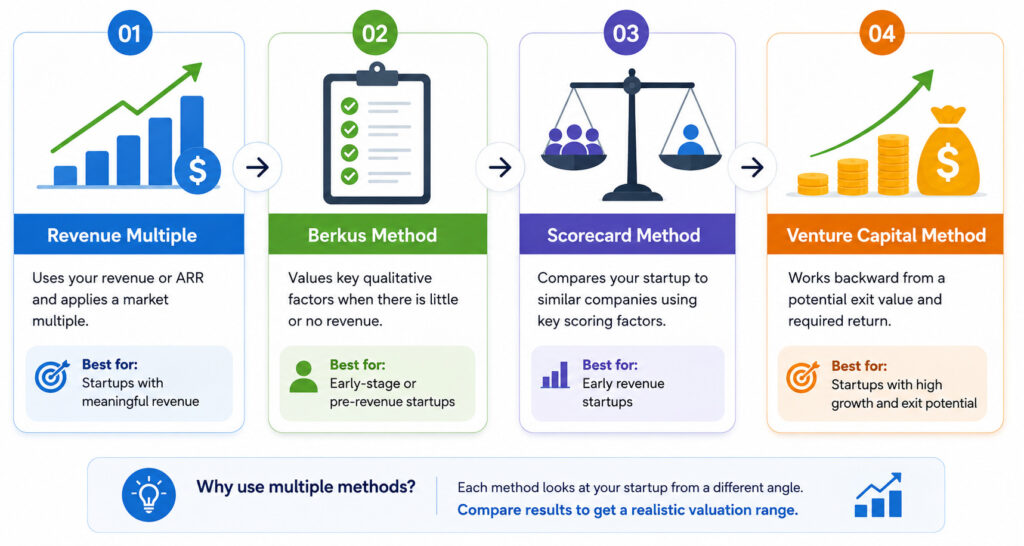
Revenue Multiple
This method uses revenue or ARR and applies a selected multiple.
Formula:
Estimated valuation = ARR × revenue multiple
For example, if a SaaS startup has $500,000 in ARR and the selected multiple is 8x:
$500,000 × 8 = $4 million
Revenue multiples can vary widely. Growth rate, gross margin, retention, market size, and comparable companies can all affect the multiple.
This method works best when a startup already has meaningful revenue.
Berkus Method
The Berkus Method is useful for early-stage or pre-revenue startups.
It looks at areas such as:
- The business idea
- Product or prototype
- Management team
- Strategic relationships
- Market or sales progress
Each area can receive an estimated value. The total creates an indicative valuation.
This method can be useful when there is not enough revenue data for a revenue multiple.
Scorecard Method
The Scorecard Method compares a startup with other startups at a similar stage.
It can consider:
- Management team
- Market opportunity
- Product
- Competition
- Sales and marketing
- Need for additional investment
- Other risk factors
The startup receives a score based on these factors. That score is then applied to a typical valuation for similar companies.
Venture Capital Method
The Venture Capital Method starts with a possible future exit value.
A simple version uses:
Post-money valuation = Expected exit value ÷ investor return multiple
For example, if an investor expects a $50 million exit and requires a 10x return:
$50 million ÷ 10 = $5 million
The calculation can then be used to estimate the amount of equity an investor may require.
This method is more useful when a startup has a clear growth and exit plan.
Which Startup Valuation Method Should You Use?
The right method depends on your startup’s stage and available data.
| Startup situation | Useful starting method |
| Pre-revenue startup | Berkus or Scorecard |
| Early revenue startup | Scorecard or VC Method |
| SaaS with meaningful ARR | Revenue Multiple |
| High-growth startup | Revenue Multiple or VC Method |
| Startup with strong comparable companies | Comparable company analysis |
| Mature profitable business | DCF or comparable companies |
You do not have to use only one method.
In fact, comparing several methods can give you a better valuation range.
For example, if three methods produce values between $5 million and $7 million, that range may be more useful than choosing the highest result of $8 million and treating it as the correct value.
What Is Pre-Money vs. Post-Money Valuation?
Pre-money valuation is the estimated value of your startup before a new investment. Post-money valuation is the value after the investment.
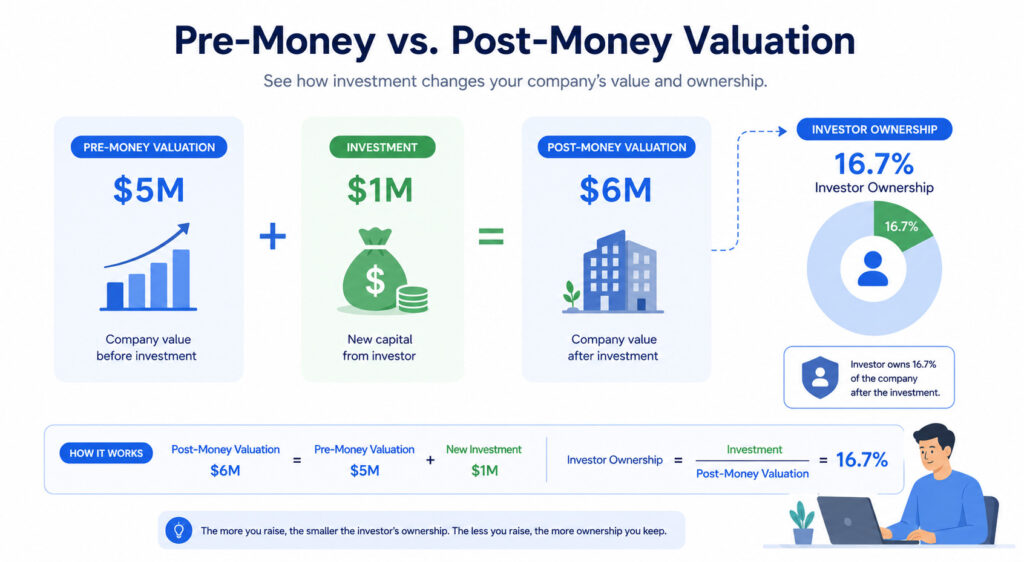
The basic formula is:
Post-money valuation = Pre-money valuation + investment
For example:
- Pre-money valuation: $5 million
- New investment: $1 million
- Post-money valuation: $6 million
The investor’s ownership can then be estimated using:
Investor ownership = Investment ÷ Post-money valuation
In this example:
$1 million ÷ $6 million = 16.7%
So the investor would own about 16.7% under this simple calculation.
Real funding rounds can be more complex because of SAFEs, convertible notes, option pools, existing shareholders, and other deal terms.
How Much Equity Will an Investor Get?
The amount of equity an investor receives depends on the investment amount and the agreed valuation.
Here are some simple examples:
| Pre-money valuation | Investment | Post-money valuation | Investor ownership |
| $4M | $1M | $5M | 20% |
| $5M | $1M | $6M | 16.7% |
| $8M | $2M | $10M | 20% |
| $10M | $2M | $12M | 16.7% |
This is basic ownership math.
A real cap table may produce a different result. An option pool can also change founder ownership. Carta explains that changes to an option pool before a financing round can affect existing shareholder dilution.
For this reason, founders should review the full funding structure rather than looking only at the headline valuation.
What Factors Affect Startup Valuation?
A startup’s value can depend on many factors.
Revenue and ARR
Revenue gives investors a measurable view of the business. For SaaS companies, ARR and MRR are often important metrics. A startup with $1 million in ARR may receive a different valuation from another startup with the same ARR if the two companies have different growth rates or retention.
Growth Rate
Fast and consistent growth can support a higher valuation.
Investors may look at:
- Monthly growth
- Annual growth
- Customer growth
- ARR growth
- Expansion revenue
Market Size
A startup serving a large market may have more room to grow. Investors can consider the total addressable market, target customers, competition, and potential market expansion.
Customer Traction
Traction can include:
- Paying customers
- Repeat customers
- Customer retention
- Revenue growth
- Partnerships
- Product adoption
A startup with strong customer traction can have a stronger case during fundraising.
Gross Margin
Gross margin shows how much revenue remains after the direct cost of delivering a product or service. For software businesses, a strong gross margin can support a higher valuation when other factors are also strong.
Team
Investors often look at the founders and leadership team.
Relevant factors can include:
- Industry experience
- Technical ability
- Previous startup experience
- Product knowledge
- Sales experience
- Ability to execute
Competition
A startup operating in a crowded market may face different valuation expectations from a company with a strong competitive position. Investors may review competitors, market share, pricing, product differentiation, and barriers to entry.
Fundraising Environment
Startup valuations can change as investor demand and venture capital conditions change. A strong funding market can support higher valuations for some companies. A weaker funding market can put more pressure on pricing.
What Are Current Startup Valuation Benchmarks in 2026?
Current data shows that startup valuations vary widely by stage, sector, geography, and company performance.
Carta reported a $24 million median seed post-money valuation in Q4 2025, up from $18 million one year earlier.
PitchBook-NVCA reported a $18.4 million median seed pre-money valuation in Q1 2026.
These numbers should not be treated as a target for every startup. They mainly provide market context.
For example, a US software startup with strong growth may have a very different valuation from an early-stage company in another country or industry.
Carta’s recent data also shows that top-performing startups can have valuations far above the median. The 95th percentile seed valuation reached about $200.4 million in Q2 2026.
That large spread shows why a startup valuation calculator should use company-specific inputs instead of applying one market number to every business.
How Should You Use These Benchmarks?
Use benchmarks as a reference point. Do not use them as proof that your startup is worth a specific amount.
A better approach is:
- Calculate your valuation using company data.
- Compare several valuation methods.
- Review comparable companies.
- Check current market benchmarks.
- Adjust your expectations based on stage, geography, industry, and traction.
- Prepare for investor negotiation.
Why Can Two Valuation Methods Give Different Answers?
Different valuation methods use different assumptions. A revenue multiple focuses heavily on revenue and growth. The Berkus Method gives more weight to early-stage risk and business progress. The Scorecard Method compares your startup with similar companies. The Venture Capital Method focuses on a possible future exit and the return an investor may need. Because these methods measure different things, their results can be different.
For example:
| Method | Result |
| Revenue Multiple | $7.0M |
| Scorecard | $5.8M |
| Berkus | $4.5M |
| VC Method | $6.5M |
Instead of asking which number is the one true valuation, look at why the numbers differ.
The middle of the range can provide a useful starting point for further research and fundraising discussions.
What Does a Startup Valuation Calculator Not Tell You?
A calculator can estimate numbers, but it cannot predict whether an investor will accept your proposed valuation.
It does not know:
- How much interest investors have in your company
- How strong your fundraising leverage is
- Which investor is interested
- The full terms of the deal
- Liquidation preferences
- Board rights
- Pro-rata rights
- SAFE terms
- Convertible note terms
- Future financing conditions
- Strategic value an investor may see
The final valuation is usually the result of a negotiation between the startup and investors.
A calculator gives you a starting point for that conversation.
Startup Valuation Calculator Example
Suppose a SaaS startup has:
- ARR: $500,000
- Annual growth: 80%
- Gross margin: 75%
- Strong customer retention
- Raise amount: $1 million
Suppose the revenue multiple used for a simple example is 8x.
The calculation would be:
$500,000 × 8 = $4 million
The estimated pre-money valuation would be $4 million.
If the company raises $1 million:
$4M + $1M = $5M post-money valuation
Investor ownership would be:
$1M ÷ $5M = 20%
So the simple scenario would look like this:
| Metric | Result |
| ARR | $500,000 |
| Revenue multiple | 8x |
| Estimated pre-money valuation | $4M |
| Investment | $1M |
| Post-money valuation | $5M |
| Investor ownership | 20% |
| Existing ownership | 80% |
This is only an example. A real valuation should consider other factors, including comparable companies, market conditions, growth, margins, customer retention, cap table structure, and deal terms.
How Should Founders Use a Startup Valuation Calculator?
Start with reliable company data. Use actual revenue, ARR, MRR, customer numbers, growth rates, and other metrics instead of optimistic guesses. Then compare the result with several methods.
A useful process is:
- Collect your latest financial data.
- Enter your revenue or ARR.
- Add growth and customer data.
- Select your startup stage.
- Choose relevant valuation methods.
- Calculate the estimated valuation range.
- Add the amount you want to raise.
- Check post-money valuation.
- Review investor ownership and founder dilution.
- Compare the result with current market benchmarks.
If you are preparing a financial model, keep your revenue forecasts, expenses, cash flow, and unit economics consistent with the assumptions used in the valuation.
For a deeper look at startup financial modeling, link to your existing Startup Booted Financial Modeling article here. For fundraising preparation, link to your existing Startup Booted Fundraising Strategy article here.
What If Your Startup Has No Revenue?
A pre-revenue startup can still have value. Revenue-based methods may not work well when there is little or no revenue.
In that case, founders can consider methods such as:
- Berkus Method
- Scorecard Method
- Venture Capital Method
- Comparable startup analysis
Investors may also look at:
- Founding team
- Product
- Prototype
- Market size
- Customer research
- Early users
- Partnerships
- Intellectual property
- Competitive position
A pre-revenue startup should not use a revenue multiple simply because another startup does.
How Does a Startup Valuation Calculator Help With Fundraising?
A valuation calculator can help founders prepare for investor conversations. Before a funding round, you can test several scenarios.
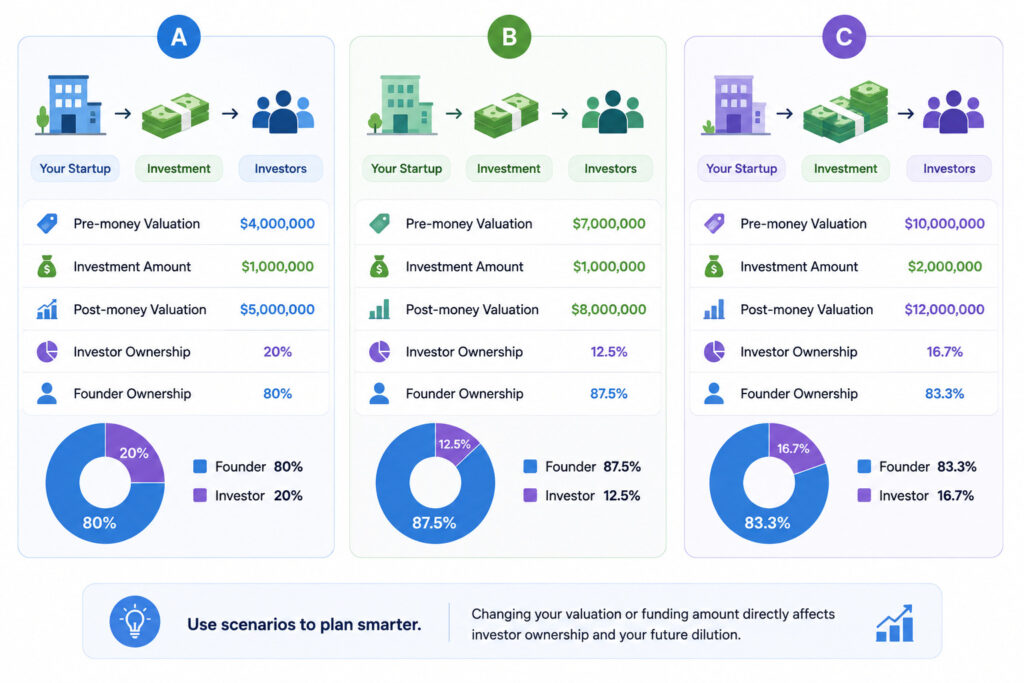
For example:
Scenario A
$5M pre-money + $1M investment
Investor ownership: 16.7%
Scenario B
$7M pre-money + $1M investment
Investor ownership: 12.5%
Scenario C
$10M pre-money + $2M investment
Investor ownership: 16.7%
These scenarios help you see how valuation and fundraising size affect ownership.
You can then compare the numbers with your growth plan and capital needs.
The goal is not to choose the highest valuation possible. A valuation that is too high can create problems in a future funding round if the company cannot grow into the price.
What Is a Good Startup Valuation?
There is no single valuation that is good for every startup.
A reasonable valuation depends on factors such as:
- Startup stage
- Revenue
- ARR
- Growth
- Market size
- Customer traction
- Gross margin
- Team
- Competition
- Geography
- Industry
- Investor demand
- Current funding conditions
A seed startup with no revenue should not be compared directly with a SaaS company generating millions in ARR.
The best valuation is one that reflects the company’s current position, future potential, market conditions, and the terms of the funding round.
Frequently Asked Questions
What is a startup valuation calculator?
A startup valuation calculator is a tool that estimates how much a startup may be worth. It can use revenue, ARR, growth, market factors, traction, and other inputs. Some calculators also estimate pre-money valuation, post-money valuation, investor ownership, and founder dilution.
How accurate is a startup valuation calculator?
A startup valuation calculator provides an estimate, not a guaranteed valuation. The final price of a funding round depends on investor demand, company performance, market conditions, comparable companies, deal terms, and negotiation.
How do I calculate startup valuation with no revenue?
For a pre-revenue startup, methods such as the Berkus Method, Scorecard Method, and Venture Capital Method can be useful. Investors may also consider the team, product, market size, early traction, partnerships, and competitive position.
What is the difference between pre-money and post-money valuation?
Pre-money valuation is the company’s value before a new investment. Post-money valuation is the pre-money valuation plus the new investment. For example, a $5 million pre-money valuation plus a $1 million investment gives a $6 million post-money valuation.
How much equity should I give an investor?
It depends on the amount invested and the agreed valuation. For a simple $1 million investment at a $5 million post-money valuation, the investor would own 20%. Real deals can differ because of SAFEs, convertible notes, option pools, and other terms.
What is the best startup valuation method?
There is no single best method for every startup. Revenue multiples can work well for startups with meaningful revenue. Berkus and Scorecard methods can help with early-stage companies. The Venture Capital Method can be useful when future exit value is an important part of the investment case.
Can a startup valuation calculator predict my final funding valuation?
No. It can help you prepare an estimate and compare different scenarios, but the final valuation is negotiated with investors. Market demand, company traction, investor interest, funding conditions, and deal terms can all change the final result.
Final Thoughts
A startup valuation calculator is most useful when it gives you more than one number.
Use your financial data to estimate a valuation range. Compare the Revenue Multiple, Berkus Method, Scorecard Method, and Venture Capital Method when they fit your startup stage. Then check pre-money valuation, post-money valuation, investor ownership, and founder dilution.
Current 2026 market data can help you understand the broader funding environment, but it should not replace company-specific analysis.
If you are preparing for a funding round, use the calculator as a starting point. Test different fundraising amounts, review your assumptions, and compare the result with relevant startup benchmarks before entering investor negotiations.
Ready to estimate your startup’s value? Use the calculator to compare valuation methods and model your next funding round.