

WIIFM stands for “What’s In It For Me?” It is a marketing and copywriting principle that tells you to lead every message with the reader’s benefit, not your product’s features. Instead of describing what you offer, WIIFM-led writing answers what the reader gains. It works across email subject lines, ad copy, sales pitches, and any message where you need to earn attention fast. Lead with the outcome, and engagement follows.
Every day, the average professional receives more than 120 emails. Most get deleted without a second thought. The ones that get opened share one thing in common: they answer a silent question that every reader asks the moment they see a new message in their inbox. That question is “What’s in it for me?”
This principle has a name. It is called WIIFM. Once you understand it and apply it, the way you write emails, subject lines, and marketing copy will never be the same. This guide covers what WIIFM means, why it matters so much in email marketing, and exactly how to use it to write messages that actually get read.
What Does WIIFM Stand For?
WIIFM is a foundational acronym in the professional world that stands for “What’s In It For Me?” In the realms of copywriting and communication, it represents the primary lens through which an audience evaluates any piece of information.
A popular industry metaphor, frequently cited by HubSpot, claims that everyone’s favorite radio station is WIIFM. This “radio station” concept serves as a memorable reminder that listeners are always tuned into a frequency that prioritizes their own personal gain or problem-solving.
The WIIFM meaning is deeply rooted in the psychological principle of self-interest, which functions as the default decision filter for human behavior. To craft an effective value proposition, a creator must move past technical features and focus entirely on the reader benefit.
Mastering this marketing principle is as fundamental to digital success as understanding email communication basics. By answering the question of what’s in it for me early and often, you ensure your message captures and holds the audience’s attention.
Why Does WIIFM Matter in Marketing?
WIIFM matters because people are wired to filter information through personal relevance. In a crowded inbox or feed, messages that immediately signal personal value get opened; those that lead with company news or product features get ignored. Addressing “what’s in it for the reader” is the fastest path from attention to action.
With the average professional receiving between 121 and 126 emails every single day, the competition for inbox engagement is fierce. This constant noise forces users to use relevance signals as a survival mechanism, scanning specifically for audience pain points to decide what to ignore. Prioritizing WIIFM in marketing is essential for optimizing email subject line performance, as a clear, benefit-driven approach provides a much higher engagement and conversion lift compared to feature-heavy messaging.
- Ads and Subject Lines: Hook attention by leading with the solution to a specific problem rather than a product name.
- Social Media Captions: Increase email open rates and social interaction by framing content around the user’s personal growth or entertainment.
- Call-to-Action (CTA) Buttons: Drive clicks by transforming generic commands into direct statements of value, such as “Start Saving Today.”
Features vs. Benefits: The Core of WIIFM
The distinction between features vs. benefits is the foundation of conversion copywriting. While a feature describes what a product or service is or does, a benefit illustrates the specific outcome for the reader. In persuasive writing, the goal is to translate technical specifications into tangible improvements in the user’s life, ensuring the value proposition is immediately clear.
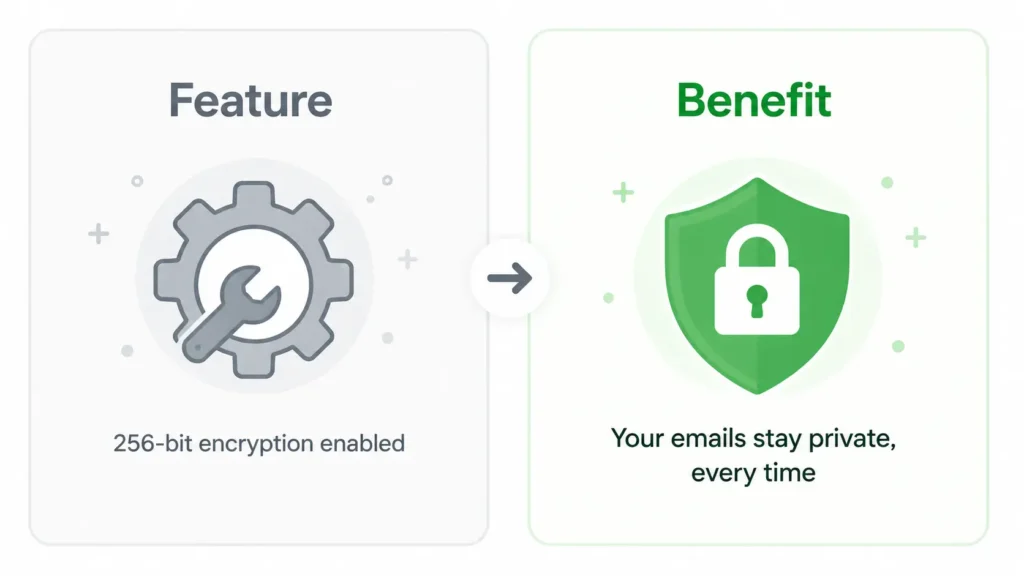
| Feature-Led (Weak) | Benefit-Led WIIFM (Strong) |
| “Our tool has AI-powered automation” | “Save 3 hours every week on manual email tasks” |
| “256-bit encryption enabled” | “Your emails stay private — always” |
| “Multi-domain support included” | “Use any inbox, anywhere, without exposing your real email” |
How to Rewrite Feature-Led Sentences Using WIIFM
To effectively implement benefit-focused messaging, writers often utilize the “you” language tactical shift. This copywriting technique moves the focus away from the “we” (the company) and places it on “you” (the customer). For example, instead of saying “We provide top-tier security,” a WIIFM-aligned approach would be “You get total peace of mind.” This simple pivot is crucial when protecting your email when testing offers or navigating new services, as it highlights the direct personal impact rather than the underlying technology.
How to Apply WIIFM in Email Marketing
To apply WIIFM in email marketing, start with your subject line, it’s the first test of relevance. Lead with the specific outcome your reader gains, not the product or promotion you’re sending. Use “you” language, include concrete benefits (time saved, money saved, problem solved), and personalize where possible. The reader’s self-interest is your most powerful open-rate lever.
Applying WIIFM email marketing principles ensures that every touchpoint in your funnel is optimized for email engagement. By consistently answering the reader’s internal question, you build a relationship based on value rather than intrusion.
Writing WIIFM Subject Lines
Benefit-focused email subject lines are the most effective way to cut through a cluttered inbox. The goal is to make the value so specific that the reader feels they are missing out by not opening the email. Use the “specific number principle” (e.g., “Save $45” vs “Save Money”) to add credibility and weight to your claims.
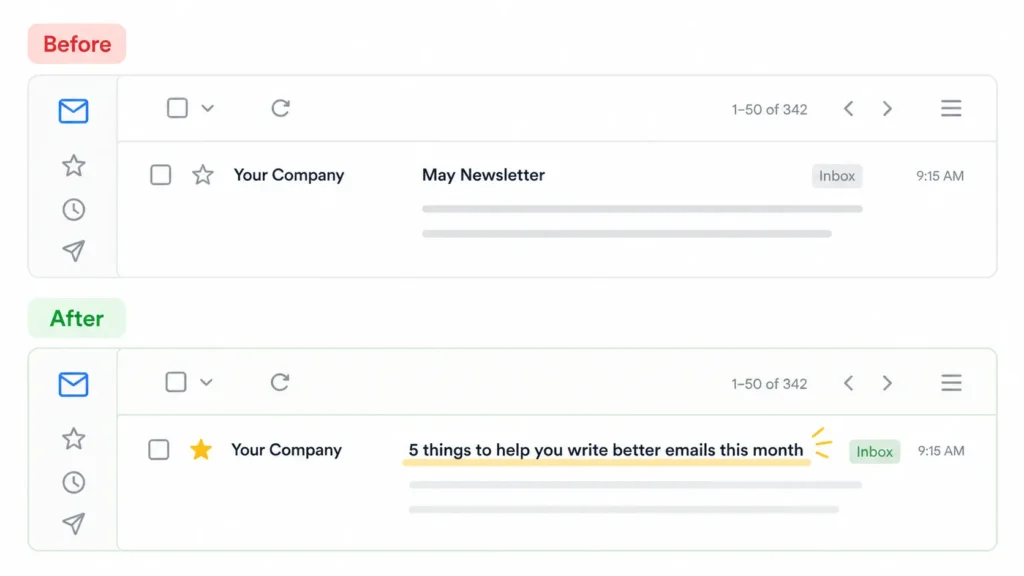
| Weak Subject Line (Feature/Announcement) | Strong WIIFM Subject Line (Outcome/Benefit) |
| “Our Q4 Newsletter is here” | “3 Strategies to double your Q4 revenue” |
| “We launched a new productivity course” | “Reclaim 10 hours of your week starting today” |
| “Check out our new security feature” | “Stop hackers from accessing your private data” |
| “Huge store-wide sale starting now” | “Get 50% off your next home upgrade” |
| “Update regarding your account” | “You have $25 in rewards waiting to be used” |
WIIFM in Email Body Copy
The body of your email should never open with “we” or “our company.” Instead, lead with the reader’s problem. By agitating a pain point they already feel, you position your message as a relevant solution rather than a cold pitch.
Effective WIIFM email marketing follows a structure where the “Solution” is presented only after the “Problem” and “Agitation” have been clearly established. Maintain a tone of helpfulness; you aren’t selling a product, you are providing a bridge to a better version of the reader’s life. To ensure your formatting and messaging land correctly across different providers, you can use tools like freemail.ai to safely test email campaigns before sending to your list.
WIIFM CTAs: Make the Action Feel Like a Gain
The Call to Action (CTA) is the final hurdle in the WIIFM journey. Most marketers use “friction” words like Submit, Buy, or Register, which imply work or cost for the reader. To increase conversion, rewrite your buttons to reflect the gain the user receives upon clicking.
- From “Download PDF” to: “Get my free growth roadmap”
- From “Sign Up” to: “Start my 14-day free trial”
- From “Click Here” to: “Show me how to save 20%”
- From “Register for Webinar” to: “Save my seat and master SEO”
By focusing on the “gain” rather than the “task,” you remove the psychological barriers to clicking, aligning the final action with the user’s primary self-interest.
WIIFM Examples Across Different Use Cases
The power of what’s in it for me marketing extends far beyond the inbox. Whether you are crafting a social media presence or building a high-converting landing page, customer-centric copywriting ensures that every interaction provides immediate value to the prospect. By shifting the focus from your credentials to the user’s results, you transform passive observers into active participants.
The following WIIFM examples demonstrate how to pivot your messaging across various business models and industries:
| Context | Without WIIFM (Company-Focused) | With WIIFM (Customer-Focused) |
| SaaS Landing Page | “Our software features 99.9% uptime and global server distribution.” | “Run your business with zero interruptions, no matter where you are in the world.” |
| E-commerce Ad Copy | “These sneakers feature a patented ergonomic foam sole.” | “Stop foot fatigue and walk further with shoes that feel like clouds.” |
| Service Business Bio | “Licensed HVAC technicians with 20 years of experience in the tri-state area.” | “Keep your family comfortable all summer while lowering your energy bills by 15%.” |
| Sales Call Script | “I’d like to walk you through our new analytics dashboard features.” | “I’ll show you exactly where you’re losing revenue so you can fix it this week.” |
| Social Media Bio | “I share my daily thoughts on digital marketing and SEO strategy.” | “Helping you rank on page 1 of Google with actionable SEO tips every Tuesday.” |
Mastering these pivots not only improves your conversion rates but also builds long-term trust. When users see that you prioritize their outcomes over your own features, they are more likely to engage with your brand. This level of clarity is also a key factor in keeping your marketing emails out of spam, as high engagement signals to providers that your content is genuinely wanted.
What Are the Most Common WIIFM Mistakes?
The most common WIIFM mistake is adding “you” language without changing the underlying message. Swapping “we offer” for “you get” without backing it up with a real, specific benefit doesn’t work. WIIFM requires genuine audience insight, knowing what outcome actually matters to that reader at that moment.
- Surface-Level Personalization: Simply swapping pronouns without shifting the focus to the reader’s audience pain points. “You can read our new whitepaper” is still company-focused, even with the word “you” in it.
- Vague or “Fluff” Benefits: Using empty buzzwords like “optimized,” “world-class,” or “efficient” instead of concrete, measurable wins. WIIFM copywriting fails when the benefit is too blurry to visualize.
- One-Size-Fits-All Messaging: Assuming every reader wants the same outcome. If the “Me” in your message is too broad, it loses marketing message relevance for everyone.
- Ignoring Segmentation: Failing to tailor the WIIFM hook to different stages of the buyer’s journey. A first-time visitor needs a different “what’s in it for me” than a long-term loyal customer.
Getting WIIFM Right Every Time
Mastering the WIIFM principle is the difference between an email that is deleted on sight and one that drives real results. By consistently focusing on the reader’s benefit rather than your own features, you build a brand that people actually want to hear from.
Before you send your next campaign, test your subject lines risk-free. Use a temporary inbox at freemail.ai to send and receive test versions without cluttering your real email, so you can get WIIFM right before it lands in real inboxes.
WIIFM (What’s In It For Me?) Comprehensive FAQ
This FAQ covers everything you need to know about the WIIFM principle, from its basic definition to advanced application in marketing and copywriting.
How is WIIFM different from a value proposition?
A value proposition is a formal statement that explains what your brand offers and why it is better than alternatives. WIIFM is the conversational, reader-level version of that idea. It shows up in individual sentences, subject lines, and CTAs. Think of a value proposition as the strategy and WIIFM as the writing technique you use to express it.
Can WIIFM hurt your copy if you overuse it?
Yes. If every single line starts with “you” or leads with a benefit claim, your writing starts to feel pushy or hollow. WIIFM works best when it is grounded in real audience insight. Overusing the technique without genuine knowledge of what your reader actually wants turns benefit-focused messaging into empty flattery.
Does WIIFM work for cold email outreach?
Cold email is one of the best places to use WIIFM because you have no existing relationship to fall back on. Your subject line and opening sentence must earn attention on their own. A cold email that immediately addresses a real pain point the reader has will always outperform one that opens with company credentials or product features.
How does WIIFM relate to email personalization?
Personalization and WIIFM are a natural pair. Personalization helps you deliver the right WIIFM message to the right person. Using the reader’s name, referencing their industry, or mentioning a specific goal they have makes the “what’s in it for me?” answer feel like it was written just for them. Together, they create inbox engagement that generic broadcasts cannot match.
Is WIIFM only useful in marketing and sales?
No. WIIFM applies anywhere communication needs to earn a response. It works in employee emails, training materials, meeting invites, internal announcements, and change management messaging. Any time you need someone to read, act, or care about what you are sharing, asking “what’s in it for them?” before you write will improve the result.