

If you have seen the phrase Startup Booted, you may wonder what it means. Is it a new type of startup? Is it the same as bootstrapping? Or does it describe a different way to build a business?
In most cases, Startup Booted is an informal phrase used to describe a bootstrapped startup. The business starts and grows mainly with founder money, customer revenue, and reinvested profits instead of depending heavily on outside investors.
The idea centers on simple principles: keep costs under control, find paying customers early, protect founder ownership, and grow at a pace the business can support.
This guide explains the Startup Booted meaning, how the model works, its benefits and risks, how it compares with venture capital, and when a founder may want to seek outside funding.
What Does “Startup Booted” Mean?
Startup Booted is an emerging phrase generally used to describe a startup that is built mainly with its own resources.
These resources can include:
- Founder savings
- Customer revenue
- Reinvested profits
- Pre-orders
- Service income
- Small business loans
- Grants
- Other forms of non-VC funding
The phrase is closely related to bootstrapping. The U.S. Small Business Administration uses bootstrapping to describe self-funding a business through personal resources and other founder-controlled funds.
So, if someone asks, “What is Startup Booted?”, the simplest answer is:
A Startup Booted business is a startup that tries to grow mainly through founder resources and business revenue, while keeping outside investment limited or optional.
It is important not to treat “Startup Booted” as a formal finance term. Bootstrapping is the established term. “Startup Booted” is better understood as an emerging phrase built around that idea.
Is Startup Booted the Same as Bootstrapping?
For most uses, yes.
Bootstrapping is the established business term. A bootstrapped startup normally uses internal resources and revenue instead of depending on venture capital.
Startup Booted is a newer phrase that can describe much of the same approach.
There can be a small difference in how some newer sources use the phrase. Some describe Startup Booted as a more structured revenue-first startup strategy, where founders build proof with limited capital and may later raise outside funding when it makes sense.
| Startup Booted | Traditional VC-backed startup |
| Founder resources are important | Investor capital is important |
| Customer revenue is a major goal | Funding can come before strong revenue |
| Founder ownership may stay higher | Equity is shared with investors |
| Growth can be slower | Growth may be faster |
| Spending is closely controlled | More capital may support larger spending |
| Fundraising may be delayed | Fundraising is often part of the plan |
| Founder has more direct control | Investors may have influence |
The main idea is simple: bootstrapping focuses on building with what the business can generate and what the founders can provide.
How Does a Startup Booted Model Work?
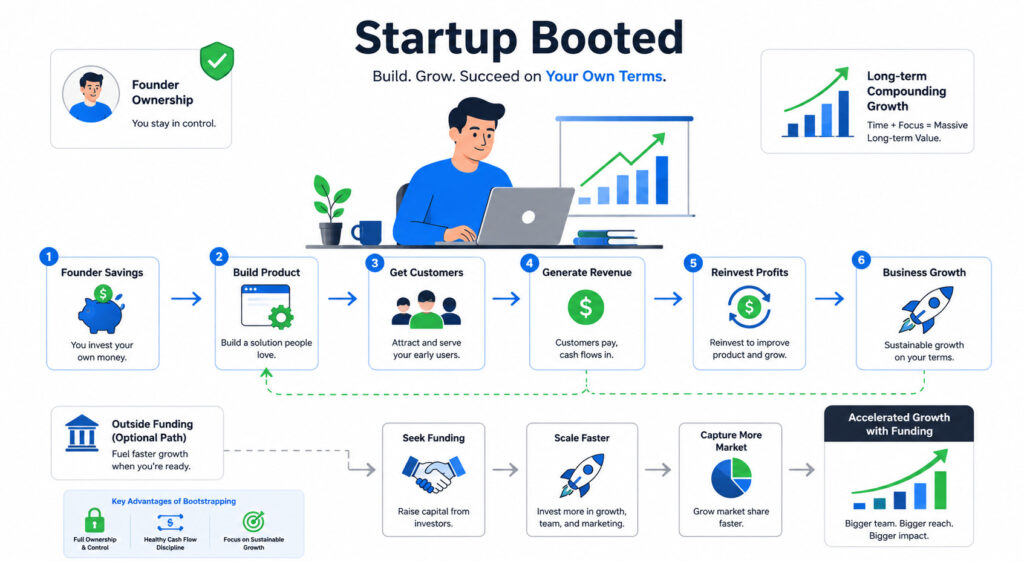
A Startup Booted model usually follows a simple path:
Founder resources → Product or service → First customers → Revenue → Reinvestment → Growth
Here is how each step works.
1. Start With Available Resources
The founders first look at what they already have.
This could be:
- Personal savings
- Existing equipment
- Professional skills
- A home office
- Existing customer relationships
- Service income
- Founder time
The goal is to avoid taking on large costs before the business has proven that customers want the product or service.
2. Validate the Business Idea
Before spending heavily, founders try to learn whether people will actually pay.
They may:
- Interview potential customers
- Build a simple product
- Offer a service manually
- Create a basic website
- Run a small test
- Take pre-orders
- Sell to early customers
This stage helps reduce the risk of spending money on something customers do not need.
3. Find the First Customers
Customer revenue is central to a bootstrapped startup.
For example, suppose a founder starts a small software company with $5,000 in personal savings.
Instead of raising a large seed round, the founder may build a basic version of the product and find 20 paying customers.
If those customers generate $2,000 per month, that revenue can help pay for:
- Software
- Hosting
- Marketing
- Contractors
- Customer support
- Product development
4. Reinvest the Revenue
The business can put part of its earnings back into growth.
For example:
$5,000 revenue
- $2,500 operating costs
- $1,000 marketing
- $500 tools
- $1,000 reinvested into product development
The exact numbers will vary, but the principle remains the same.
The company tries to let its revenue support its next stage of growth.
5. Grow After Proof
Once the startup has paying customers and clearer unit economics, the founder can decide how quickly to grow.
The company may hire people, improve the product, enter another market, or increase marketing.
At this point, the founder also has more information about:
- Customer demand
- Customer acquisition cost
- Gross margin
- Revenue
- Cash flow
- Customer retention
- Product-market fit
This makes future funding decisions easier.
What Are the Benefits of a Startup Booted Approach?
A Startup Booted model can offer several benefits.
Higher Founder Ownership
When founders use their own resources and revenue, they may not need to sell equity during the early stages.
That can help founders keep a larger ownership share.
More Control
Founders usually have more control over business decisions when there are fewer outside shareholders.
They may have more freedom to decide:
- Which customers to target
- How fast to grow
- How much to spend
- Which products to build
- When to hire
Stronger Cost Discipline
Limited cash forces founders to think carefully about spending.
Instead of hiring a large team immediately, a founder may start with a small team.
Instead of spending heavily on advertising, the company may focus on referrals, partnerships, content, or direct sales.
Early Customer Validation
A customer paying for a product provides useful proof.
For example, 100 people saying they like an idea is helpful.
But 20 people paying $50 each month provides stronger evidence that the business has real demand.
Less Dependence on Fundraising
A bootstrapped startup does not need to make every business decision around the next funding round.
This can reduce pressure to raise money before the company is ready.
Potential for Sustainable Growth
When growth is tied to customer revenue, the founder has a clear connection between sales and spending.
That does not guarantee success, but it can encourage careful financial planning.
What Are the Risks of Building a Startup This Way?
Bootstrapping also has real disadvantages.
A balanced article should not present it as the best choice for every startup.
Slower Growth
A startup with limited cash may not be able to hire quickly or spend heavily on marketing.
A competitor with millions in funding may move faster.
Limited Resources
Some businesses need large amounts of money before they can generate revenue.
This can make bootstrapping difficult.
Examples include:
- Biotech
- Hardware
- Heavy manufacturing
- Deep technology
- Large infrastructure projects
Founder Financial Risk
When founders use personal savings, they carry more of the early financial risk.
A failed business can result in lost personal money.
Hiring Challenges
A company with limited cash may struggle to compete with larger companies for experienced employees.
It may need to offer:
- Flexible work
- Meaningful responsibilities
- Smaller teams
- Future equity
- Strong learning opportunities
Founder Burnout
Bootstrapped companies often require founders to handle many jobs.
One founder might manage:
- Sales
- Product development
- Customer service
- Marketing
- Accounting
- Hiring
That workload can become difficult over time.
Missed Growth Opportunities
A startup may have strong demand but lack enough cash to take advantage of it.
For example, imagine a software company receives 500 new customer requests but does not have enough money to hire support staff.
Outside funding might help the company serve those customers faster.
Startup Booted vs. VC-Backed Startup
The biggest difference is how the company gets the money it needs to grow.
Startup Booted
A Startup Booted company often starts with:
Founder money + customer revenue + reinvested profits
VC-backed startup
A venture-backed company may use:
Founder money + angel investment + seed funding + venture capital
Neither model is automatically better.
The right choice depends on the business.
| Factor | Startup Booted | VC-backed |
| Main funding | Founder resources and revenue | External investors |
| Founder ownership | Often higher | Usually diluted |
| Growth pace | Controlled | Often faster |
| Spending | Careful | More capital available |
| Founder control | Usually higher | Investors may have influence |
| Customer revenue | Often important early | May come later |
| Fundraising | Optional or delayed | Often a key part of growth |
| Financial pressure | Strong focus on cash flow | Strong focus on growth and future funding |
| Best fit | Businesses that can reach revenue with modest capital | Businesses that need large capital to grow quickly |
Can a Startup Booted Company Still Raise Venture Capital?
Yes.
This is one of the most important points to understand.
Bootstrapping does not mean a company can never raise outside funding.
A founder can start with personal savings, find customers, generate revenue, and later decide that outside funding would help the company grow.
For example:
Stage 1: Founder invests $10,000.
Stage 2: The company launches its first product.
Stage 3: The company reaches $5,000 in monthly recurring revenue.
Stage 4: Customer demand increases.
Stage 5: The company needs more money to hire developers and expand.
Stage 6: The founder considers a seed round.
In this case, the founder used a Startup Booted approach first and considered external capital later.
The goal is not to avoid funding forever.
The goal is to make funding a choice rather than the only way the business can survive.
What Funding Can a Startup Use Without Traditional VC?
Venture capital is only one funding option.
Depending on the company, founders may consider:
- Founder savings
- Customer revenue
- Grants
- Business loans
- Pre-orders
- Crowdfunding
- Revenue-based financing
- Angel investors
- Strategic partners
- Later-stage venture capital
In the United States, the SEC provides several securities offering exemptions. For example, eligible companies using Regulation Crowdfunding can raise up to $5 million in a 12-month period, subject to the rules and requirements that apply.
The SEC also lists other offering pathways, including Rule 504 and Regulation A. Rule 504 has a $10 million limit for eligible offerings in a 12-month period, while Regulation A Tier 2 has a $75 million limit, subject to the relevant requirements.
These rules are specific to the United States. Founders in other countries need to follow their local laws.
Which Startups Are Best Suited to the Startup Booted Model?
Some businesses are easier to bootstrap than others.
Businesses That May Be Easier to Bootstrap
SaaS
Software can often be built with a small team and sold through recurring subscriptions.
Consulting
A founder can sell professional skills without large equipment costs.
Agencies
A small agency can start with a few clients and use revenue to hire more people.
Digital Products
Courses, templates, software tools, and other digital products can have relatively low production costs.
Niche E-commerce
A focused product line may allow a founder to start with limited inventory.
Service Businesses
Services can often generate revenue before a company builds a large physical operation.
Businesses That May Need More Outside Capital
Bootstrapping can be harder when a startup requires large upfront spending.
Examples include:
- Biotech companies
- Medical technology
- Hardware startups
- Semiconductor companies
- Heavy manufacturing
- Large logistics operations
- Deep technology research
A company may need years of research before it can sell a product.
In these cases, grants, loans, angel investment, or venture capital may play a larger role. For businesses that have started generating revenue but need additional capital to support operations or growth, direct business funding can also be an option to consider.
How Do You Know When to Stop Bootstrapping?
There is no fixed revenue number that tells every founder when to seek funding.
Instead, look at the business situation.
You may want to consider outside funding when:
Demand Is Greater Than Your Capacity
Customers are ready to buy, but you cannot serve them with your current team or equipment.
Your Unit Economics Are Clear
You understand how much it costs to acquire a customer and how much revenue that customer can generate.
Revenue Is Becoming Predictable
Regular revenue gives you a better base for planning future spending.
A Large Growth Opportunity Appears
You may have an opportunity to enter a new market or build a major product, but you need more money to do it.
Funding Can Speed Up Growth
Outside capital can make sense when it helps an already working business grow.
It is less attractive when the money is only being used to hide a weak business model.
Startup Booted Roadmap: From Idea to Growth
Here is a simple roadmap founders can follow.
Phase 1: Validate the Idea
Start with customer research.
Ask:
- Who has the problem?
- How are they solving it now?
- Would they pay for a better solution?
- How much could they pay?
Phase 2: Build a Simple Product
Do not spend heavily before testing demand.
Create the simplest useful version of the product or service.
Phase 3: Find Paying Customers
Focus on real customers rather than only opinions.
Try to make the first sales as early as practical.
Phase 4: Track the Numbers
Watch:
- Revenue
- Costs
- Cash flow
- Gross margin
- Customer acquisition cost
- Customer retention
- Monthly recurring revenue
- Runway
These numbers help you understand whether the business can support itself.
Phase 5: Reinvest
Use part of the revenue to improve the product, reach more customers, and support the team.
Phase 6: Decide on Funding
Once the business has stronger proof, ask:
Would outside money help us grow faster without creating problems that are bigger than the benefit?
If the answer is yes, fundraising may be worth considering.
If the answer is no, continuing to bootstrap may be the better choice.
Why Financial Modeling Matters for a Startup Booted Business
A startup can have good sales and still run out of cash.
That is why financial modeling matters.
A basic financial model can help a founder estimate:
- Future revenue
- Monthly costs
- Cash flow
- Hiring costs
- Marketing spending
- Break-even point
- Cash runway
- Funding needs
For example, a company might make $20,000 in monthly revenue but spend $22,000.
That business is growing sales while losing $2,000 each month.
A financial model can show how long the company can continue at that rate.
It can also help founders test different choices.
For example:
What happens if we hire two employees?
What happens if sales grow by 20%?
What happens if sales fall by 10%?
What happens if we raise $500,000?
Good financial planning helps founders understand these choices before making them. When those decisions depend on projected revenue, costs, cash flow, and different budget scenarios, QuickBooks budgeting software can give founders a more structured way to evaluate the numbers before committing to a course of action.
Revenue-First Growth in a Startup Booted Business
Revenue-first growth means trying to create a paying business early.
For example, a founder might launch a simple service before building a large software platform.
The service generates revenue.
That revenue helps fund product development.
The product then creates more revenue.
The company reinvests part of that money into growth.
This creates a cycle:
Customers → Revenue → Product → More Customers → More Revenue
This approach can reduce the amount of outside capital needed during the early stages.
It also forces founders to listen closely to customers.
Startup Booted and Founder Ownership
Founder ownership is one reason people choose bootstrapping.
Suppose two founders start a company and each owns 50%.
If they raise outside investment very early, they may need to sell part of the company.
Their ownership percentages can fall.
If they can grow using revenue instead, they may delay that dilution.
That does not mean outside investment is bad.
Selling equity can provide money, connections, hiring power, and access to markets.
The real question is:
What are you giving up, and what are you getting in return?
That is a better way to think about startup funding.
Startup Booted and Venture Capital: Which Is Better?
There is no universal winner.
A Startup Booted approach may fit when:
- Startup costs are low
- Customers can pay early
- The product can reach market quickly
- Founders want more control
- Growth can happen without huge spending
- The company has healthy margins
Venture capital may fit when:
- The market is moving very quickly
- Large amounts of capital are needed
- The company needs expensive research
- Rapid hiring is important
- Competitors are already well funded
- The opportunity is large but time-sensitive
A hybrid model may fit when:
- The company can reach early revenue
- Founders want to prove demand first
- More capital could speed up growth later
The best funding plan depends on the company’s costs, customers, market, and growth goals.
A Simple Decision Framework for Founders
Ask these five questions:
1. Can we reach paying customers without a large investment?
If yes, bootstrapping may be practical.
2. Can revenue cover a meaningful part of our costs?
If yes, the company has a stronger base for self-funded growth.
3. Do we need to grow very quickly?
If yes, outside capital may help.
4. Does raising money solve a real business problem?
If funding will help you hire, build, or expand after proving demand, it may be useful.
5. What happens if we do not raise money?
If the business can continue growing, you have more funding choices.
If the business will fail without funding, you need to understand why before raising capital.
Startup Booted: A Simple Example
Consider a founder who wants to build a project management tool.
The founder has $8,000.
Instead of raising a large seed round, they use the money to:
- Build a basic product
- Buy essential software
- Create a website
- Test customer demand
After three months, they find 30 customers.
Each customer pays $50 per month.
That creates:
30 × $50 = $1,500 monthly revenue
The founder then improves the product and finds more customers.
After one year, the company reaches $15,000 in monthly revenue.
At this point, the founder has choices.
They could:
- Continue bootstrapping.
- Take a business loan.
- Find an angel investor.
- Raise a seed round.
- Use a combination of funding sources.
The key difference is that the founder now has customer evidence and revenue.
That can make the funding decision more informed.
The Current Funding Picture
The wider startup funding market also shows why founders need to think carefully about funding choices.
Carta reported that U.S.-based startups on its platform raised $10.4 billion across 50,316 SAFEs and convertible notes in 2025. Carta also reported that startup funding was becoming more concentrated among a smaller group of companies.
This does not mean bootstrapping is better.
It means founders have a reason to think about when to raise money and what the money will accomplish.
A founder does not need to choose between:
Bootstrap forever
and
Raise money immediately
There is a middle path.
A company can bootstrap early, build customer traction, and raise outside funding later if the money can help it grow.
Is Startup Booted a Good Choice for Your Business?
A Startup Booted approach may be a good fit if your company can reach revenue without large upfront costs.
It can work especially well for:
- SaaS
- Consulting
- Agencies
- Digital products
- Small online businesses
- Niche software
- Service companies
It may be harder for businesses that require large amounts of capital before they can generate revenue.
The key question is not:
“Is bootstrapping good?”
Ask instead:
“Can this business grow well with the money we can generate ourselves?”
If the answer is yes, bootstrapping may give you more control and flexibility.
If the answer is no, outside funding may be necessary.
Frequently Asked Questions
Is Startup Booted the same as bootstrapping?
In most contexts, yes. Bootstrapping is the established term for building a business with internal or founder-controlled resources. Startup Booted is a newer phrase that is often used for a similar approach.
Can a Startup Booted company raise venture capital?
Yes. A bootstrapped startup can raise venture capital later. Bootstrapping does not mean avoiding outside funding forever.
What is the biggest benefit of bootstrapping?
Founder ownership and control are two major benefits. A company can also develop strong spending discipline and focus closely on paying customers.
What is the biggest risk?
Limited capital can slow growth. Founders may also carry more financial risk and have fewer resources for hiring, marketing, and product development.
Is Startup Booted better than VC funding?
Not for every company. Bootstrapping can work well for businesses that can reach revenue with modest capital. VC funding can be more useful for companies that need large amounts of money to grow quickly.
Can a SaaS startup use a Startup Booted model?
Yes. SaaS can be a good fit because a founder may be able to launch a small product, gain paying customers, and use recurring revenue to support future development.
What is revenue-first growth?
Revenue-first growth means trying to generate customer revenue early and using that revenue to support future business growth.
Final Thoughts
Startup Booted is best understood as an emerging phrase connected to the established idea of bootstrapping.
The core approach is simple:
Start with available resources. Find real customers. Generate revenue. Control costs. Reinvest when possible. Raise outside funding only when it serves a clear purpose.
This model can give founders more ownership and control, but it can also limit growth and put more financial pressure on the founders.
The right choice depends on the business.
A small SaaS company may be able to grow from $5,000 in founder savings to meaningful recurring revenue. A biotech company may need millions of dollars before it can reach the market.
So the best funding strategy is not about following one rule.
It is about understanding your cash flow, unit economics, customer demand, growth needs, founder ownership, and funding options, then choosing the path that fits the business.