

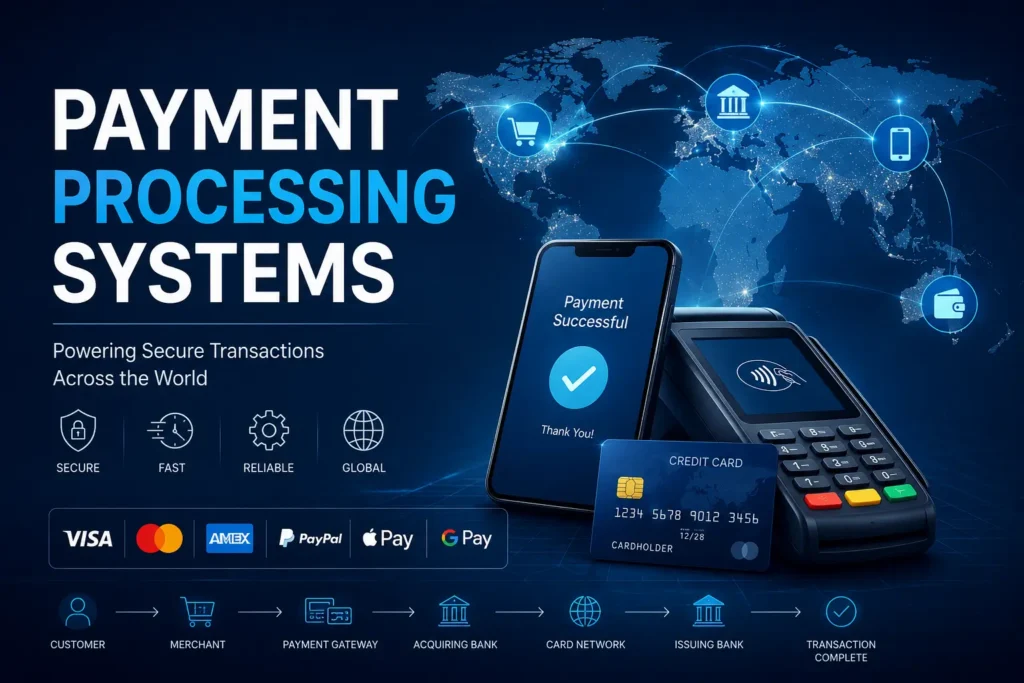
A payment processing system is the network of tools and banks that move money from a customer to a business. It includes a payment gateway, a payment processor, an acquiring bank, a card network, and an issuing bank. The system checks and approves each payment in a few seconds, then settles the funds within one to three business days. Knowing how it works helps you pick the right system and understand what you pay for it.
Every time someone taps a card or clicks “buy now,” a lot happens behind the scenes. Banks talk to each other. Data gets checked and approved. Money moves from one account to another, and it all happens in a few seconds. This chain of steps is called a payment processing system. The global market for these systems is worth close to 90 billion dollars in 2026, and it keeps growing each year, according to Grand View Research. This guide explains what a payment processing system is, the parts that make it work, how a single payment moves from start to finish, what it costs, and how it stays safe.
What Is a Payment Processing System?
A payment processing system is the set of tools, companies, and banks that work together to move money from a customer to a business. It is not just one piece of software. It is a full chain of steps and players that check a payment, approve it, and send the money where it needs to go.
People often mix up a payment processing system with a payment processor. A payment processor is only one part of the system. Think of the system as the whole road, and the processor as one of the cars driving on it. The system also includes the payment gateway, the banks involved, and the card network that sets the rules for each transaction.
Businesses of every size use payment processing systems. A small coffee shop that takes a tap-to-pay card and a large online store that ships products across the country both rely on the same basic setup, even if the tools look different on the surface.
What Are the Main Components of a Payment Processing System?
A payment processing system has several parts. Each one plays a specific role in moving a payment from the customer to the business.
- Customer: The person paying for goods or services with a card, bank transfer, or digital wallet.
- Merchant: The business accepting the payment.
- Payment gateway: The tool that collects and encrypts the customer’s payment details at checkout.
- Payment processor: The company that sends the payment data through the system for approval and later settlement.
- Acquiring bank: The bank that holds the merchant’s account and receives the funds on the merchant’s behalf.
- Card network: Companies such as Visa, Mastercard, American Express, and Discover that set the rules for how card payments move and connect the acquiring bank to the issuing bank.
- Issuing bank: The bank that gave the customer their card and decides whether to approve or decline the payment.
Some providers, like Stripe, Square, and Adyen, combine several of these roles into one product. That is why business owners sometimes think a single company handles everything, when in fact several parties are working together behind the screen.
There is one more term worth knowing here: a payment facilitator, often shortened to PayFac. A payment facilitator lets smaller businesses start accepting payments faster because they operate under the facilitator’s own merchant agreement instead of setting up a separate merchant account from scratch.
Payment Processor vs. Payment Gateway vs. Merchant Account: What Is the Difference?
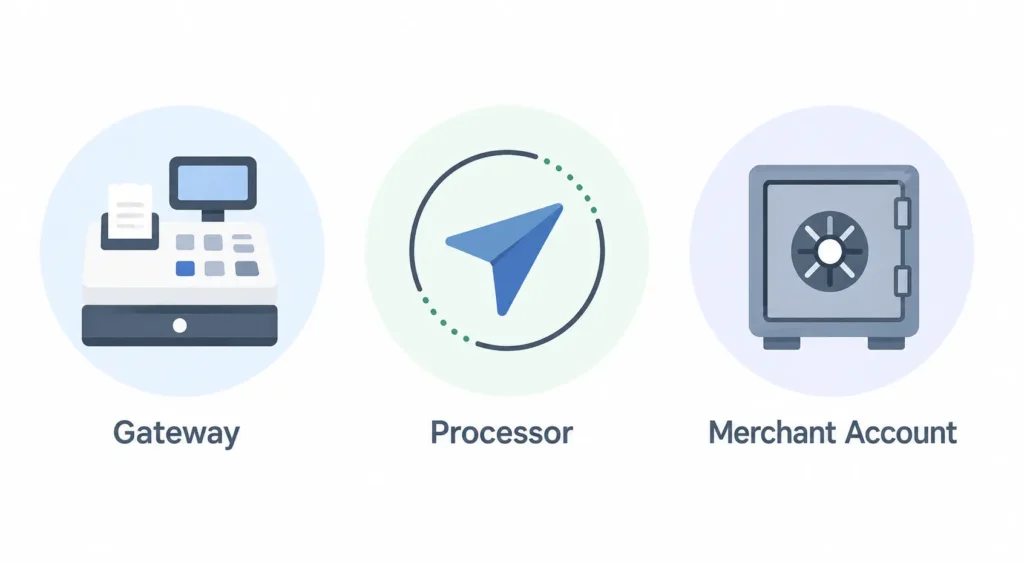
A payment gateway collects and protects the customer’s payment details at checkout. A payment processor sends that data to the right banks for approval and settlement. A merchant account is the actual bank account where the approved funds land. Many providers bundle all three into one service today.
| Role | What It Does | Simple Way to Think About It |
| Payment gateway | Collects and encrypts payment details at checkout | The digital cash register |
| Payment processor | Sends the payment data to the right banks and networks for approval | The messenger between banks |
| Merchant account | Holds the approved funds before they reach the business’s main bank account | The holding tank for money |
These three terms get mixed up a lot, and that is easy to understand. A payment gateway vs payment processor comparison often confuses new business owners because both tools work at almost the same moment in a sale. The gateway grabs the payment details. The processor moves them along. A merchant account vs payment processor mix-up happens for a similar reason: the account holds the money, while the processor moves it there. Many companies now offer all three in one package, so the lines blur even more.
How Does a Payment Processing System Actually Work?
A payment moves through several steps in just a few seconds. The customer enters their payment details, the gateway encrypts and sends the data, the processor and card network ask the issuing bank for approval, and the bank approves or declines the payment. Approved payments are grouped together and settled into the merchant’s account within one to three business days.
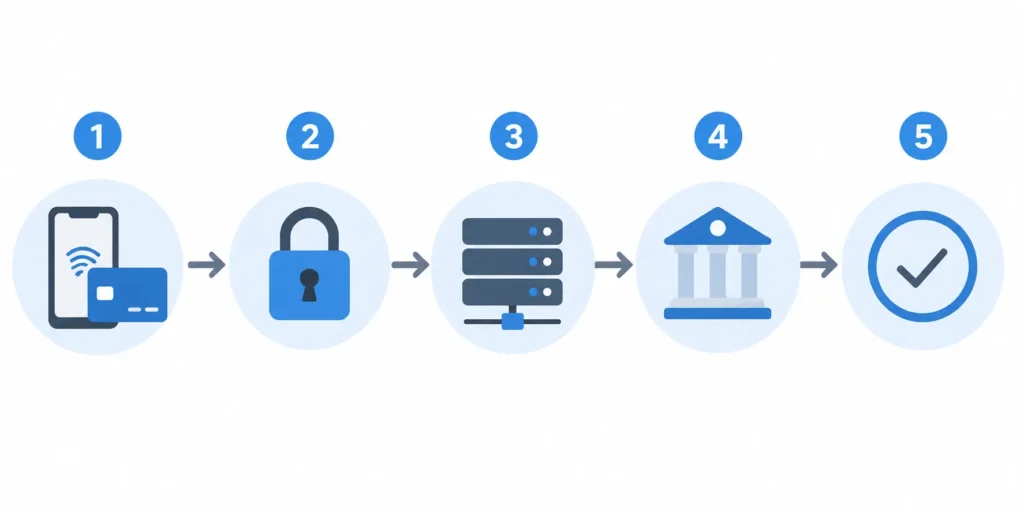
Here is the full path a single payment takes, from authorization to settlement:
- The customer starts the payment by swiping a card, tapping a phone, or typing card details into an online checkout page.
- The payment gateway collects the details and encrypts them so no one else can read the data as it travels.
- The payment processor receives the encrypted data and checks it for errors.
- The processor and card network send the transaction to the issuing bank and ask for approval.
- The issuing bank checks the customer’s account and either approves or declines the payment.
- The approval or decline message travels back through the same path, and the result shows up on the screen in two to three seconds.
- At the end of the day, the merchant’s approved transactions are grouped together in a batch and sent out for settlement.
- The acquiring bank receives the funds from the issuing bank through the card network and places the money into the merchant’s account, usually within one to three business days.
Most modern card readers also use EMV chip technology. This creates a unique code for every single purchase, which makes stolen card numbers much harder to reuse.
If a customer later disputes a charge, the issuing bank can pull the payment back. This is called a chargeback, and it can add extra fees on top of the lost sale, so businesses try to keep their chargeback rate as low as possible.
What Types of Payment Processing Systems Are There?
Payment processing systems generally fall into a few groups: card-based systems for credit and debit cards, ACH systems for direct bank transfers, digital wallets like PayPal, Apple Pay, and Google Pay, point-of-sale systems for in-person sales, and newer real-time payment systems that settle in seconds instead of days.
- Card-based processing: Handles credit and debit card payments through networks like Visa and Mastercard. This covers both a card tapped in a store and online payment processing on a website.
- ACH transfers: Move money directly between bank accounts. This method is often used for bills, payroll, and business-to-business payments, and it is managed in the United States by NACHA.
- Digital wallets: Apps such as PayPal, Apple Pay, and Google Pay that store card or bank details so people can pay without typing them in every time.
- Point-of-sale (POS) systems: Hardware and software used in stores and restaurants for in-person sales, usually built around a card reader or terminal.
- Real-time payment systems: Newer rails, including FedNow in the United States, that move money in seconds instead of days.
Digital Wallets Are Growing Fast
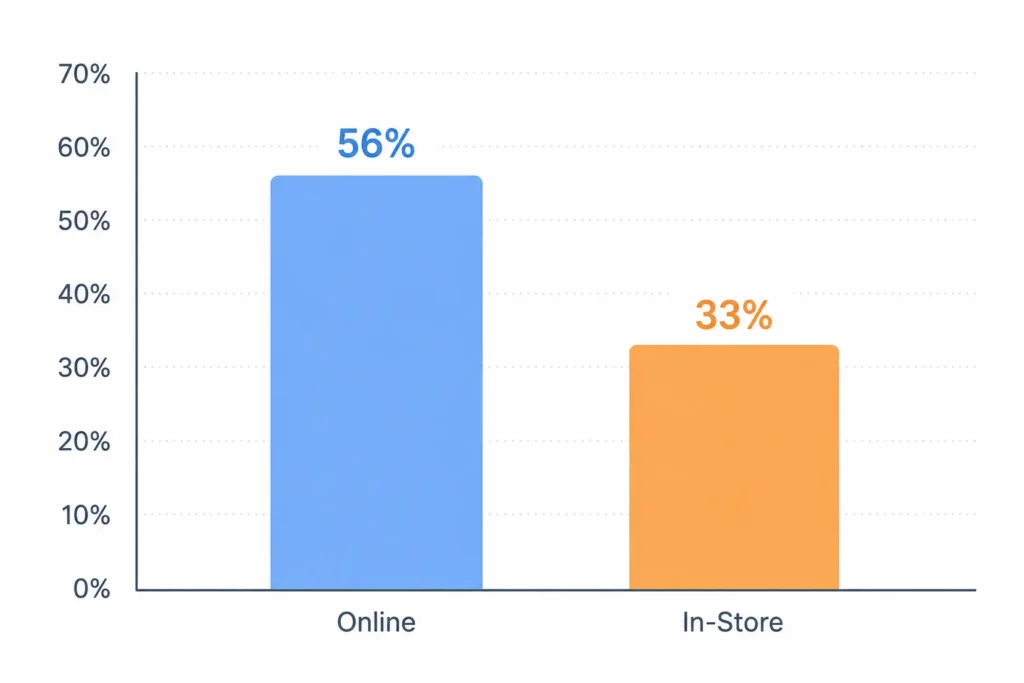
Digital wallets are becoming one of the biggest ways people pay for things. According to Worldpay’s 2026 Global Payments Report, digital wallets made up 56 percent of global online spending and 33 percent of in-store spending in 2026. In the United States, wallet use in stores is expected to grow to 26 percent of purchases by 2030, and online wallet use is expected to reach 44 percent of checkouts in the same time. This shift means a modern payment processing system needs to support more than just a card swipe.
What Do Payment Processing Systems Cost?
Most businesses pay somewhere between 1.5 percent and 3 percent of each sale in payment processing fees. The exact cost depends on the pricing model, the card type, and how the payment is made. Interchange fees set by the card networks usually make up most of that cost, not the processor’s own markup.
Payment processing fees can feel confusing, and there is a good reason for that. There are three common pricing models:
- Flat-rate pricing: One fixed percentage on every sale, no matter the card type. Simple, but often more costly for high-volume businesses.
- Interchange-plus pricing: The processor charges the real interchange fee plus a small, clear markup on top. This is often the fairest option for growing businesses.
- Tiered pricing: Transactions get sorted into pricing tiers based on risk. This model is harder to predict because you do not always know which tier a card will fall into.
Most of the cost in any of these models comes from interchange fees, which the card networks set and the acquiring bank pays to the issuing bank. According to Federal Reserve data, interchange fees make up 70 to 90 percent of the total cost of processing a card payment. In-person card payments usually cost between 1.8 and 2.6 percent plus a small flat fee, while online payments often run a bit higher, closer to 2.25 to 3 percent. Debit card fees are lower than credit card fees because of a rule called the Durbin Amendment, which caps debit fees for larger banks.
Payment processing fees are also the number one payment challenge reported by small businesses, according to a 2024 Federal Reserve survey. That same survey found that 38 percent of small firms collect payment at the time of service, which means processing costs hit their cash flow right away.
How Are Payment Processing Systems Kept Secure?
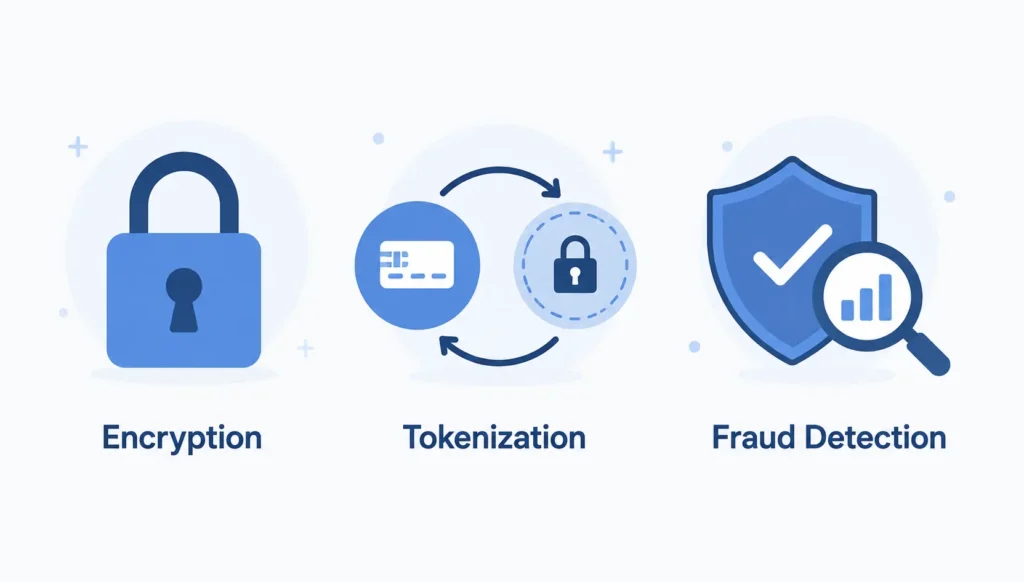
Payment processing systems protect customer data using encryption, tokenization, and fraud detection tools. They also follow a security rule called PCI DSS, set by the PCI Security Standards Council, or PCI SSC. Any business that stores, sends, or handles card data must follow PCI DSS, no matter its size.
A few tools work together to keep card data safe:
- Encryption: Scrambles payment data so it cannot be read while it travels between the customer, the gateway, and the banks.
- Tokenization: Replaces sensitive card numbers with a random code, called a token, so the real card number is never stored on the merchant’s system.
- Fraud detection: Software that watches for unusual patterns, like a card being used in two countries within minutes, and blocks the payment before it goes through. This works on the same basic idea as real-time threat detection used elsewhere in cybersecurity: catch the problem while it’s happening, not after.
Skipping PCI DSS can cost a lot. A business that does not follow the rules can get fined by its bank. These fines can run from 5,000 dollars to 100,000 dollars each month. A full data breach costs even more, often millions of dollars to fix. This can happen fast. In fact, a single vulnerability can turn into a full breach faster than most businesses expect.
PCI DSS compliance is not optional. Any business that stores, processes, or sends card data must follow it, even a small shop that only takes a few payments a month. The cost of skipping it can be steep. Businesses that fail to meet PCI DSS requirements can face fines from the acquiring bank ranging from 5,000 dollars to 100,000 dollars a month, and a full data breach can cost millions of dollars to clean up. The Federal Trade Commission, or FTC, also keeps watch on how payment companies market their fees and handle customer data.
How Do You Evaluate a Payment Processing System?
Choosing a payment processing system is not just about the lowest fee. A few questions can help you compare your options and figure out how to choose a payment processor that actually fits your business, not just the cheapest one on paper.
- Where do you sell? A business that sells only online needs a strong payment gateway. A business with a physical store needs a reliable point-of-sale system. Many businesses need both.
- Does it work with your other tools? Check if the system connects with your accounting software. Check if it connects with your online store too. It should also work with tools like workflow automation platforms you already use.
- Does the pricing model fit your sales volume? Flat-rate pricing is often easier for small, low-volume businesses. Interchange-plus pricing can save money once your sales grow.
- Is it secure and compliant? Make sure the provider follows PCI DSS and offers tools like encryption, tokenization, and fraud detection.
- How fast do you get paid? Some systems settle funds the next day. Others take two or three business days. This matters more for businesses that depend on steady cash flow.
- What kind of support do you get? Look for a provider with live support, not just email tickets, especially since a payment problem can stop you from taking sales altogether.
Taking time to answer these questions before signing up with a payment processing system can save a business real money and real headaches later.
Frequently Asked Questions
What is a payment processing system?
A payment processing system is the full group of tools and banks, including a payment gateway, a payment processor, an acquiring bank, a card network, and an issuing bank, that work together to move money from a customer to a business safely and quickly.
What is the difference between a payment processor and a payment gateway?
A payment gateway collects and protects payment details at checkout. A payment processor sends that data to the right banks for approval and settlement. Some companies offer both in one product, which is why people often use the terms as if they mean the same thing.
How much do payment processing systems cost?
Most businesses pay between 1.5 percent and 3 percent of each sale. The cost depends on the pricing model, the card type, and whether the sale happens online or in person. Interchange fees usually make up most of that cost.
How long does it take for a payment to settle?
Approval happens in just a few seconds, but settlement, when the money actually reaches the merchant’s bank account, usually takes one to three business days, depending on the payment method used.
Do I need to be PCI DSS compliant to accept payments?
Yes. Any business that stores, processes, or sends card data must follow PCI DSS rules, no matter its size or how many payments it handles each month. The current version is PCI DSS 4.0.1.
What are the main types of payment processing systems?
The main types are card-based processing, ACH transfers, digital wallets like PayPal and Apple Pay, point-of-sale systems for in-person sales, and newer real-time payment systems such as FedNow.
How do I choose the right payment processing system for my business?
Start by looking at where you sell, how well the system connects with your other tools, whether the pricing model fits your sales volume, and whether the provider follows PCI DSS security rules.
A Quick Recap
A payment processing system comes down to a few clear parts working together: a gateway, a processor, a few banks, and a set of security rules that keep everyone’s data safe. Once you know how each piece works, comparing your options gets a lot easier and a lot less confusing. If you found this breakdown useful, you can find more guides like it on the blog.