

By the Freemail Editorial Team | Last Updated: April 2026
The Freemail Editorial Team researches technology, digital privacy, and the future of work. Our analysis draws on primary studies from the World Economic Forum, EY, 4 Day Week Global, OpenAI, and Harvard Business Review to deliver clear and balanced insight for working professionals and business leaders.
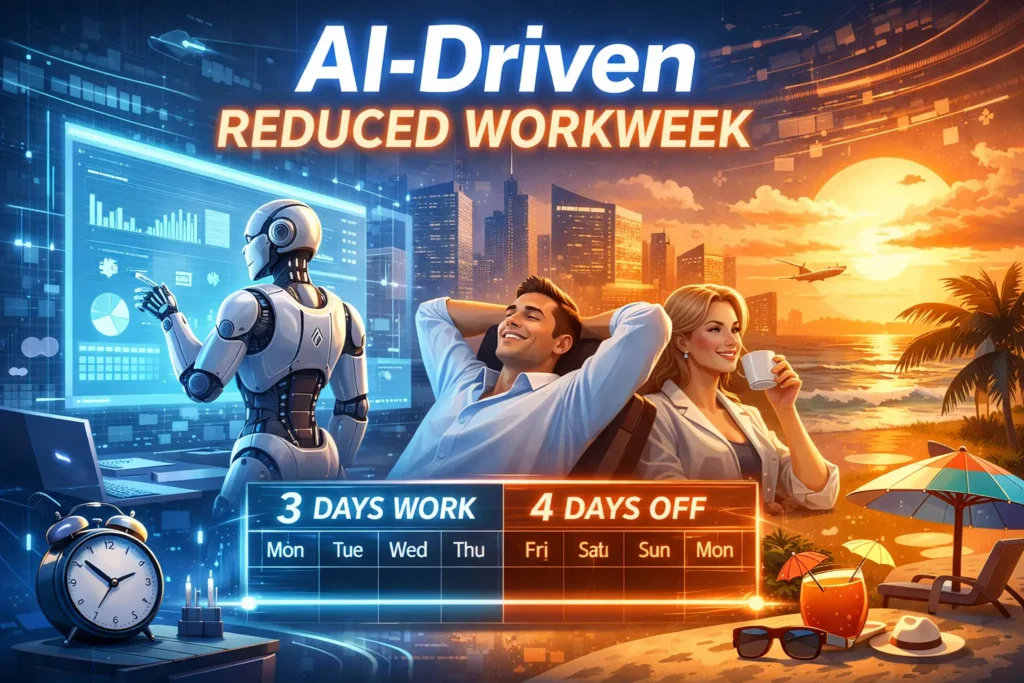
An AI-driven reduced workweek is a work model whre artificial intelligence automates routine tasks well enough to let employees maintain full output in fewer working hours, usually shifting from five days to four days at the same pay. Evidence from Microsoft Japan, 4 Day Week Global trials, and OpenAI’s 2026 proposal supports its potential. However, the gap between AI’s theoretical and actual time savings remains a real implementation challenge that requires deliberate organizational policy, not just AI adoption.
Introduction
In April 2026, OpenAI formally recommended that organizations test a four-day workweek without reducing salaries. At the same time, a separate survey from EY found that 64% of employees say their workloads have actually increased since they started using AI.
That contradiction sits at the heart of the AI-driven reduced workweek conversation.
The concept has moved from a niche experiment to a mainstream policy discussion. AI automation reduced working hours is now something executives, HR teams, policymakers, and workers are all talking about. But what does it actually mean? Does it work? And what stands between the idea and real practice?
This article answers all of those questions honestly, with real data and a clear implementation model you can use.
What Is an AI-Driven Reduced Workweek?
An AI-driven reduced workweek is a work arrangement where artificial intelligence automates enough routine and repetitive tasks to allow employees to complete their full workload in fewer hours. The most common model shifts employees from a five-day, 40-hour week to a four-day, 32-hour week while keeping their pay exactly the same. The key point is that the time savings come from AI-powered workflows, not from cutting employee output or compensation.
It is important to separate this from a simple compressed schedule.For organizations exploring shorter working schedules, these four-day workweek statistics provide useful context on adoption, employee outcomes, and the broader shift toward reduced workweeks. A compressed workweek means working the same 40 hours across four longer days. An AI-enabled shorter workweek means genuinely working fewer hours because AI has absorbed the tasks that used to fill those hours.
The core idea is straightforward. When AI handles low-value cognitive work, employees recover time. Organizations can then choose to redirect those recovered hours into higher-value work or compress the total working schedule. An AI-driven reduced workweek happens when organizations choose the second option and back it with policy.
Simple definition: AI does the repetitive work. Employees get the saved time back in the form of a shorter week, not more tasks.
This connects directly to broader questions about AI transformation in the workplace, where the technology is ready but the organizational structures to use it well are still catching up.
How Does AI Actually Enable a Shorter Workweek?
AI enables a shorter workweek by taking over the tasks that consume large amounts of time without producing proportional value. When AI-powered workflows handle these tasks automatically, employees recover hours they can use to compress their working schedule rather than simply fill with more work. The mechanism is task substitution, not magic. AI replaces specific categories of human cognitive work, and those categories add up to significant weekly time savings.
Where Does the Time Actually Come From?
Workers who use AI tools across the following task categories see the largest time savings:
- Email management: AI drafts, sorts, and summarizes emails, cutting inbox time by 30 to 50% for heavy email users
- Meeting scheduling and preparation: AI tools automate calendar coordination and generate pre-meeting briefings automatically
- Data entry and processing: Workforce automation tools handle form filling, data validation, and spreadsheet population
- Report drafting: AI generates first drafts of weekly reports, performance summaries, and client updates
- Research summarization: AI condenses long documents, competitor reports, and industry updates into brief summaries
- Routine customer communications: AI-powered workflows handle standard query responses and ticket routing
- Meeting notes and follow-ups: AI transcription and summary tools replace manual note-taking in real time
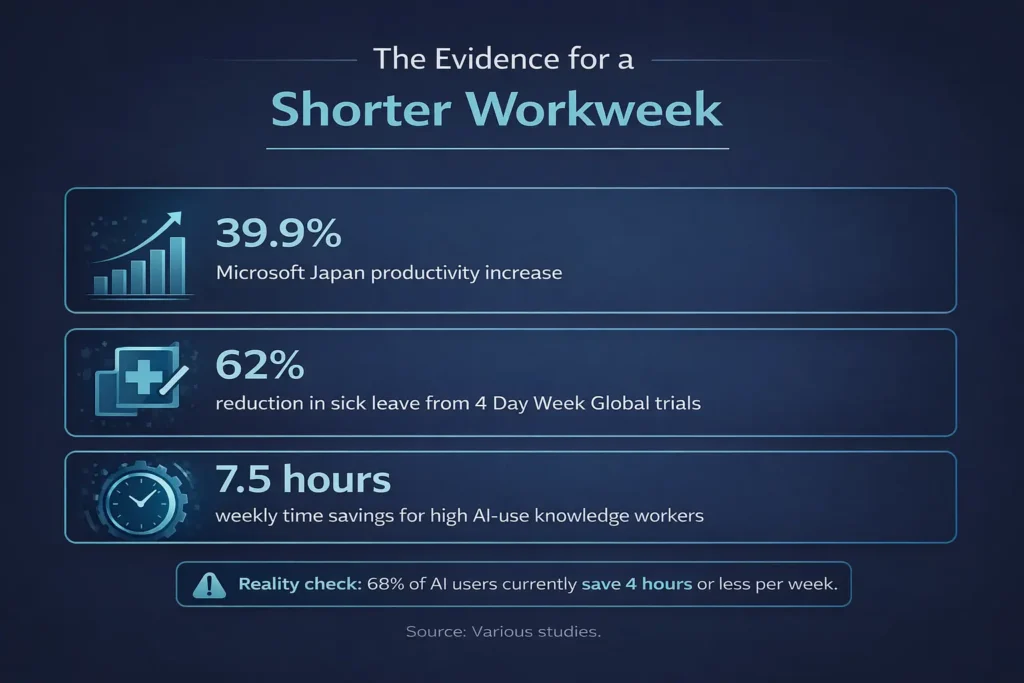
Currently, AI tools save workers an average of 2 to 3 hours per week across these categories, with knowledge workers in intensive AI-use environments saving up to 7.5 hours per week. Automation broadly saves an average of 3.6 hours per worker weekly at the global level. Meeting notes tools alone account for a meaningful chunk of that savings, which is why so many teams compare the best read AI alternatives before settling on one for their workflow.
Those hours are the foundation of the AI-driven reduced workweek. The question is whether organizations choose to give that time back to workers or simply use it to raise output expectations.
What Does the Evidence Say? Real Results from Real Organizations
The case for an AI-enabled shorter workweek is not just theoretical. Real organizations have run real trials and published real results.
The Microsoft Japan Experiment
In 2019, Microsoft Japan closed its offices every Friday for one full month as part of its Work Life Choice Challenge. The results were striking. Productivity increased by 39.9%. Electricity use fell by 23.1%. Printed pages dropped by 58.7%. Meetings became shorter and more focused. Workers reported higher satisfaction, and the company reported higher output per hour worked.
Microsoft Japan did not use advanced AI automation for this trial. The results came primarily from structural changes to how meetings were run and how communication happened. The implication is clear: when knowledge workers are given fewer hours, they often produce the same or more output because they eliminate low-value activities rather than simply doing less.
4 Day Week Global Trial Results
4 Day Week Global has run multi-industry trials spanning healthcare, finance, retail, and professional services. The results across participating organizations show:
| Metric | Result |
|---|---|
| Reduction in sick leave | 62% |
| Reduction in employee burnout | 17% |
| Improvement in mental health | 17% |
| Improvement in work-life balance | 35% |
| Companies reporting maintained or improved revenue | 92% |
These results held across different industries and different sizes of organization. The four-day model is not a tech-company luxury.
The Reality Check: What AI Actually Saves Today
| Study | Sample | Time Saved per Week |
|---|---|---|
| klu.so AI Productivity Report 2025 | Knowledge workers | 2 to 3 hours average |
| LSE and Inc. Research | High-adoption AI users | Up to 7.5 hours |
| EMarketer Survey 2026 | UK and North America workers | 68% save 4 hours or less |
| Global automation average | Workforce-wide | 3.6 hours |
The potential exists. Whether organizations capture that potential depends on how deliberately they deploy and govern AI tools.
What Are the Benefits of an AI-Driven Reduced Workweek?
Beyond the trial data, the benefits of a well-implemented AI-driven reduced workweek fall into three clear categories.
Benefits for employees:
- Employee burnout prevention: Shorter weeks with maintained pay consistently reduce reported burnout rates. The 4 Day Week Global data shows a 17% reduction. Workers with more recovery time return to work with more focus and less fatigue.
- Work-life balance improvement: A 35% improvement in work-life balance was reported across 4 Day Week Global trial participants. Employees report more time for family, health, exercise, and personal commitments.
- Mental health gains: Reduced cognitive load across the working week directly improves mental health outcomes. Workers who are not always on are measurably healthier over time.
Benefits for organizations:
- Talent attraction and retention: Flexible work arrangements are now among the top factors workers consider when choosing employers. Organizations offering a genuine four-day model gain a significant recruiting advantage.
- Reduced absenteeism: The 62% reduction in sick leave from 4 Day Week Global trials translates directly into cost savings and operational continuity.
- Higher output per hour: Workers who use AI tools are 90% more likely to report high productivity. The most productive workers globally are 242% more likely to be using AI as part of their regular workflow.
Benefits for productivity:
- Focused deep work: Fewer total hours naturally forces organizations to cut low-value meetings and unnecessary tasks. The quality of the remaining work typically improves.
- Output-based performance culture: Shifting from presence-based to output-based performance measurement is a fundamental organizational improvement that benefits management and employees alike.
53% of executives project that AI and automation will deliver a 10 to 30% productivity boost over the next three years. An AI-driven reduced workweek is one structured way to convert that productivity gain into a tangible employee benefit.
Does AI Actually Reduce Work Hours, or Does It Create More Work?
AI does not automatically reduce working hours. In many organizations, AI has intensified work rather than reducing it. The technology creates the potential for a shorter workweek, but that potential only becomes reality when organizational leaders make a deliberate policy decision to give the recovered time back to workers. Without that decision, AI simply raises output expectations.
This is the honest part of the conversation that most articles skip.
Harvard Business Review published research in February 2026 showing that AI does not reduce work. It intensifies it. When AI makes workers more capable, many organizations respond by raising targets, expanding scope, and adding new responsibilities rather than reducing hours.
The EY Work Reimagined Survey 2025 reinforces this. Despite 88% of employees using AI at work, 64% report that their workloads have increased over the past year. Most employees are using AI only for basic tasks like search and summarization. Only 5% are using AI at a level that genuinely transforms their work capacity.
The gap in practice:
- AI potential: Save 7.5 hours per week per knowledge worker
- AI reality: 68% of AI-using employees save 4 hours or less per week
- Reason for the gap: Most organizations redirect AI gains into higher output, not shorter hours
What this means for organizations:
- An AI-driven reduced workweek does not happen automatically when you give employees AI tools
- It requires a leadership decision to measure output rather than hours
- It requires a policy commitment to reduce scheduled hours when AI time savings are confirmed
- It requires the same kind of governance thinking that applies to AI transformation challenges more broadly
The technology is ready. The organizational will is the variable.
The WORKDAY Framework: How to Implement an AI-Driven Reduced Workweek
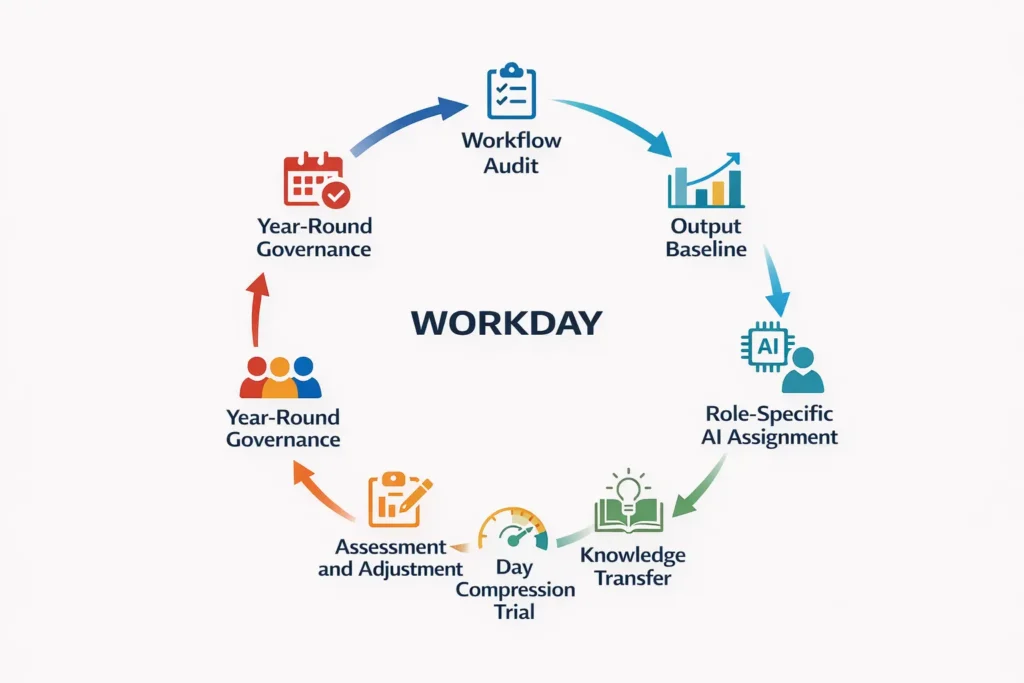
No competitor article offers a structured implementation model. The WORKDAY Framework is a seven-step process any organization can follow to move from concept to operational AI-enabled shorter workweek.
WORKDAY stands for: Workflow Audit, Output Baseline, Role-Specific AI Assignment, Knowledge Transfer, Day Compression Trial, Assessment and Adjustment, Year-Round Governance.
W: Workflow Audit
Map every recurring task across every role by time consumption and AI-automability. Identify which tasks take the most time and which are most suitable for AI-powered workflows to absorb. This audit creates the foundation for realistic time savings estimates.
O: Output Baseline
Before reducing hours, define clear output benchmarks for each role. Document what full productivity looks like at 40 hours. This baseline makes it possible to confirm later that 32 hours is genuinely producing equivalent results.
R: Role-Specific AI Assignment
Match AI tools to specific task categories for each role. Do not deploy one AI tool across all teams. Knowledge worker productivity improves most when AI tools are matched precisely to the highest time-cost tasks in each role. Human-AI collaboration works best when the assignment is deliberate.
K: Knowledge Transfer
Train employees on AI tools with structured learning time built into the workday. 88% of employees currently use AI only for basic tasks because they were never trained to use it at a higher level. Workforce automation only reaches its potential when employees know how to use it well.
D: Day Compression Trial
Run a 90-day pilot with one team before organization-wide rollout. Measure output, wellbeing, and efficiency metrics weekly. OpenAI specifically recommends phased pilot programs as the correct approach. Do not commit the whole organization before confirming the model works in your specific context.
A: Assessment and Adjustment
At the end of the pilot, measure output against the baseline established in step two. Measure employee wellbeing, sick leave rates, and reported satisfaction. Adjust the model based on what the data shows before scaling.
Y: Year-Round Governance
Establish ongoing monitoring and organizational accountability for AI and human workflow standards. Assign a governance owner for the reduced workweek program. Schedule quarterly reviews. AI capabilities change rapidly, and the time savings available will grow. Year-round governance ensures the organization captures that growth and continues adjusting the program accordingly.
What Is the Future of the AI-Driven Reduced Workweek?
The AI-driven reduced workweek is moving from experiment to policy discussion in 2026. OpenAI formally recommended a four-day workweek without salary reductions in April 2026, proposing that governments offer incentives to employers who implement it and that AI productivity gains be shared directly with workers. Meanwhile, 22% of employers have already implemented a four-day model, and 51% of HR leaders globally are actively considering it.
Several experts now predict that the 4-day week is an intermediate step. As AI automation deepens and autonomous AI agents take on more complex tasks, some researchers project that a 3-day or 3.5-day week becomes technically achievable for knowledge workers within a decade.
The Washington Post profiled multiple companies in December 2025 that had already made the switch using AI tools as the enabling infrastructure. These companies span professional services, retail, and financial services, showing that the model is not limited to tech companies.
The biggest variable is not technology. It is organizational will and workforce automation governance. Countries like Japan and Iceland have already piloted national-level shorter workweek programs. Legislative proposals in several European countries would require employers to offer four-day schedules on request by 2027.
The AI-driven reduced workweek is no longer a question of if. For many organizations, it is becoming a question of when and how.
Real Case Example: When an AI-Driven Workweek Goes Wrong Without Governance
The following example reflects patterns documented across multiple organizations in published governance and workforce automation research.
A mid-size professional services firm introduced AI tools to its operations team in early 2025 with the goal of enabling a four-day workweek within six months. The tools were deployed quickly. No workflow audit was completed. No output baseline was established. No role-specific AI assignment plan was created. No training program was built.
Within three months, the team was using AI to generate more client reports, not to work fewer hours. Output expectations had quietly risen because leadership saw that AI made the team faster. Employees were working the same five days but producing 30% more volume with no corresponding benefit to their schedules or wellbeing.
Six months in, employee satisfaction had fallen. Three senior team members resigned. The firm had achieved significant efficiency gains for the organization, but none of those gains had translated into the shorter workweek that had been the original goal.
The AI worked perfectly. The governance did not. Without the WORKDAY Framework or any equivalent structure, the technology created efficiency that benefited the organization exclusively rather than being shared with employees as reduced working time.
This pattern is exactly what the EY Work Reimagined Survey 2025 documented at scale. AI creates the potential. Organizations determine whether employees receive any of that potential back.
Building an AI-Driven Reduced Workweek That Actually Works
The AI-driven reduced workweek is real. The evidence is strong. The technology exists. The organizations that have committed to it fully are seeing genuine benefits in employee wellbeing, organizational efficiency, and talent retention.
But the evidence is equally clear that AI adoption alone does not create a shorter workweek. 64% of workers report increased workloads since adopting AI. 88% use AI only for basic tasks. The gap between potential and reality is not a technology gap. It is a governance and leadership gap.
The WORKDAY Framework gives any organization a clear path from concept to practice: audit workflows, baseline output, assign AI tools by role, train employees properly, run a 90-day trial, measure results honestly, and govern the program continuously. That structure is the difference between AI transformation that benefits employees and AI adoption that only benefits the organization.
As AI reshapes how and when we work, managing your digital communications more efficiently matters too. Every hour AI saves is an hour worth protecting. Try freemail.ai for a free, private temporary email solution that keeps your digital workflow clean and secure, wherever your workweek takes you.