

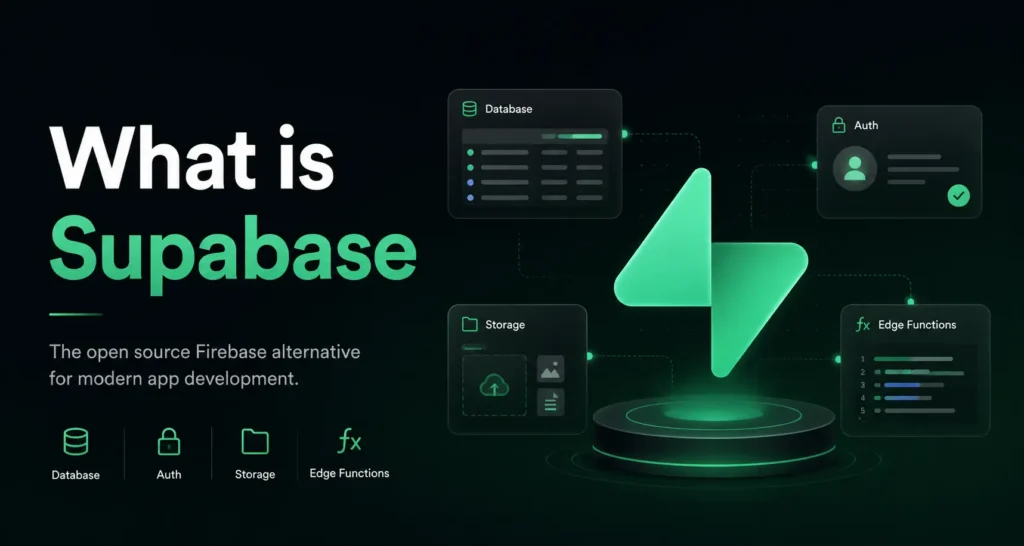
Supabase is an open-source backend-as-a-service (BaaS) platform built on PostgreSQL. It gives developers a managed database, user authentication, file storage, serverless functions, and real-time capabilities in one place. It is widely described as the open-source alternative to Google Firebase. A free tier is available, with paid plans starting at $25 per month for growing projects.
Building a backend used to mean setting up a database on one service, wiring up authentication on another, managing file storage somewhere else, and then writing custom APIs to connect all of it. That process took weeks even for experienced developers.
Supabase changes all of that.
Instead of stitching together five different tools, Supabase packages everything a backend needs into a single, easy-to-use developer platform. You sign up, create a project, and your database, auth system, storage bucket, and APIs are ready to use within minutes.
This guide explains exactly what Supabase is, what it does, who it is for, and how it compares to Firebase. No coding experience needed to follow along.
What Is Supabase?
Supabase is an open-source backend-as-a-service platform built on top of PostgreSQL. It was founded by Paul Copplestone and Ant Wilson, and the company has raised nearly $200 million in venture capital from investors including Accel, Craft Ventures, and Peak XV Partners.
In simple terms, Supabase is a developer platform. It gives you a full backend without forcing you to build or manage one from scratch. Everything you need to store data, handle user logins, save files, and run server-side logic is included out of the box.
Supabase is also frequently called the open-source alternative to Google Firebase. Both tools solve the same problem: giving developers a ready-made backend. But they take very different approaches under the hood, which we will cover later in this guide.
By 2025, Supabase had grown to $70 million in annual recurring revenue, up from $30 million at the end of 2024. That is a 132 percent increase in a single year. The company was valued at $2 billion in early 2025 and was reportedly seeking a new funding round at a $10 billion valuation by mid-2026.
What Does Supabase Do?
Supabase acts as your entire backend infrastructure. Think of it as a control panel for your app’s behind-the-scenes system.
Here is what a developer would normally need to set up separately, versus what Supabase handles for them automatically:
- User accounts and logins: Supabase handles authentication so users can sign in with email, Google, GitHub, or magic links
- Data storage: Your app’s data lives in a managed PostgreSQL database with a visual table editor
- File storage: Images, videos, and documents are stored in an S3-compatible bucket
- APIs: REST and GraphQL APIs are auto-generated the moment you create a database table
- Server-side logic: Edge Functions let you run custom backend code without managing servers
- Live data: Realtime subscriptions push database changes to your app the instant they happen
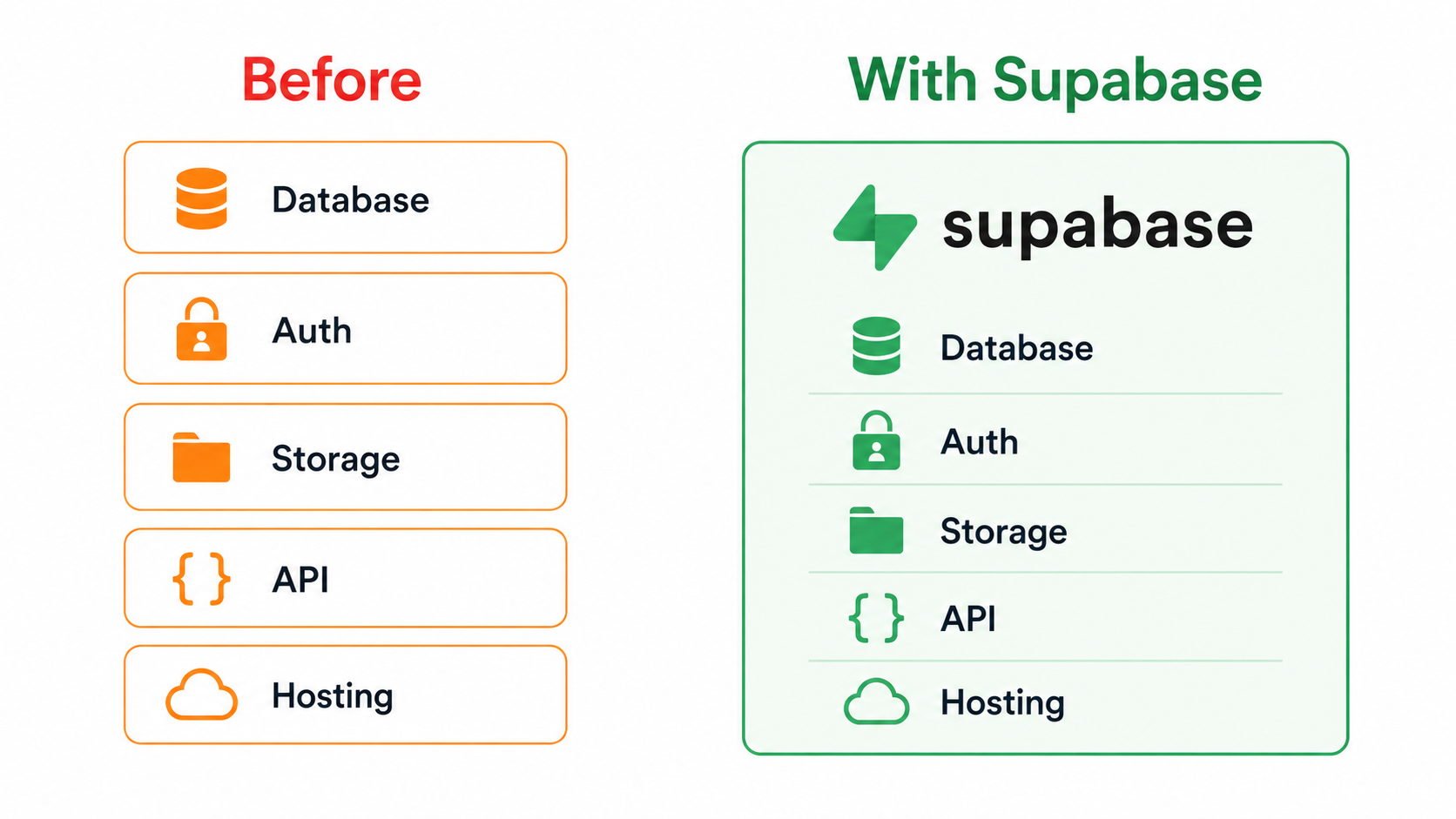
For a startup team or solo developer, this means you can go from idea to working prototype in a fraction of the time it would take using traditional infrastructure.
What Are the Core Features of Supabase?
Supabase is built on several open-source technologies, primarily PostgreSQL, PostgREST, and GoTrue, all unified inside a single dashboard and client SDK.
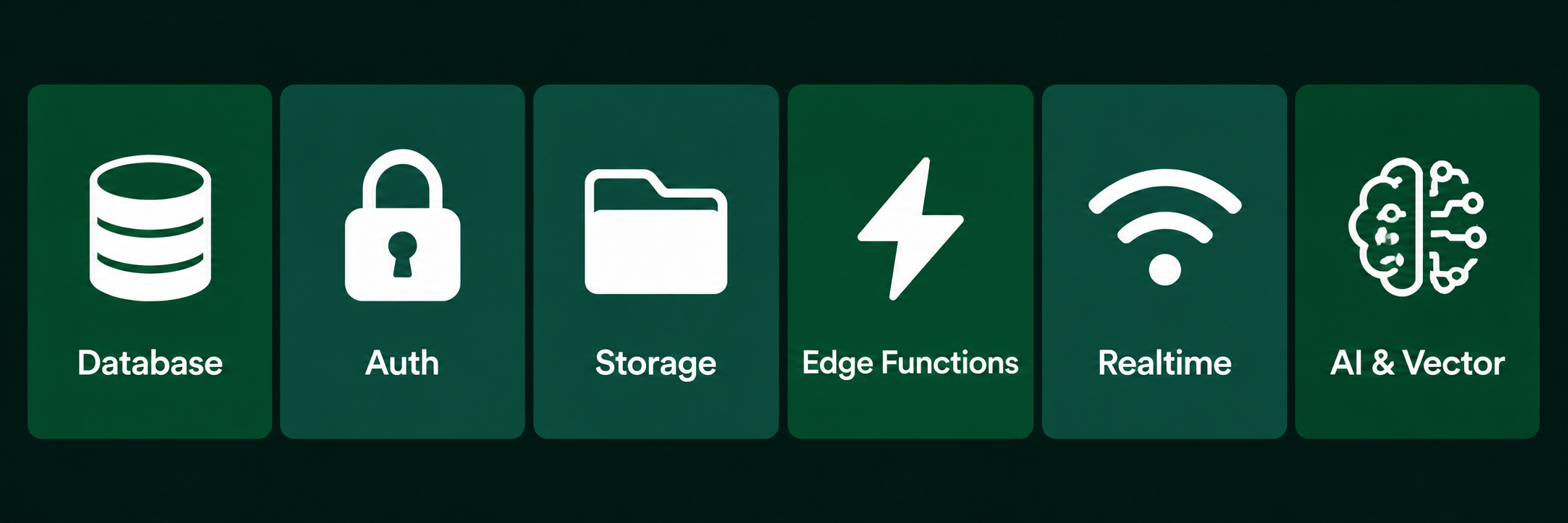
Database and Auto-Generated APIs
The heart of Supabase is a fully managed PostgreSQL database. PostgreSQL is one of the most powerful and widely trusted open-source relational databases in the world. When you create a table in Supabase, it instantly generates a REST API and a GraphQL API for that table. You do not need to write any API code yourself. Row-Level Security (RLS) lets you control exactly who can read or write each row of data.
In 2025, Supabase introduced a new API key architecture and enabled RLS by default on all new projects. They also launched a Security Advisor tool to help developers identify and fix common security gaps.
Authentication
Supabase includes a full authentication system powered by GoTrue. It supports email and password login, OAuth providers like Google and GitHub, magic links, phone number sign-in, and enterprise SSO. Setting up user authentication takes minutes and requires very little code.
Storage
Supabase Storage is an S3-compatible file storage system. You can store and serve images, videos, documents, and any other files your app needs. Access controls are tied directly to your database permissions, so the same Row-Level Security rules apply to file access as well.
Edge Functions and Realtime
Edge Functions are serverless functions that run close to your users around the world. They handle custom backend logic like sending emails, processing payments, or calling third-party APIs. Realtime subscriptions use WebSockets to push live database updates directly to connected clients, which is useful for chat apps, dashboards, and collaborative tools.
AI and Vector Search
Starting in 2024 and expanding through 2025, Supabase added strong support for pgvector, a PostgreSQL extension that stores and searches vector embeddings. This makes Supabase a popular backend choice for AI-powered apps that need semantic search, recommendation engines, or retrieval-augmented generation (RAG) pipelines.
Is Supabase Open Source?
Yes. Supabase is fully open source. The entire codebase is publicly available on GitHub, and the company actively maintains it with contributions from a global developer community.
This matters for a few important reasons. First, you can inspect the code and verify exactly how your data is handled. Second, you are not locked into Supabase’s paid hosting. If you ever want to move your infrastructure, you can self-host the entire Supabase stack on your own servers. Third, your data stays in a standard PostgreSQL format, which means you can export and migrate it using standard tools like pg_dump at any time.
Most competing BaaS platforms are fully proprietary. If they shut down or raise prices, you have limited options. With Supabase, the open-source nature of the platform gives you a genuine exit path.
How Does Supabase Compare to Firebase?
Supabase and Firebase both solve the backend-complexity problem, but they are built on fundamentally different foundations.
Firebase is owned by Google and uses Firestore, a NoSQL document-based database that stores data as JSON-like documents. It is proprietary and fully managed by Google. Supabase uses PostgreSQL, a relational database that stores structured data in rows and columns with full SQL support. It is open source and can be self-hosted.
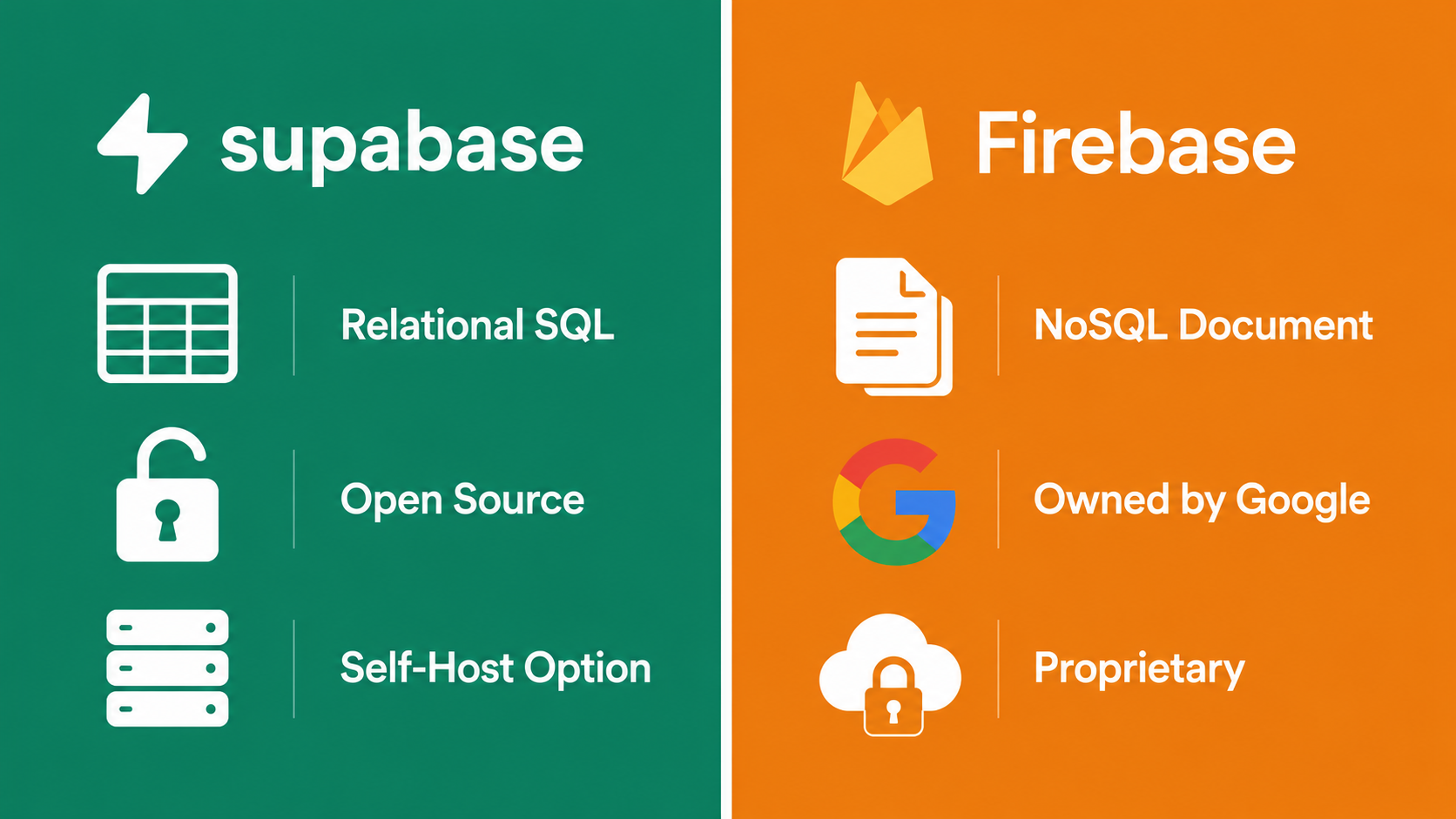
Here is a quick side-by-side look at the key differences:
| Feature | Supabase | Firebase |
| Database type | PostgreSQL (relational, SQL) | Firestore (NoSQL, document) |
| Open source | Yes | No |
| Self-hosting | Yes | No |
| Best for | Structured data, SaaS, complex queries | Mobile-first, real-time, document data |
| Pricing model | Flat monthly plans | Pay-as-you-go, can scale unexpectedly |
Neither platform is universally better. Firebase suits mobile-first, real-time, document-oriented applications like chat apps or mobile games. Supabase suits SaaS products, e-commerce backends, and any app that benefits from relational data and complex SQL queries.
Who Should Use Supabase?
Supabase works well for a wide range of people building web or mobile applications:
- Solo developers and indie hackers: Get a full backend running fast without DevOps knowledge
- Startup teams: Skip months of backend infrastructure work and focus on product
- Students and bootcamp graduates: Learn real-world backend development with a visual dashboard
- Developers migrating from Firebase: Especially those who need relational data or more predictable pricing
- AI app builders: Developers using pgvector for semantic search and embedding storage
If you are comfortable with SQL or are learning it, Supabase will feel very natural. Even if you are not, the visual table editor in the Supabase dashboard lets you manage your data without writing a single SQL statement.
How Much Does Supabase Cost?
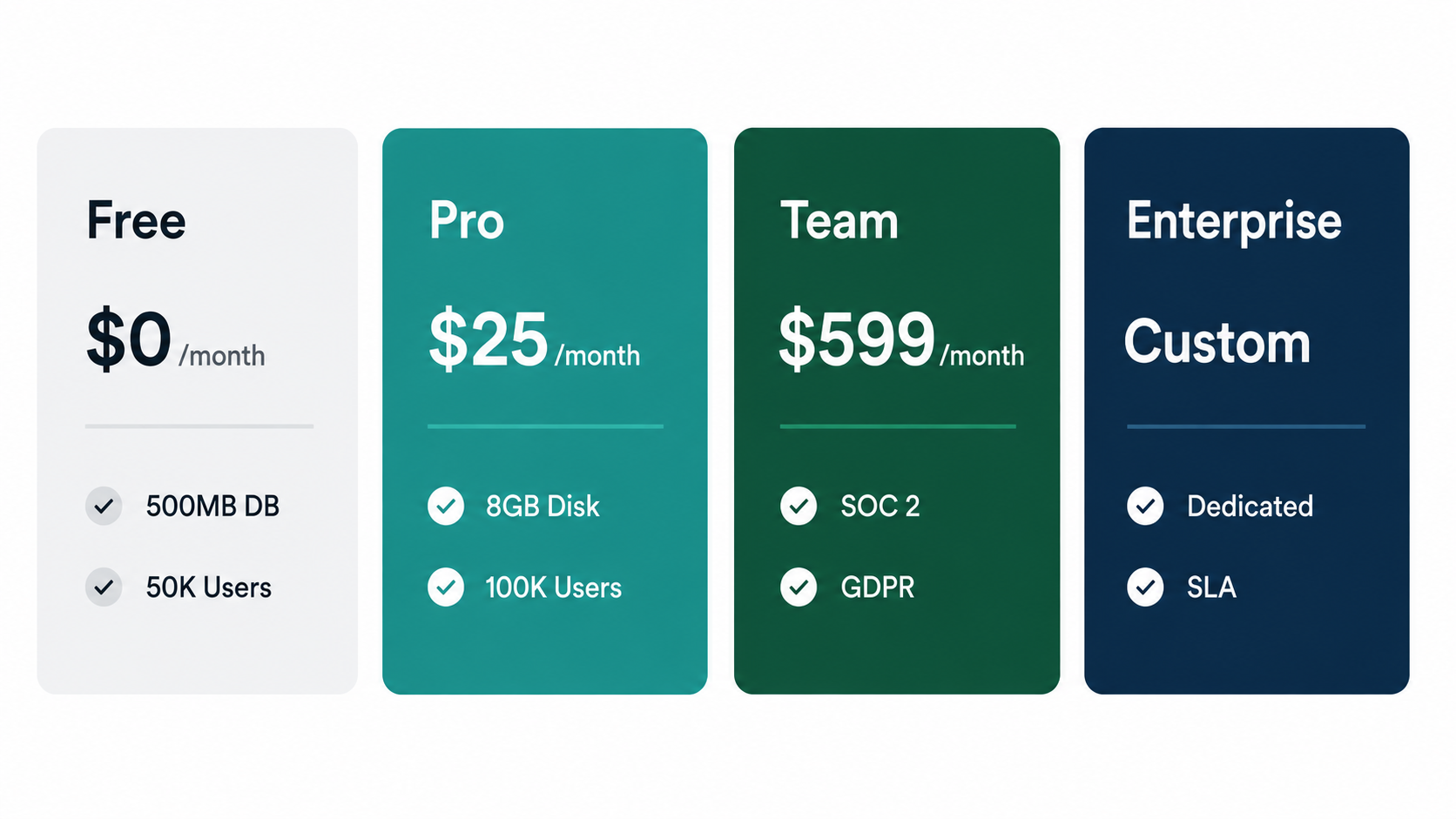
Supabase offers four pricing tiers. Here is a simple breakdown:
| Plan | Price | Best For |
| Free | $0/month | Side projects, prototypes, learning |
| Pro | $25/month per project | Growing production apps |
| Team | $599/month | Teams needing compliance (SOC 2, GDPR) |
| Enterprise | Custom | Large-scale, dedicated infrastructure |
The free tier includes 500MB of database storage, 1GB of file storage, unlimited API requests, and up to 50,000 monthly active users. For most prototypes and side projects, the free plan is more than enough.
The Pro plan at $25 per month adds 8GB of disk space, 100,000 monthly active users, 250GB bandwidth, and daily backups. It also includes $10 in compute credits to offset usage costs.
What Can You Build With a Supabase?
Supabase is versatile enough to power a wide variety of application types. Developers use it to build:
- SaaS products: Multi-tenant apps with user accounts, billing, and complex data relationships
- E-commerce backends: Product catalogs, order management, and customer authentication
- Internal dashboards: Admin tools, analytics views, and reporting systems
- Mobile apps: Authentication, data sync, and file storage for iOS and Android apps
- AI-powered tools: Semantic search, recommendation engines, and RAG pipelines using pgvector
- Collaborative apps: Real-time editing tools, chat systems, and live notification systems using Realtime subscriptions
- Content management systems: Blog platforms, media sites, and document editors with structured data needs
Because Supabase is built on PostgreSQL, it can handle complex data relationships and large query volumes that would be difficult or impossible to model in a NoSQL system.
Final Thoughts
Supabase has grown from a developer-friendly experiment into one of the most trusted backend platforms in the market. Its $70 million ARR in 2025 and a potential $10 billion valuation in 2026 reflect how quickly the developer community has embraced it.
What makes Supabase stand out is not just the feature set. It is the combination of openness, flexibility, and ease of use. You get enterprise-grade PostgreSQL infrastructure with the simplicity of a visual dashboard. You keep full control of your data. And you have a genuine path to self-hosting if you ever need it.
Whether you are a student building your first app, a startup trying to move fast, or an experienced developer who wants reliable relational infrastructure without the DevOps overhead, Supabase is worth exploring.
Ready to figure out if the pricing fits your project? Check out the full breakdown of every Supabase plan, free tier limits, and what you actually pay at scale in our complete Supabase pricing guide.