


Emergent AI (emergent.sh) is a vibe coding platform that turns plain-language descriptions into full-stack web and mobile applications using a multi-agent AI system. It requires no coding experience and covers backend, database, authentication, and deployment. Pricing starts free with 10 credits and scales to $20 per month on Standard or $200 per month on Pro. The platform works best for prototyping and MVPs. Complex or regulated applications need extra human review. Credit costs can be unpredictable.
Emergent AI hit $100 million in annual revenue within eight months of its launch. Over six million people have used it to build apps in more than 190 countries. Those are hard numbers to ignore for a platform that barely existed in 2025.
But fast growth does not automatically mean a tool is right for you. Plenty of platforms grow quickly and still frustrate their users. This Emergent AI review gives you a straight answer. You will learn what Emergent is, how it works, what it truly costs, the honest pros and cons, how it stacks up against alternatives like Lovable and Replit, and how to try it for free without filling your inbox with spam.
What Is Emergent AI?
Emergent AI is a full-stack AI app builder. It turns natural language descriptions into working web and mobile applications. You type what you want to build. The platform builds it. No coding experience is required.
The company is officially called Emergent Labs Inc. It was founded in 2024 by brothers Madhav Jha and Mukund Jha. Madhav holds a PhD in Theoretical Computer Science and was a founding member of the team that built Amazon SageMaker. Mukund leads the company as CEO. They are headquartered in San Francisco, with most of their roughly 75 employees based in Bengaluru, India.
Emergent went through Y Combinator’s W25 batch and has since raised $230 million in total funding. Investors include Khosla Ventures (led by Vinod Khosla), SoftBank Vision Fund 2, Lightspeed, Prosus, and Google’s AI Futures Fund. In July 2026, the company closed a $130 million Series C round at a $1.5 billion valuation, making it an official unicorn.
The platform sits inside a growing category called vibe coding. Researcher Andrej Karpathy coined the term in early 2025. It describes a way of building software where you describe what you want and let AI do the actual writing. Emergent Labs is one of the most visible vibe coding platforms today.
What separates Emergent from template-based no-code platforms like Bubble or Webflow? Emergent generates real, exportable code. You are not locked into a visual editor that only works on that platform. You own the code. You can sync it to GitHub and move it anywhere.
The vibe coding market is currently valued at $4.7 billion and is projected to reach $12.3 billion by 2027, based on data from Second Talent Research. Gartner projects that 60% of all new code will be AI-generated by the end of 2026. A Stack Overflow survey found that 92% of US developers now use AI coding tools every day. Emergent is riding that wave directly.
How Does Emergent AI Work?
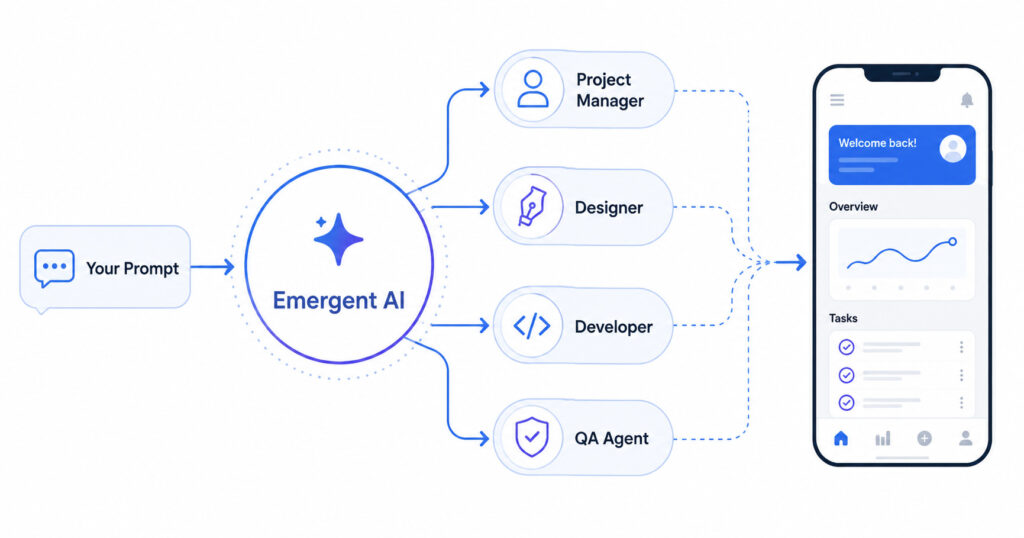
You open a chat interface and describe the app you want to build. Emergent’s AI agents take over from there. They plan the app, design it, write the code, test it, and deploy it, all inside the same platform.
Here is the basic build process:
- Describe your app. Type what you want in plain language. You can also upload a PDF, a UI screenshot, or attach a GitHub repo.
- Agents begin building. A team of AI agents gets to work at the same time. One acts as a project manager. Another handles design. Others manage the backend code and quality testing.
- See a live preview. A window shows your app updating in real time as the agents write the code.
- Refine with more prompts. Type follow-up instructions like “add a login page” or “make the dashboard show only this week’s orders.” Each instruction is read and applied.
- Deploy. Click to publish. The app goes live directly from Emergent.
If the AI breaks something while fixing a bug, you can describe the problem in plain language. For example, you type “the submit button does not work” and the AI agent tries to fix it. There is also an online version of VS Code built into the platform so developers can edit the code directly.
This multi-agent architecture is what Emergent calls its core strength. Rather than one AI writing everything, a team of specialized AI agents collaborates on your project. Emergent says this is closer to how a real software development team works.
What Tech Stack Does Emergent Generate?
A typical Emergent-built app uses a React or Next.js frontend, a Node.js or FastAPI backend, and MongoDB for the database. The code syncs to GitHub, and you can pull it into your own tools at any time. This means the output is real, standard code, not a proprietary format that traps you on one platform.
What Can You Build with Emergent AI?
Emergent covers a wide range of project types. The most common ones include:
- SaaS tools and web apps: Custom business software, portals, and dashboards
- Mobile apps: iOS and Android apps built with Expo and React Native
- CRMs and ERPs: Customer tracking, lead management, and operations tools
- E-commerce stores: Product listings, carts, and checkout flows
- Internal business tools: Apps that replace spreadsheets, email threads, or paper forms
- Landing pages: Simple marketing or product pages
About 80% to 90% of new Emergent projects are mobile-focused, according to CEO Mukund Jha in a TechCrunch interview from February 2026. Around 40% of users are small businesses moving operations off spreadsheets and messaging apps.
There are clear limits. Emergent does not do well with highly regulated industries like healthcare or finance. Complex security requirements, advanced API connections, and high-traffic production systems often need extra engineering work on top of what Emergent generates. If your app handles medical records or financial transactions, you need a developer to review the code before it goes live.
How Much Does Emergent AI Cost?
Emergent AI pricing follows a credit-based model. Here is the current plan breakdown as of July 2026:
| Plan | Monthly Price | Credits Per Month |
| Free | $0 | 10 credits |
| Standard | $20 | 100 credits |
| Pro | $200 | 750 credits |
| Team | $300 | 1,250 shared credits |
| Enterprise | Custom | Custom |
Annual billing saves about 17% across paid plans, based on data from CostBench, which verified this pricing from six independent sources in July 2026.
The Credit System: What Buyers Need to Know
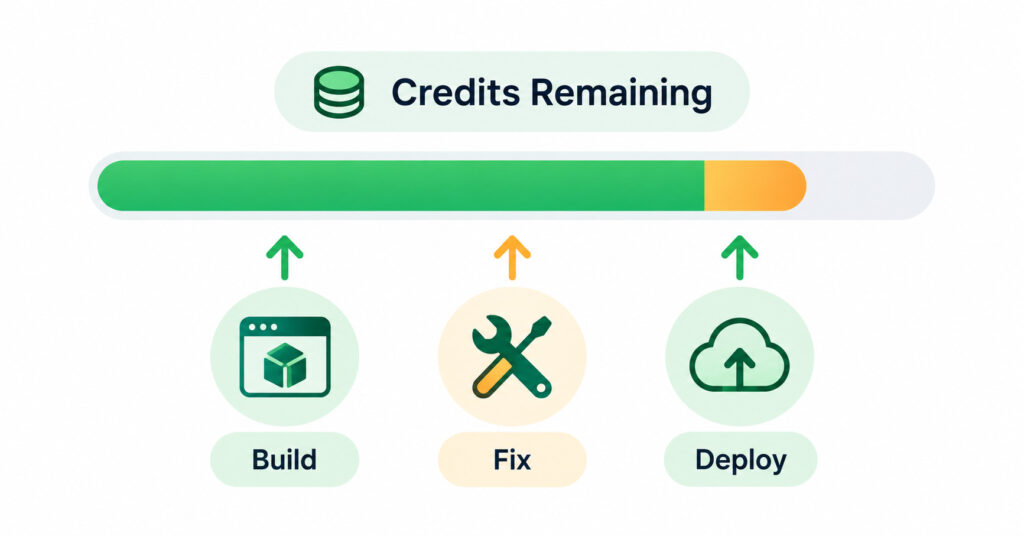
Credits are not like a flat monthly subscription where you pay once and use the tool as much as you want. Every time the AI does something, it uses credits. That includes generating your first app, adding new features, fixing bugs, and redeploying.
Small, simple projects may only use a few credits. A more complex app with many screens, user accounts, and back-and-forth adjustments can drain credits much faster than you expect.
A 2026 review from No Code MBA advised budgeting 30% more credits than you think you will need in your first month. That is practical advice, especially if you are building something with multiple user roles or third-party connections.
There is one more detail many buyers miss. Emergent does not refund credits spent on failed builds. Several users on Trustpilot have described paying credits to fix bugs, only to have those fixes fail and cost more credits. The platform’s Trustpilot score sits at approximately 2.7 out of 5 as of July 2026, with billing and refund issues being the most repeated complaints. (Source: CostBench, July 2026)
That score does not mean the platform is bad. It means the credit system surprises users who expected a different model. Knowing this before you sign up puts you in a much better position.
What Are the Pros and Cons of Emergent AI?
What Emergent Does Well
Speed from idea to app. You can go from a written description to a deployed app in minutes. This is not a stretch. Thousands of users have done it. For a startup founder who needs to test a product idea this week, that speed matters.
Full-stack generation. Most AI app builders only handle the frontend, the visual layer of your app. Emergent generates the database, authentication system, API connections, and deployment setup from a single prompt. That is rare in the no-code platform space and is Emergent’s biggest technical advantage.
You own the code. The code syncs to GitHub. You can download it, host it anywhere, and have any developer work on it later. You are not locked into Emergent forever.
No coding experience needed. The interface is a chat window. If you can describe what you want in plain sentences, you can build with Emergent. About 70% of its users have no prior coding background.
Active development. With $230 million raised and over eight million users, the team is shipping new features fast. The “Wingman” autonomous agent, which works across existing business tools, launched in mid-2026. The platform is not standing still.
Where Emergent Falls Short
Credit costs are unpredictable. This is the most repeated user complaint. You can start a project on the Standard plan and find yourself needing more credits before the project is finished.
No refunds on failed builds. If the AI makes a mistake and burns credits doing it, you do not get those credits back. This is a real financial risk on larger projects.
AI regression. Fixing one part of your app can break something else. The more complex the project, the harder it is to keep everything working through prompts alone. This is a known issue across most prompt-to-app platforms, not just Emergent.
Trustpilot score of 2.7 out of 5. The reviews that pull this score down are mostly from users who ran into billing issues or hit walls on complex builds. Simple project users tend to leave positive feedback. Complex project users are the ones writing detailed complaints.
Not ready for regulated industries by default. Emergent holds SOC 2 and ISO 27001 security certifications, which are real and meaningful. But AI-generated code for healthcare, finance, or legal applications still needs a trained developer to audit it before launch.
How Does Emergent AI Compare to Its Alternatives?
Several vibe coding platforms compete with Emergent. Here is a side-by-side look at the main ones:
| Platform | Best For | Starting Price | Code Ownership | Needs Coding? |
| Emergent AI | Non-technical founders; full-stack autonomous builds | Free / $20/month | Yes (GitHub) | No |
| Lovable | Polished UI; simple to mid-size MVPs | $25/month | Yes | No |
| Bolt (by Vercel) | Next.js and Vercel ecosystems | Free / token-based | Yes | Some |
| Replit | Full coding environment; developer control | Free / $25/month | Yes | Some |
| Cursor | Professional developers editing real codebases | $20/month | Yes | Yes |
| Bubble | Visual no-code apps with a long track record | Free / $32/month | Partial | No |
| v0 (by Vercel) | React and Next.js UI scaffolding | Free / credit-based | Yes | Some |
| Base44 | Full-stack apps without deep custom logic | Free / credit-based | Partial | No |
Emergent AI vs Lovable. Lovable is often easier for complete beginners and produces cleaner-looking first results. Emergent goes deeper, handling mobile apps and backend systems more fully. For a polished landing page or a simple SaaS prototype, Lovable may feel faster. For a full-stack app with user accounts, a real database, and payment processing, Emergent has a stronger foundation.
Emergent vs Replit. Replit gives you a full coding environment. You see and control all the code. That is great if you have some coding skills. Emergent is a better fit if you have none.
Emergent vs Cursor. Cursor is for professional developers who want AI assistance inside an existing codebase. It is a code editor, not a prompt-to-app platform. These two tools serve very different users.
Who Should (and Should Not) Use Emergent AI?
Good fit for:
- Non-technical founders who need to test a product idea fast without hiring a developer
- Small business owners building a custom app to replace a spreadsheet or email workflow
- Developers who want to skip the scaffolding phase on internal tools
- Marketers or operations staff who need a dashboard, CRM, or simple SaaS prototype quickly
- Y Combinator-style early-stage startups validating ideas before raising money (25% of YC Winter 2025 startups had codebases that were over 90% AI-generated)
Not a good fit for:
- Teams building apps that handle medical records, financial data, or other regulated content where AI-generated code must be audited
- Anyone who needs a predictable flat monthly rate with no surprise costs
- Long-term projects maintained by a non-technical team, since managing AI-generated code over time gets complicated without a developer
- Enterprise teams that need custom security review as part of the deployment process
A simple test: if you need a working prototype in one week and you have no engineering team, Emergent is worth trying. If a bug in your app could cost you legally or financially, bring in a developer to review the output before you launch.
Is Emergent AI Safe to Try, and Do You Need to Give Your Real Email?
Emergent AI is safe to use for app development. The platform holds SOC 2 and ISO 27001 certifications. These are two widely recognized standards for data protection and system security in software platforms. Your project files and generated code are stored on secure servers.
That said, signing up for Emergent does require an email address. The platform sends a verification email before your account becomes active. Many users prefer to test a new AI tool before linking it to their primary inbox. That is a fair call. You do not yet know if you will keep using Emergent, and most AI platforms send marketing emails after signup. A data breach at a company you barely used is also a real risk, as the history of software companies shows.

A disposable email address handles this cleanly. You get a working temporary inbox, receive the verification email from Emergent, confirm your account, and explore the free plan with your 10 starting credits. Your real email never enters the picture.
Here is exactly how to do it:
- Go to FreeMail AI. Visit freemail.ai. A disposable email address appears on screen right away. No sign-up and no personal information required. Click the copy button.
- Open the Emergent sign-up page. Go to emergent.sh and choose the email registration option. Skip the “Sign in with Google” button, as that pulls your real Google account email into the process.
- Paste your disposable address. Type or paste the address into the email field and click continue.
- Check your FreeMail AI tab. Switch back to your FreeMail AI tab. Emergent’s verification email usually arrives within a few seconds. Click the link inside to confirm your account.
- Start building. Your Emergent account is active. Use your 10 free credits to test a project and see if the platform fits your needs.
If Emergent rejects your disposable domain because it has been blocklisted, generate a new address from FreeMail AI. You can also try the Gmail Generator at freemail.ai. It creates temporary addresses that look like standard Gmail addresses and pass more blocklist checks because the format matches what most platforms expect.
Before signing up, run your address through FreeMail AI’s Disposable Email Checker. It tests whether your domain is on common blocklists so you know what to expect before you try.
One firm rule: never use a disposable email on a paid Emergent plan. Billing receipts, account recovery, and payment details all go to the address you registered with. If that temporary inbox expires, you lose access to your paid account with no recovery path. Use a real email address if you decide to subscribe.
If you are testing multiple AI tools at once, the same approach works across platforms. See the Temporary Email for AI Tools guide for a full walkthrough. For Claude AI specifically, the Temp Mail for Claude AI guide covers the extra verification steps Anthropic added in 2026.
Frequently Asked Questions
Is Emergent AI free?
Yes, Emergent offers a free plan with 10 monthly build credits. These credits cover basic testing but run out quickly on anything more than a simple project. Paid plans start at $20 per month (Standard, 100 credits) and go up to $200 per month (Pro, 750 credits). Credits are consumed every time the AI performs work, including generating features or fixing bugs.
Is Emergent AI legit?
Yes, Emergent is a legitimate company backed by over $230 million in funding from Khosla Ventures, SoftBank, and Google. It has more than six million users worldwide and holds SOC 2 and ISO 27001 security certifications. The Trustpilot score sits at about 2.7 out of 5, with most negative reviews focused on credit billing practices and the no-refund policy for failed builds.
What are the best Emergent AI alternatives?
The main alternatives are Lovable (better for polished UI and simpler apps), Bolt by Vercel (better for Next.js and Vercel-native workflows), Replit (better for developers who want full control of the code), and Cursor (for professional developers who write and maintain real codebases). Base44 and v0 by Vercel are also worth looking at depending on your project type.
Can Emergent AI build production-ready apps?
Emergent can generate production-level applications, but those apps need human review before going live in most cases. For startup MVPs and simple internal tools, the output is generally solid. For financial, healthcare, or high-stakes enterprise applications, a developer should review the generated code for security gaps and edge cases before deployment.
How does Emergent AI’s credit system work?
Each plan includes a set number of credits per month. Credits are used every time an AI agent performs work: generating code, adding new features, fixing bugs, or redeploying the app. Complex builds with many iterations consume credits faster than simple ones. Unspent credits generally do not carry over. Emergent does not issue refunds for credits spent on failed or broken builds, based on multiple documented user reports.
Do I need to give my real email to try Emergent AI?
Emergent requires an email address to create an account. If you prefer to test the free plan before sharing your primary inbox, a disposable email address lets you complete the verification step and explore the platform without linking it to your real identity. If you decide to keep using Emergent, update your account to a real email address while you are still logged in.
Ready to test Emergent AI’s free plan without putting your real inbox on the line? Go to FreeMail AI and generate a disposable email address with one click. No account, no form, and no personal information needed. Paste the address into Emergent’s sign-up form, retrieve the verification email, click the link, and you are in. If you decide the platform is worth keeping, update your account email to your real address before the temporary inbox expires. No commitment, no spam in your inbox either way.