


Many brands think email revenue will come from sending more campaigns, growing subscriber lists, and having more frequent promotions. However, sending a higher volume of emails does not necessarily mean receiving better results.
Marketers unknowingly have poor results because they are seeing lower engagement, higher unsubscribe rates, and customers who are getting tired of emails. These problems are often due to an incorrect approach by the brand in relation to email campaigns.
By building a disciplined strategy that is based on an understanding of the audience, marketers can take advantage of a great opportunity to grow their business. Email segmentation moves the conversation from thinking about email as a broadcast channel to seeing email as an exact tool—one that is based on the behavior, intent, and context of the customer.
Instead of asking, “How many emails should we send?”
Brands should ask, “Who should receive this email and why?”
Hence, a strategic marketer should know how segmentation increases email revenue. From here, one should note that the key to achieving results through emails is precise targeting and research.
The Limits of a Volume-Driven Email Strategy
It is common to confuse being busy with making progress: more email messages sent, more promotions run, more names added to a list—all of these things give an impression of moving forward in the marketing process, but simply putting out more emails does not always create a reward for doing so.
Sending too many emails can create fatigue within your audience, ultimately leading to lower levels of engagement over a long period of time. If someone who subscribes to receive emails from you is getting too many messages that do not match their interests, they are likely to stop paying attention, which could lead them to unsubscribe altogether.
Having a large list of potential customers does not guarantee you will get back a solid return on your effort unless the messaging you send is relevant to the recipient. A database that is made up of mismatched audiences will dilute the effectiveness of your content as opposed to adding to it.
While aggressive promotion can generate short bursts in sales, it can also have a negative impact on the long-term value of your brand. Offering discounts repeatedly teaches customers to wait and not take action until you give them one.
This is where many companies find themselves stuck. They optimize for growth instead of for relevance.
But the hard truth is relevance drives response. According to Mailchimp, relevantly segmented email marketing has a 14.31% better open rate and a 100.95% better click-through rate than emails that are not classified. This difference in results is not due to additional effort; it’s due to alignment.
Therefore, in the absence of an effective strategy for email segmentation, even the best-designed email campaign can struggle to deliver results.
Why Audience Intelligence Is the Foundation of Smarter Email Marketing

The distinction between guessing and a strategy is the ability to maximize audience intelligence.
These are the three (3) critical areas that will be determined through audience intelligence:
- Who your customers are
- What they care about
- How they behave over time
Rather than constructing campaigns around a calendar, brands should bank on people. Some key pieces of data that help marketers target their audiences more smartly include:
- Purchase history
- Browsing behavior
- Engagement patterns
- Lifecycle stage
The more you know about your customers, the better your messaging decisions will be. This includes copy and visuals; marketers are increasingly adapting their creative assets across segments. For example:
- Showcasing different product sets based on browsing history
- Adjusting the layout to match user preference
- Customizing imagery to reflect the intent of the audience
Pro Tip: Producing visuals using tools like a background remover solution will help teams quickly and easily customize content to fit the specific audience segment. This tip efficiently eliminates the need to recreate all assets for each segment.
Overall, a robust and aligned email audience segmentation scheme will turn data into direction, and this cohesive and clear content direction will eventually drive performance.
How Segmentation Makes Email More Effective
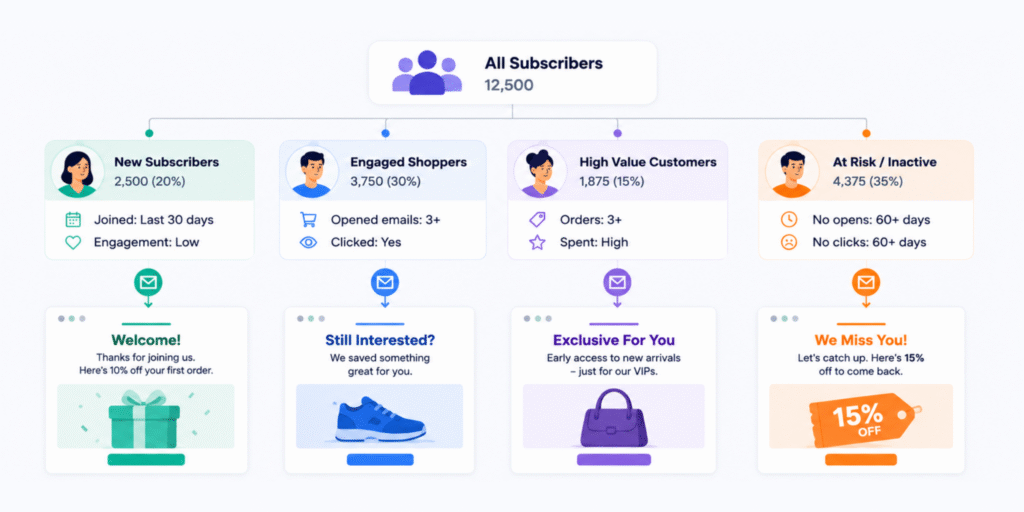
Segmentation is a structural benefit. It helps brands group their audiences based on commonalities, which allows them to create customized messages that will resonate with each group of customers. Therefore, when content aligns with the customer intent, it performs better.
There are several different methods brands use to segment their audiences effectively:
- Studying the behavioral signals that customers exhibit, such as browsing history, previous purchases, interest search, etc.
- Assessing the engagement or interaction level that customers have with the brand/product (active vs. inactive subscribers).
- Monitoring the stage of the customer’s lifecycle with the brand (e.g., new customers, loyal customers, and at-risk customers).
Moreover, email segmentation enables the generation of more relevant content for subscribers, yielding the likelihood of opens, clicks, conversions, and so forth. This is how segmentation increases email revenue from calculated marketing.
Instead of sending one message to everyone, brands communicate with customers through multiple customized experiences based on their needs. This is how an effective segmentation strategy makes email more effective.
According to research by Campaign Monitor, marketers can see an increase of as much as 760% by sending revenue-generating campaigns that efficiently follow a segmented email marketing tactic.
Besides, an effective email segmentation strategy also means replacing non-specific communication with true value-driven, targeted communications that are cumulative in the long run.
From Retention Channel to Revenue Driver
Email has traditionally served as a means of retaining and acquiring more customers by enabling your brand to stay in touch with them and keep relevance. However, this perspective greatly restricts the nature of what email can do.
By implementing a more sophisticated segmentation system, email can be leveraged as a tool for guiding growth rather than simply maintaining it.
Using targeted email campaigns, businesses can support increased revenue through upsell, cross-sell, repeat purchase, and lifetime value. Remember: a customer who purchases an item does not want to receive a generic email following their purchase; they want a suggestion for another product that complements the one they recently purchased. Hence, a high-value segment may respond to an exclusivity offer better than they would react to a discount.
It is safe to say that email audience segmentation now begins to have a direct impact on revenue growth. Whereas brands previously used frequency as a method of generating return on investment, they now look at precision. All messaging is now better contextualized rather than simply being sent in bulk.
Short-term spikes versus long-term performance discourse is fundamentally a function of whether or not businesses use segmentation to drive revenue growth or only volume to produce it. After all, when a brand focuses on pertinent email communications instead of simply sending lots of messages, that brand can therefore experience more stable, sustainable revenue growth.
What a Smarter Email Strategy Looks Like in Practice
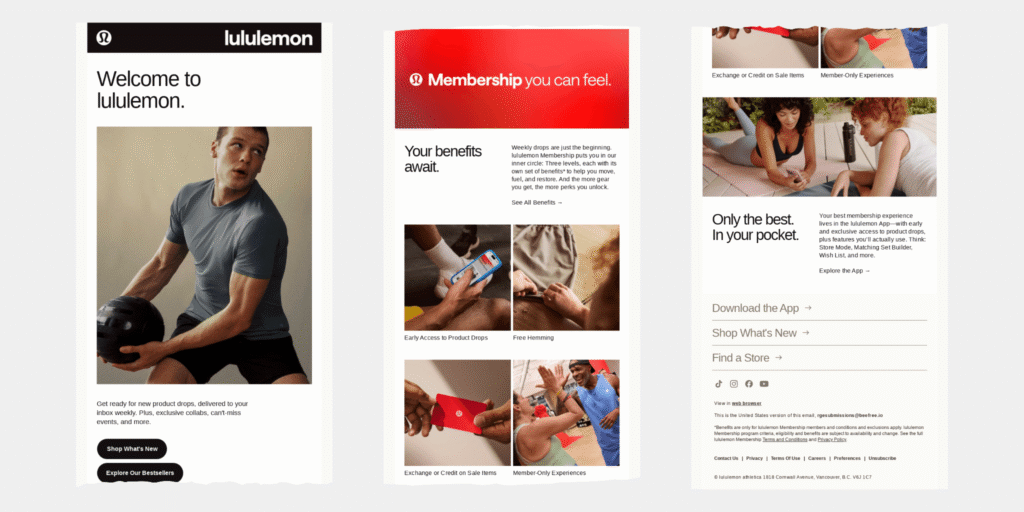
Having a more intelligent approach does not require a lot of effort, but it should be performed with care and purpose.
This system begins with segmenting your audience into three classifications, as briefly mentioned earlier:
- Engagement levels: active subscribers or inactive subscribers?
- Purchase activity: first-time buyer, repeat buyer?
- Stage of your life cycle: are they new, growing, loyal, or at-risk?
Once your audience has been segmented based on relevant criteria, you can then begin to evolve your messaging strategies.
For example, a person who is at the beginning of their lifetime may receive onboarding information via email or some other medium. A customer who has been loyal to your brand may receive early access to email promotions. An individual who has not responded to your campaigns in at least 90 days would typically receive a re-engagement email campaign.
Execution becomes much more refined when the creative pieces of a campaign are tailored to fit the segment. This ensures that the message being created and what is visually represented will support one another in the eyes of your recipients. Production tools such as the background remover tool or customizable templates make it easier for businesses to replicate images quickly and effectively for various segments without having to start all over again.
The ability to easily modify images for different segments makes it much easier for an email marketer to successfully scale their segmented emails.
At the same time, the ultimate goal of a smarter strategy is to focus on higher-quality interactions vs. higher-volume interactions. Instead of simply increasing the frequency of sending emails, it is better to strive to improve each touchpoint with customers.
And most importantly, segmentation is not static. Segments are continuously refined based on performance and customer response. What worked last quarter may not work today. Thus, a strong email segmentation strategy evolves alongside the audience.
Strategic Takeaway for Brands
When looking to improve email marketing, the question shouldn’t be, “How can we send more emails?” but rather, “How do I make each email work hard for us in terms of return on our investment? ”
To do that, having a great email segmentation strategy forces brands to operate with intention behind every email sent. It requires focusing on impact rather than volume, guided by not only who the recipient is but also what they will respond to in an engagement. This is where many teams start to see the difference between activity and effectiveness.
Brands able to successfully utilize segmented email marketing have defined their audiences, know the behaviors that constitute a potential for conversion, and use insights from those areas to create communications that feel planned vs. routine. As a result, there is an increase in engagement, greater efficiency of content, and more clarity in the revenue generated by each campaign.
Operating at elevated levels, email marketing personalization becomes a competitive advantage rather than just an enhancement to design.
When understanding the impact of segmentation on email revenue, the true effect is consistency and relevancy, not theory. These simple differences for the reader compound an increase in overall campaign success. Opens become consistently better. Clicks continue to bolster. Conversions become reliably predictable.
Conclusion
More income is not realized by merely doing more, but by maximizing the aspects that you do more precisely.
Through a well-developed email segmentation strategy, one makes everything more fruitful and “brand changing.” Rather than increasing the overall volume of messages sent, a team is allowed to increase its alignment between the message and the audience. This will ultimately create email marketing as a reliable source of scalable revenue.
More and more, as brands have developed email marketing segmentation, they are now able to respond to customer behavior after the fact, as compared to prior to. Targeted email campaigns give the appearance that they have been sent on time and are not being scheduled. This escalates the probability of engagement as well as value over the long term.
At the same time, email marketing personalization has progressed beyond the surface. It has become an integral part of how email campaigns are structured, designed, and delivered. The execution element of an email campaign is now household platforms, like a background remover or remove.bg, and has been added to increase the sonic relevance to the recipient.
Overall, when using segmentation effectively, each piece or message sent will serve its purpose in a larger whole. Brands should emphasize building a disciplined approach to using segmentation and have it as part of their marketing strategy if they want to build consistent results over time.