

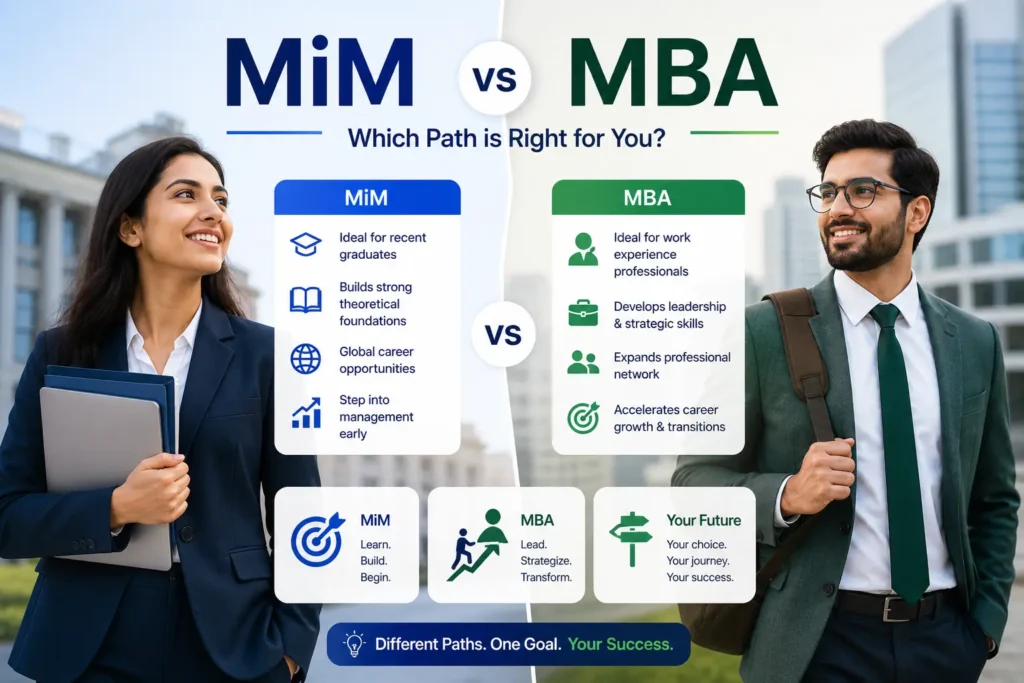
A MiM (Master in Management) is a postgraduate business degree built for recent graduates with little or no work experience. An MBA (Master of Business Administration) is designed for mid-career professionals with 3 to 7 years of experience. The biggest differences are in work experience requirements, tuition cost, starting salary, and where each degree puts you in your career. Neither degree is better than the other. The right choice depends on where you are in your career right now.
When you start researching postgraduate business degrees, the MiM vs MBA question comes up fast. Both degrees teach business. Both can lead to great careers. But they are built for very different people at very different stages of life.
Choosing the wrong one can cost you time, money, and career momentum. The average MiM tuition sits around $54,000, while the average MBA runs closer to $88,000. But cost alone is not the deciding factor. Career stage is.
This guide breaks down the 10 most important differences between a MiM and an MBA, shows you the real salary numbers, and gives you a clear decision framework so you know which degree fits your goals.
What Is a MiM Degree?
A Master in Management, or MiM, is a postgraduate business degree for people who just finished their undergraduate studies. It is designed as a career starter, not a career accelerator.
Most MiM programs run between 12 and 24 months. They cover the core areas of business, including financial accounting, marketing management, corporate finance, operations management, and business analytics. The goal is to give you a strong foundation in how businesses run before you enter the workforce full time.
Top MiM programs are based mostly in Europe. Schools like HEC Paris, London Business School, and ESSEC regularly top the Financial Times MiM rankings. These programs attract thousands of international students every year, with 25% preferring the UK, 23% France, and 10% Germany as their study destination.
What a MiM typically covers:
- Business fundamentals and organizational behavior
- Marketing strategy and financial accounting
- Operations management and business economics
- Corporate finance and business analytics
- Elective options in digital marketing or entrepreneurship
Students interested in exploring MiM programs often sign up for multiple school portals, test prep platforms, and information sessions. Using a temporary email address during this research phase helps you manage sign-ups without filling your main inbox with brochures and newsletters.
What Is an MBA Degree?
A Master of Business Administration is a postgraduate business degree built for working professionals. It is designed to help people move into leadership positions, switch industries, or build their own business.
Most full-time MBA programs run 12 to 18 months in Europe and around two years in the United States. The curriculum focuses on practical, experience-based learning, including strategic management, advanced financial management, marketing strategy, leadership and ethics, and global business. Unlike the MiM, the MBA builds on what you already know from years of real work.
Top MBA schools include Harvard Business School, Stanford Graduate School of Business, Wharton, Columbia Business School, and London Business School. These programs train graduates for senior consulting roles at McKinsey, BCG, and Goldman Sachs, as well as leadership positions at firms like Amazon and JP Morgan.
What an MBA typically covers:
- Advanced organizational behavior and strategic management
- Managerial economics and leadership and ethics
- Global business environment and operations strategy
- A wide range of specializations in finance, marketing, technology management, and healthcare
- Strong alumni network and leadership development programs with many business schools using alumni engagement software to keep graduates connected through events, mentoring, and career opportunities
MiM vs MBA: Key Differences
Before diving deeper, here is a side-by-side comparison of the most important factors.
| Factor | MiM | MBA |
| Typical applicant age | 21 to 24 | 27 to 32 |
| Work experience required | 0 to 2 years | 3 to 7+ years |
| Program duration | 12 to 24 months | 12 to 18 months (EU) / 2 years (US) |
| Average tuition | $40,000 to $70,000 | $65,000 to $130,000 |
| Average starting salary | $55,000 to $80,000 | $95,000 to $150,000+ |
| Career entry level | Entry-level / analyst roles | Manager / leadership roles |
| Curriculum focus | Business fundamentals | Strategy, leadership, decision-making |
| Top regions | Europe and UK | USA and global |
| GMAT/GRE requirement | Often required (650+ typical) | Usually required (700+ typical) |
| Top recruiters | Accenture, Deloitte, HSBC, IBM | McKinsey, Goldman Sachs, Amazon |
The salary gap between the two degrees reflects career stage, not degree quality. MBA graduates earn more because they step into managerial roles. MiM graduates earn less at the start because they are entering the workforce for the first time. Over a career of 10 to 15 years, both paths can lead to senior leadership.
Is a MiM Right for You?
A MiM is the right choice if you are a recent graduate with little or no professional experience and want to enter the business world with a strong foundation.
The MiM makes sense when you do not yet have the work history required for an MBA, but you are ready to move into business, consulting, or finance right after your undergraduate degree. It costs significantly less than an MBA, and the return on investment is faster for early-career students because you are not giving up years of salary to go back to school mid-career. Students who need to complete specific prerequisite courses in mathematics, statistics, or economics before enrolling often use accredited online providers such as Portage Learning, where self-directed credit-bearing courses can transfer to more than 2,800 institutions at a fraction of the cost of traditional college coursework.
Choose a MiM if you:
- Just finished your undergraduate degree or have under 2 years of work experience
- Are between the ages of 21 and 25
- Want to enter consulting, finance, marketing, or operations at an entry level
- Prefer a lower tuition cost and faster time to income
- Are considering Europe or the UK as your study destination
- Plan to pursue an MBA later after gaining work experience
Top schools for an early career business program include HEC Paris, which consistently ranks number one globally in the Financial Times MiM rankings, along with LBS, ESSEC, and IE Business School.
Is an MBA Right for You?
An MBA is the right choice if you already have professional experience and want to move into leadership, change your career path, or reach senior management faster.
The MBA is built on the assumption that you already understand how business works. It pushes you further, into strategy, decision-making, and leadership. Because you bring experience to the classroom, you also get more out of case studies, peer discussions, and alumni networks. The MBA delivers higher salaries and stronger global mobility, but the investment is much bigger, both in time and money.
Choose an MBA if you:
- Have 3 to 7 years of full-time professional experience
- Are between the ages of 27 and 32
- Want to move into senior management, consulting leadership, or investment banking
- Are ready to invest $65,000 to $130,000 or more in your education
- Want to switch industries or build a startup with strong business credentials
- Need access to a powerful global alumni network for senior-level opportunities
Top MBA schools like Harvard, Stanford, and Wharton require GMAT scores of 700 or above, with average tuition of $78,700 to $87,970 per year. These programs open doors to roles at McKinsey, Goldman Sachs, Amazon, and JP Morgan.
MiM vs MBA Salary: What Can You Actually Earn?
Salary is one of the biggest factors students look at when comparing these two degrees. Here is what the data says.
MiM Graduate Salaries by Role
MiM graduates typically start in entry-level roles such as analyst, associate, or junior consultant. The average starting salary ranges from $55,000 to $80,000 depending on the employer, location, and specialization. Yocket data puts the top end of MiM salary ranges at $68,000 to $106,000 for higher-paying roles and regions.
Common early-career roles for MiM graduates include:
- Business analyst at firms like Accenture, Deloitte, or HSBC
- Marketing coordinator or brand associate
- Financial analyst at mid-size banks or consulting firms
- Management trainee at large corporations
MBA Graduate Salaries by Role
MBA graduates typically enter managerial or leadership-track roles right after graduation. The average starting salary for MBA graduates is around $96,000, with top-paying roles at leading firms reaching $169,000 to $228,000.
Common roles for MBA graduates include:
- Senior manager or director at large corporations
- Strategy consultant at McKinsey, BCG, or Bain
- Investment banker in financial services
- Entrepreneur or startup founder
ROI: Which Degree Pays Back Faster?
The MiM delivers a faster payback period for students entering the workforce early. Since the total investment is lower and you start earning sooner, the break-even point comes faster. The MBA has a longer payback period, but the total lifetime earnings potential is significantly higher because you are competing for senior-level roles from day one after graduation.
For students in India and South Asia, both degrees carry strong international value, with the MiM being an increasingly popular route to European careers and the MBA remaining the gold standard for reaching senior leadership globally.
Top Schools for MiM vs MBA
Choosing the right school is as important as choosing the right degree. Rankings from the Financial Times and QS Business Masters Rankings are the most trusted sources for evaluating graduate management education programs.
Top MiM Programs (Global):
- HEC Paris (ranked number one globally by the Financial Times)
- London Business School
- ESSEC Business School
- IE Business School
- ESADE Business School
- Rotterdam School of Management
- University of St. Gallen
Top MBA Programs (Global):
- Harvard Business School
- Stanford Graduate School of Business
- Wharton School, University of Pennsylvania
- Columbia Business School
- INSEAD (France/Singapore)
- London Business School
- MIT Sloan School of Management
Note that LBS appears in both lists, making it one of the few schools where students can pursue either degree depending on their career stage. INSEAD is also well known for offering one of the fastest and most internationally respected MBA programs, running just 10 to 12 months in Europe.
Can You Do an MBA After a MiM?
Yes, and this is one of the most overlooked strategies in graduate management education.
Many MiM graduates go on to pursue an MBA later in their careers, typically after gaining four to six years of professional experience. This two-step pathway is smart for students who are ready to enter the job market early but also want the long-term benefits of an MBA eventually.
The logic is simple. You start with a MiM to build your business fundamentals and get into the workforce faster. You spend several years in consulting, finance, or operations, gaining the work experience that top MBA programs want. Then you apply for an MBA with a much stronger application, real leadership stories, and employer sponsorship in some cases.
Top business schools like Harvard, INSEAD, and Wharton actively welcome candidates who come from strong postgraduate business backgrounds. A MiM from HEC Paris or LBS is viewed positively by MBA admissions committees.
This pathway also helps with cost. Many companies sponsor MBA applications for high-performing employees, reducing the financial burden of the second degree significantly.
If you are not sure whether to choose one now, ask yourself this: am I ready to contribute professionally with no work experience? If yes, start with the MiM and build from there.
MiM vs MBA for Specific Career Paths
Your target career should play a big role in your decision. Here is a quick breakdown by industry.
Consulting: A MiM opens doors to analyst and associate roles at firms like Accenture and Deloitte. An MBA from a top school gives access to senior consulting roles at McKinsey, BCG, and Bain. Both work, but the MBA unlocks the higher level faster.
Finance: Both degrees are valued in finance. MiM graduates typically start in financial analyst or junior associate roles at banks and asset management firms. MBA graduates enter at the investment banking associate or VP track level at firms like Goldman Sachs and JP Morgan.
Technology and startups: A MiM is increasingly popular for technology roles because many top MiM programs now include digital marketing, data analytics, and entrepreneurship electives. An MBA is preferred for product management leadership roles at firms like Amazon or Google.
Marketing: A MiM is excellent for entering marketing coordinator, brand associate, or digital marketing roles early. An MBA with a marketing specialization is better for reaching chief marketing officer or senior brand director level.
Entrepreneurship: An MBA gives you a stronger network, more funding contacts, and deeper strategy knowledge. However, some founders do their MiM first, build their idea while young, and then get the MBA later to scale their business.
How to Manage Your Business School Applications
Applying to business schools involves a lot of moving parts. You will sign up for GMAT or GRE prep platforms, register on school application portals, download program brochures, and join webinars. Each of these sign-ups sends emails to your inbox, often for months.
Here is a practical checklist to keep your application process clean:
- List the MiM or MBA programs you want to apply to
- Check the exact GMAT or GRE score requirements for each school
- Gather your academic transcripts and letters of recommendation
- Write a focused statement of purpose that matches your career stage
- Use a separate email address for school registrations and test prep sign-ups to keep your main inbox organized
One simple way to manage the research phase is to use a free temp mail generator for platforms you are exploring but not yet committed to. This keeps your primary email free from marketing lists while you compare programs across different schools and countries.
Frequently Asked Questions
Does a MiM give the same business knowledge as an MBA?
Both degrees cover core business subjects like finance, marketing, and strategy, but the depth and application are very different. A MiM teaches business fundamentals from the ground up for students with no experience. An MBA builds on years of professional work with a focus on real-world leadership decisions. They are complementary, not interchangeable.
At what age should I start thinking about a MiM versus an MBA?
If you are between 21 and 24 with a fresh undergraduate degree, the MiM is designed for your stage. If you are between 27 and 32 with solid professional experience behind you, the MBA fits better. Age is not a strict rule, but most programs have cohorts built around these ranges, so you will study alongside people in similar life situations.
Which degree is more recognized outside of Europe?
The MBA holds stronger global recognition, especially in the United States, Latin America, and the Middle East. The MiM is primarily recognized in Europe and is gaining ground in India and Southeast Asia. If you plan to work in North America, the MBA carries more weight with employers than a MiM does.
How do MiM and MBA programs differ in teaching style?
MiM programs are more theory-focused and classroom-based, covering academic frameworks and foundational concepts. MBA programs are case-study heavy and use real business problems, peer debates, and executive guest lectures. The MBA assumes you can connect theory to real experience because you have already lived it.
Can you get a scholarship for a MiM or MBA?
Yes, both degrees offer merit-based and need-based scholarships. Top MiM schools like HEC Paris and LBS offer partial scholarships for high-performing candidates. MBA programs at Harvard and Stanford offer need-based financial aid, and many companies sponsor employees for MBA study as part of leadership development programs.
Is the GMAT required for both degrees?
Most top programs for both degrees accept either the GMAT or the GRE. Competitive MiM programs typically look for GMAT scores of 650 or above, while top MBA programs usually expect 700 or higher. Some schools offer waivers for exceptional academic records or significant professional achievements.
What industries hire the most MiM graduates globally?
Consulting, financial services, and technology are the top three industries hiring MiM graduates. Firms like Accenture, Deloitte, Barclays, HSBC, and IBM are among the most active recruiters of MiM graduates from top European programs. Marketing and retail management are also growing destinations, especially for specialized MiM tracks.
Deciding between a MiM and an MBA does not have to be complicated. If you are fresh out of university and want to build a strong business foundation before entering the workforce, the MiM is your path. If you already have professional experience and want to move into leadership or switch careers, the MBA is the right investment.
And if you are in the middle of researching schools, comparing programs, and signing up for information sessions across multiple platforms, keep your inbox organized. Using a free temporary email for your school research sign-ups means your main email stays clean while you make one of the most important decisions of your career.