

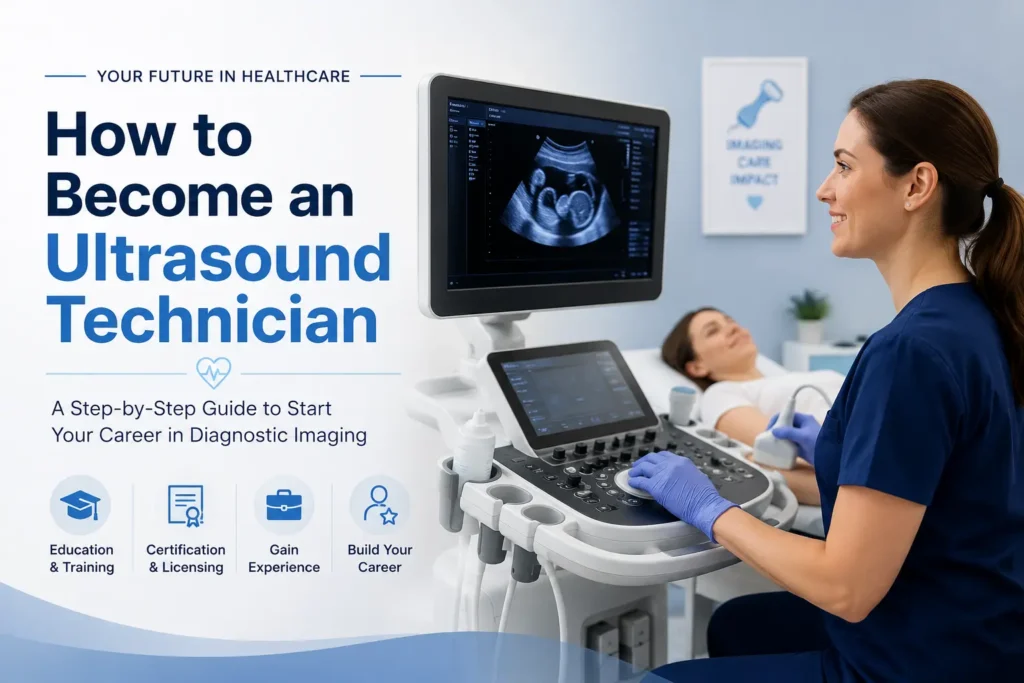
Becoming an ultrasound technician takes about 2 to 3 years. You need to complete an accredited diagnostic medical sonography program, finish clinical training hours, and earn an ARDMS or ARRT certification. The career pays a median salary of $89,340 per year and is growing 13% through 2034. Both technical skills and people skills matter equally in this role.
If you are looking for a healthcare career that pays well, grows fast, and does not require a four-year university degree, learning how to become an ultrasound technician is one of the smartest moves you can make right now.
The Bureau of Labor Statistics reports that diagnostic medical sonographers earn a median annual salary of $89,340, and the field is projected to grow 13% from 2024 to 2034. That is much faster than the average for all jobs in the United States. About 5,800 new job openings are expected every single year throughout that period.
This guide walks you through every step of the process, from building your academic foundation to landing your first job as a sonographer. No fluff, no confusion, just a clear and honest roadmap.
What Does an Ultrasound Technician Actually Do?
Before committing to this path, it helps to understand what the job looks like day to day.
An ultrasound technician, also called a diagnostic medical sonographer, uses high-frequency sound waves to create images of the inside of a patient’s body. These images help doctors diagnose conditions without using radiation. The technician uses a handheld device called a transducer, which sends sound waves into the body and captures the returning signals as a sonogram.
On a typical day, an ultrasound tech will:
- Prepare patients and explain the imaging procedure clearly
- Operate ultrasound equipment and adjust settings for image quality
- Capture diagnostic images of organs, tissues, and blood flow
- Review image quality and note anything unusual for the physician
- Maintain equipment and keep accurate patient records
Most ultrasound technicians work in hospitals, which account for about 60% of all positions. Around 20% work in physician offices, and 11% work in diagnostic imaging laboratories. Others work in outpatient care centers, OB/GYN clinics, and cardiac facilities.
The role is physically active. You will stand for most of your shift and perform repetitive movements with your hands and arms. Understanding this upfront helps you prepare properly.
How Long Does It Take to Become an Ultrasound Technician?
Most people enter the workforce as a certified ultrasound technician within 2 to 3 years. The exact timeline depends on the path you choose.
| Pathway | Duration | Best For |
|---|---|---|
| Associate Degree in Diagnostic Medical Sonography | 2 years | Most beginners with no healthcare background |
| Postsecondary Certificate Program | 12 to 18 months | Those with an existing healthcare degree or credential |
| Bachelor’s Degree in Sonography | 4 years | Those seeking leadership or academic roles |
The associate degree route is the most common. It includes classroom instruction in anatomy, physiology, and medical imaging, plus required clinical training hours. The certificate program is a great option if you are already a nurse, radiographer, or other healthcare professional looking to add sonography to your qualifications.
Step-by-Step Guide to Becoming an Ultrasound Technician
Many people assume that breaking into a healthcare career requires years of university education and mountains of debt. The reality for sonography is very different. The path to becoming a certified ultrasound technician is structured, affordable, and achievable in as little as two years. Each step below builds directly on the one before it, so if you follow this process in order, you will move from zero experience to a job-ready credential with confidence and clarity. Here is exactly what that journey looks like.
Step 1: Build Your Academic Foundation

Your journey starts in high school or with your GED. Strong grades in biology, physics, chemistry, and math will give you a real advantage when you enter a sonography program. These subjects directly connect to the anatomy and physiology concepts you will study during your training.
If you did not take advanced science courses in high school, many community colleges offer prerequisite courses you can complete before applying to a sonography program.
Step 2: Choose a CAAHEP-Accredited Sonography Program

This is the most important decision you will make in this process. You must enroll in a program accredited by CAAHEP, the Commission on Accreditation of Allied Health Education Programs. Graduation from an accredited program is required before you can sit for the ARDMS certification exam.
When evaluating programs, look for:
- Accreditation status (CAAHEP or ABHES)
- Clinical placement partnerships with hospitals and diagnostic centers
- Program completion rates and job placement outcomes
- Instructor credentials and real-world healthcare experience
- Financial aid availability and program cost
NPCollege’s Diagnostic Medical Sonography Technician program in Lakewood, California, is built around hands-on clinical training and career services support. Students learn from experienced healthcare professionals in a program designed to prepare them for immediate entry into the workforce.
Step 3: Complete Your Clinical Training Hours
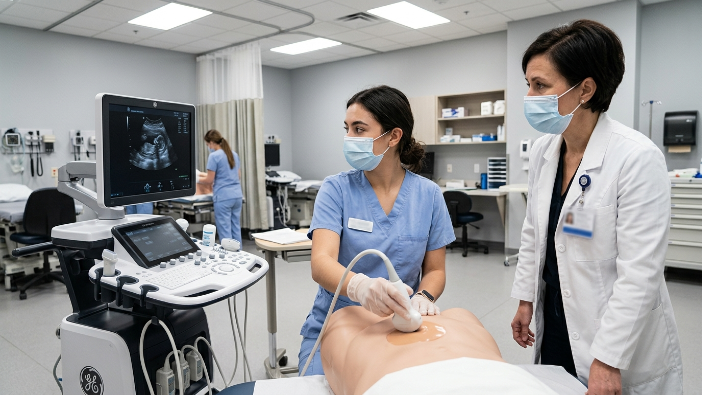
Classroom knowledge alone is not enough. Every accredited sonography program requires hands-on clinical training hours completed at a real medical facility. This is where you practice using the transducer, working with actual patients, and developing the judgment that textbooks cannot teach.
Clinical training also helps you build the patient care skills that make a strong sonographer. Patients who come in for imaging are often anxious or unwell. Your ability to communicate calmly and work efficiently under pressure is developed during this stage.
Step 4: Know What Skills You Will Need Before You Enroll

Many people focus entirely on the education steps and overlook the personal side of the career. The truth is that this role demands a mix of technical ability and strong interpersonal qualities. You need to operate medical imaging equipment with precision, but you also need to make patients feel comfortable during procedures that can be stressful or emotional.
Taking time to honestly assess the skills required to become an ultrasound technician before you apply to a program can save you time and help you choose a training path that matches your strengths. Physical stamina, attention to detail, and calm communication under pressure are just as important as technical knowledge.
Step 5: Earn Your ARDMS or ARRT Certification

After graduating from an accredited program, you need to earn a professional credential. The two most recognized certifications in the United States are:
- ARDMS (American Registry for Diagnostic Medical Sonography): The most widely accepted credential among employers. ARDMS offers specialty credentials in obstetric and gynecologic sonography, abdominal sonography, vascular technology, and more.
- ARRT (American Registry of Radiologic Technologists): Also widely recognized, especially in hospital systems that employ both radiographers and sonographers.
Many employers require one of these credentials either at the time of hire or shortly after starting the job. Earning your certification demonstrates that you meet the national professional standard for competency in diagnostic medical sonography.
Step 6: Apply for Your First Position

With your degree and certification in hand, you are ready to enter the job market. Entry-level ultrasound technicians typically earn between $60,000 and $75,000 per year. The setting you choose affects both your starting salary and your day-to-day experience.
Common entry-level work environments include:
- Hospital imaging departments
- OB/GYN and women’s health clinics
- Outpatient diagnostic imaging centers
- Physician offices and specialty practices
- Cardiac and vascular diagnostic labs
NPCollege’s career services team supports students through the job search process, helping connect graduates with clinical partners and employer networks in the Los Angeles and Southern California area.
What Is the Job Outlook for Ultrasound Technicians?
The job outlook for this career is genuinely strong, and the numbers back it up.
The Bureau of Labor Statistics projects 13% employment growth for diagnostic medical sonographers from 2024 to 2034. That translates to approximately 11,700 new jobs created over the decade, with around 5,800 openings available per year.
The growth is being driven by several clear factors. First, the United States has an aging population. Baby boomers are now in their 60s and 70s, and older adults require far more diagnostic imaging than younger patients. Second, ultrasound is increasingly preferred over CT scans and X-rays in many situations because it produces no radiation and is considered safer for repeated use. Third, expanding clinical applications mean sonography is now being used in more specialties than ever before.
Travel sonographers, who take short-term contract positions in different locations, are earning even more. In 2025, travel ultrasound techs were averaging around $98,000 per year. California consistently ranks as the highest-paying state, with an average salary of $114,480 for sonographers.
How Much Do Ultrasound Technicians Make?
Salary in this field varies based on experience, specialization, and geographic location.
| Experience Level | Typical Annual Salary |
|---|---|
| Entry-level (0 to 2 years) | $60,000 to $75,000 |
| Mid-level (3 to 7 years) | $80,000 to $90,000 |
| Experienced or Specialized | $90,000 to $115,000+ |
| Travel Sonographer (2025) | Around $98,000 average |
The BLS national median sits at $89,340 as of May 2024. Specialized credentials in cardiac sonography, echocardiography, or vascular technology can push your earnings well above that median. Location also plays a major role. California, Alaska, Hawaii, and Oregon consistently rank among the top-paying states for diagnostic medical sonographers.
Can You Specialize as an Ultrasound Technician?
Yes, and specializing is one of the most effective ways to increase your earning potential and grow your career over time.
After gaining experience in a general sonography role, you can pursue additional certification in focused areas. Common specializations include:
- Obstetric and Gynecologic Sonography: Imaging during pregnancy and reproductive health exams
- Echocardiography: Imaging the heart and surrounding structures for cardiac conditions
- Vascular Technology: Studying blood flow patterns and circulatory system health
- Abdominal Sonography: Focused imaging of the liver, kidneys, gallbladder, and other abdominal organs
- Musculoskeletal Sonography: Imaging muscles, tendons, and joints for sports injuries or chronic conditions
Each specialization requires its own ARDMS credential exam. The more specialized your skills, the more valuable you become to employers. NPCollege also offers training in Cardiovascular Sonography for students who already know they want to focus on the cardiac side of the field from day one.
A Note on Education and Career Planning
Choosing a healthcare career involves more than picking a training program. It means thinking about how you finance your education, how long the investment takes to pay off, and whether the career lines up with your longer-term goals.
Some students pursuing healthcare careers also explore complementary paths over time. If you are thinking about the business side of healthcare administration, resources on online MBA programs offer a useful look at how others are building hybrid skill sets in today’s workforce. And if you ever consider starting a health-related business down the road, understanding a startup bootstrapped fundraising strategy can help you plan your financial foundation while you are still in training.
Final Thoughts: Is This the Right Career for You?
Becoming a diagnostic medical sonographer is one of the most practical healthcare career decisions available today. The training timeline is short. The job market is strong. The salary is competitive from day one, and there are clear paths to growth through specialization, experience, and additional credentials.
But beyond the salary figures and job outlook numbers, this is a career where your work genuinely matters. Every sonogram you capture helps a physician make a faster and more accurate diagnosis. That is real impact, delivered every single day.
If this career path sounds like the right fit for you, NPCollege’s Diagnostic Medical Sonography Technician program gives you the hands-on clinical training, experienced instructors, and career support you need to move from enrollment to employment with confidence. Reach out to the NPCollege admissions team today to ask about program start dates, financial aid options, and what your very first step looks like.