

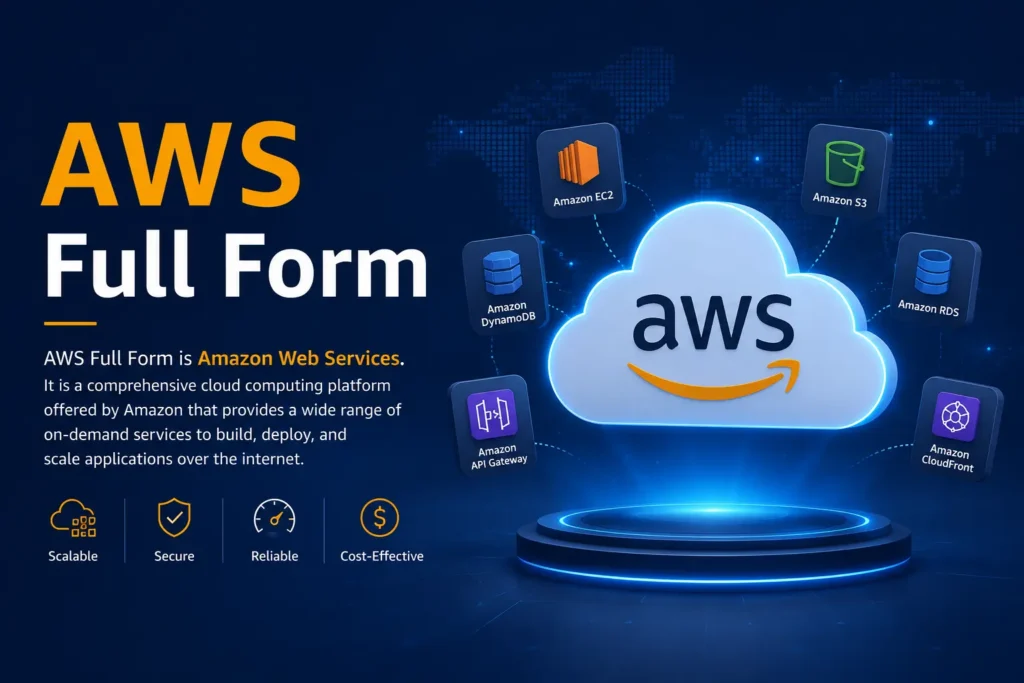
AWS stands for Amazon Web Services. It is a cloud computing platform built by Amazon that gives you access to servers, storage, databases, and AI tools over the internet. AWS is the world’s largest cloud provider, holding 28% of the global cloud market as of Q4 2025. Students, developers, and businesses use it every day without even knowing it.
Have you ever seen “AWS” on a job posting, in a class assignment, or in a tech article and wondered what it actually means? You are not alone. Millions of people search for this every month, especially students and job seekers exploring the tech world for the first time.
The good news is that the answer is simple. AWS stands for Amazon Web Services. But once you know the full form, you will naturally want to know what it actually does, who uses it, and why it matters in 2025 and 2026. This article answers all of that in plain English, with no confusing jargon.
What Is the Full Form of AWS?
AWS full form is Amazon Web Services.
Amazon Web Services is a cloud computing platform created and operated by Amazon. It was launched commercially in 2006 and has grown into the largest cloud services provider in the world.
In simple terms, Amazon Web Services is Amazon’s technology division that rents computing power, storage, and software tools to businesses, developers, students, and organizations over the internet.
This is different from Amazon’s online shopping platform. The two are separate services run by the same parent company.
What Does Amazon Web Services Actually Do?

Think of AWS like a giant electricity grid, but instead of electricity, it provides computing power and digital services.
Before cloud computing existed, a company that needed to run a website had to buy physical servers, set them up in a building, and pay to maintain them all year. This was expensive and slow.
AWS changed that completely. Now, instead of buying hardware, you simply log in to the Amazon Web Services platform and rent exactly what you need, for as long as you need it. You pay only for what you use, just like paying a water bill instead of buying a water treatment plant.
This model is called pay-as-you-go pricing, and it is one of the core reasons AWS became so popular so fast.
AWS is what makes it possible for small startups to build apps that can grow to serve millions of users without spending millions of dollars upfront. It also powers massive enterprises, government agencies, and even everyday tools that people use without realizing it.
What Are the Main AWS Services?
AWS offers over 200 fully featured cloud services as of 2025. That sounds like a lot, but the services fall into a few clear categories that are easy to understand.

Compute Services
This category is about raw processing power. The most well-known service here is Amazon EC2 (Elastic Compute Cloud), which lets you rent virtual machines over the internet. Think of EC2 as renting a computer in the cloud that you can turn on and off whenever you need it.
AWS Lambda is another popular compute service. It lets developers run code without managing any server at all.
Storage Services
Amazon S3 (Simple Storage Service) is one of the most used services on the entire platform. It stores files, images, videos, and data in the cloud so they can be accessed from anywhere in the world.
S3 is used by many apps and websites to store user-uploaded content, backups, and media files.
Database and Networking Services
Amazon RDS (Relational Database Service) handles structured data for businesses. It manages databases automatically, so developers do not have to worry about updates or backups.
Amazon CloudFront is a networking service that delivers content fast to users around the world by storing copies of data at locations near them.
AWS also provides strong security, identity and compliance tools and machine learning services, including Amazon Bedrock, which helps companies build AI-powered applications.
How Big Is AWS in 2025 and 2026?

AWS is not just large. It is the dominant force in the entire cloud computing industry.
As of Q4 2025, AWS holds 28% of the global cloud infrastructure market share, making it the single largest cloud provider in the world. That means more than one in every four cloud services running globally is built on Amazon Web Services.
The next two biggest competitors are Microsoft Azure and Google Cloud Platform. Together, AWS, Azure, and Google Cloud control roughly 68% of all enterprise cloud spending worldwide.
Here is a simple comparison:
| Cloud Provider | Full Name | Approx. Market Share (Q4 2025) | Best Known For |
| AWS | Amazon Web Services | 28% | Broadest service range, startup and enterprise use |
| Azure | Microsoft Azure | ~22% | Enterprise Microsoft integration |
| Google Cloud | Google Cloud Platform | ~12% | AI, data analytics, and machine learning |
Google Cloud was the fastest-growing provider in Q4 2025, narrowing the gap slightly with AWS. Even so, AWS maintains a commanding lead built over nearly two decades of operation.
Who Uses AWS?
AWS is used by an incredibly wide range of people and organizations.
Businesses of all sizes use AWS to run their websites, store customer data, send emails, and manage their software. A startup building a new app and a Fortune 500 company managing global operations can both be running on the same AWS infrastructure.
Some of the most recognized companies in the world run on AWS. Netflix uses AWS to stream video to hundreds of millions of viewers. NASA uses AWS for data storage and research. Airbnb, Coca-Cola, and many global banks rely on Amazon Web Services infrastructure every day.
Developers and software engineers use AWS to build, test, and deploy applications without managing physical servers.
Students and educators use the AWS Free Tier to learn cloud computing skills, build portfolio projects, and prepare for cloud certifications.
Government agencies and nonprofits use AWS for secure, scalable data management. AWS operates across 190 countries, serving organizations in education, healthcare, finance, and more.
Is AWS Free to Use?
Yes, AWS is free to join and offers a Free Tier that gives new users access to over 100 services at no cost for the first 12 months.
The Free Tier is designed for students, beginners, and developers who want to explore the platform before committing to paid services.
After the Free Tier period, or if you go beyond the free usage limits, AWS uses its pay-as-you-go model. You only pay for what you actually use. There are no upfront costs and no minimum fees.
This makes AWS accessible to individuals and small teams who want to experiment with cloud computing, scalable cloud storage, and virtual machines without a large financial commitment.
Why Should Students and Job Seekers Learn About AWS?
Here is something most “AWS full form” articles never tell you: knowing what AWS stands for is just the beginning. The real opportunity is what comes after.
AWS is one of the most in-demand skill sets in tech hiring today. Job postings for cloud engineers, DevOps specialists, data analysts, and even project managers frequently list AWS knowledge as a required or preferred skill.
The AWS Certified Cloud Practitioner certification is the entry-level credential designed specifically for non-technical people who want to understand cloud computing and Amazon Web Services at a foundational level. You do not need a computer science degree to earn it.
Here is why learning AWS basics matters for students right now:
- Cloud computing is the backbone of modern software, AI tools, and data services
- AWS certifications are recognized globally by employers in every industry
- The AWS Free Tier lets you practice real skills at zero cost
- Understanding IaaS (Infrastructure as a Service) and PaaS (Platform as a Service) concepts, which AWS provides, gives you a strong foundation for any tech career
Even if you are not planning a technical career, understanding what Amazon Web Services is and how on-demand cloud services work makes you a stronger candidate in marketing, operations, finance, and business roles that increasingly rely on cloud platforms.
If you are studying for an exam, exploring tech careers, or just trying to understand a job description, knowing the AWS full form and the basics behind it puts you ahead of most people at the same stage.
Final Thoughts
AWS stands for Amazon Web Services, and it is far more than just a tech acronym. It is the cloud computing platform that powers a huge portion of the modern internet, from the apps on your phone to the streaming services you use at night.
The key facts to remember are simple: Amazon Web Services gives businesses and developers access to computing power, storage, databases, and AI tools over the internet on a pay-as-you-go basis. It is the world’s largest cloud provider, used by millions of organizations across 190 countries.
Whether you are a student, a job seeker, or just a curious person, knowing what AWS means and how it works is genuinely useful knowledge in 2025 and 2026.
If you use online tools every day and want to explore more cloud-based services that protect your privacy, check out free temporary email tools on FreeMail.ai. They are perfect for signing up to platforms like AWS without using your personal inbox.