

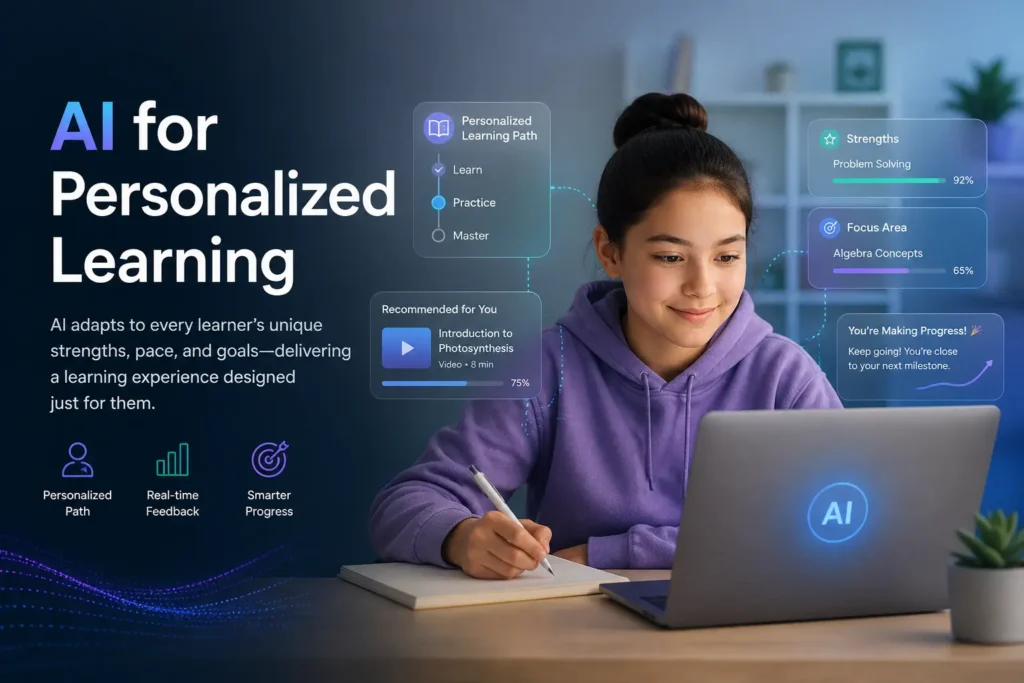
AI for personalized learning uses machine learning to adapt lessons, difficulty, and pace to each individual learner in real time. Instead of following a fixed curriculum, AI-powered systems track how you learn, find your knowledge gaps, and serve content that fits your exact needs. Research shows this approach can improve learning outcomes by up to 30% and boost course completion by 70%. From students to working professionals, AI-powered learning tools are now accessible to almost anyone who wants to learn smarter, not harder.
Every classroom has the same problem. The teacher moves at one speed. Some students get bored. Others fall behind. Nobody wants to say they are lost. So the lesson keeps going, and the gaps keep growing.
The AI for personalized learning revolution is changing that. Artificial intelligence now makes it possible to give every learner a path that fits them and only them. The global AI personalized learning market was valued at $9.15 billion in 2025 and is projected to reach $291.85 billion by 2035, growing at a 41.5% compound annual rate. That kind of growth does not happen by accident. It happens because the technology actually works.
This guide explains what AI personalized learning is, how it works, which tools are leading the way in 2026, and how you can start using them today without any hassle.
What Is AI for Personalized Learning?
AI for personalized learning is the use of artificial intelligence to tailor educational content, learning pace, and difficulty to each individual student. It is not just about letting someone go at their own speed. It is deeper than that.
Traditional education gives everyone the same lesson at the same time. A student who already knows the material has to sit through it anyway. A student who is struggling does not always get extra help in time. Personalized learning technology fixes both problems.
With AI, a learning platform watches how you respond to questions, what you skip, where you slow down, and what you get wrong. It then builds a customized learning path just for you. The content changes based on your strengths and your knowledge gaps. It does not wait for a teacher to notice you are behind. It adjusts right away.
This is very different from self-paced learning, where you just move faster or slower through the same fixed material. AI-powered adaptive learning changes the actual content, not just the speed.
How Does AI Adapt Learning to Individual Students?
AI adapts learning by continuously collecting data on how a student interacts with content, including which questions they get wrong, how long they pause, and what they skip. It then adjusts the difficulty, format, and sequence of lessons in real time to close knowledge gaps and reinforce strengths, without waiting for a teacher to step in.
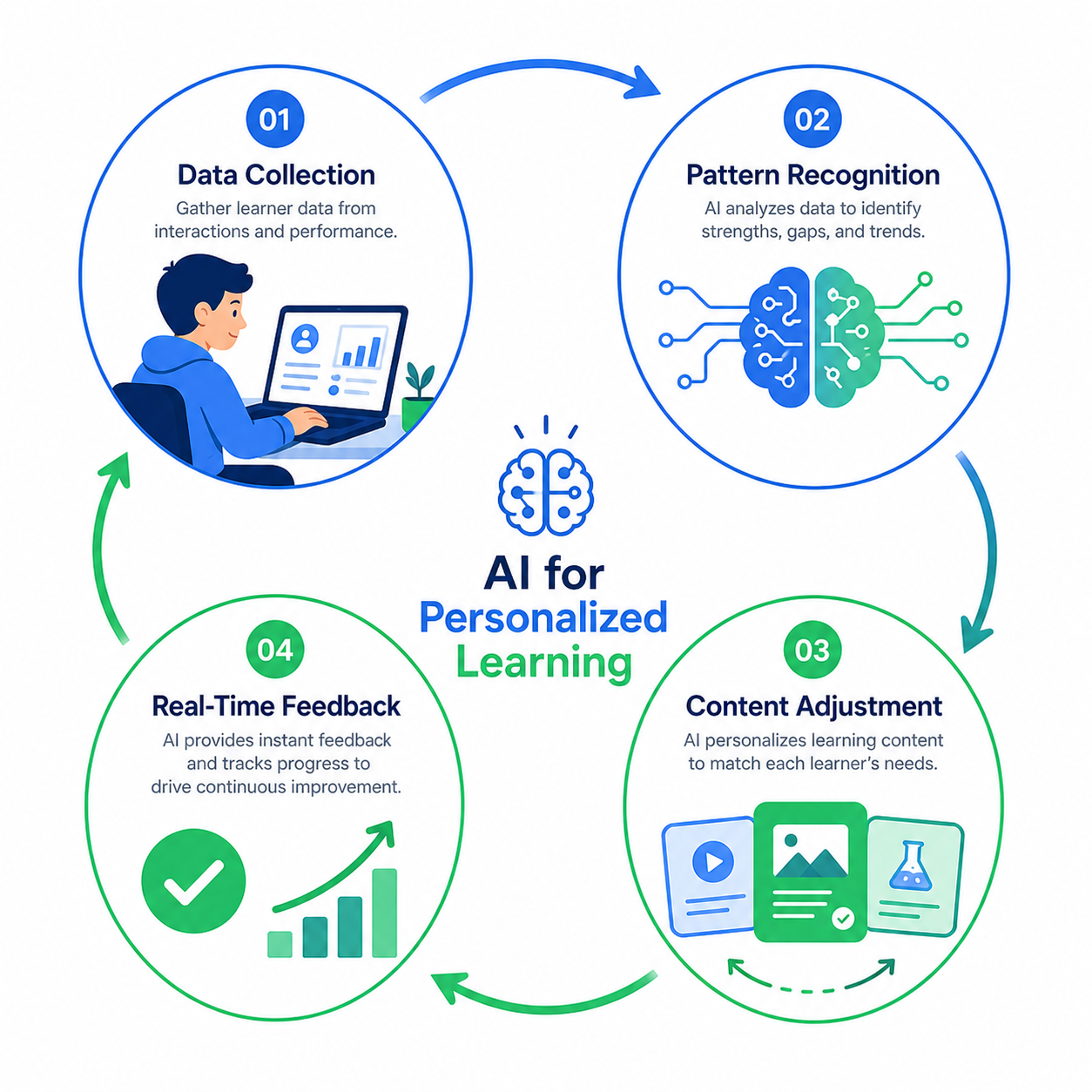
Here is how the process works, step by step:
- Data collection: The platform collects information on every interaction. This includes your correct and incorrect answers, the time you spend on each question, and the content you skip or revisit.
- Pattern recognition: Machine learning algorithms look for patterns in your data. They identify which topics you have mastered and which areas need more practice.
- Content adjustment: Based on those patterns, the system updates your learning path. It might give you easier questions to rebuild confidence, or harder ones to push you forward. It may switch the format too, from reading to video to quiz.
- Real-time feedback: You get instant, actionable feedback instead of waiting for a graded test. This is one of the biggest advantages of AI-driven formative assessment.
What Data Does AI Collect from Learners?
AI systems in education collect performance data such as quiz scores and response times, as well as behavioral data like how often you log in and which sections you reread. More advanced platforms also factor in learner preferences and career goals to refine your customized learning path.
A Dartmouth study published in late 2025 found that students actively trusted AI chatbots as a 24/7 support tool for personalized learning at scale, calling it a step toward precision education. This confirms that learner data analytics, when used responsibly, lead to better and more trusted outcomes.
What Are the Real Benefits of AI Personalized Learning?
The biggest benefit is efficiency. AI removes the time wasted on content a learner already knows and speeds up the work on areas where they struggle. Studies show AI personalization can boost course completion by 70% and improve exam scores by up to 10%.
Here are the main benefits backed by research:
- Better outcomes: McKinsey research cited by Enrollify shows that AI-driven personalized learning can improve student outcomes by up to 30% compared to traditional instruction.
- Higher engagement: Students stay more motivated when content matches their level. AI tools connect lessons to real-world scenarios and student interests, which keeps learners engaged.
- Faster knowledge gap analysis: AI identifies weak spots much faster than a human teacher can in a classroom of 30 students.
- Support for all learning styles: Whether a student learns best by reading, listening, or doing, AI can switch content formats to match individual preferences.
- Student ownership: Platforms powered by AI let learners see their own progress, choose how to demonstrate understanding, and track their skill progression over time.
- Equitable access: AI makes high-quality personalized instruction available beyond well-funded schools, supporting learners in low-resource settings too.
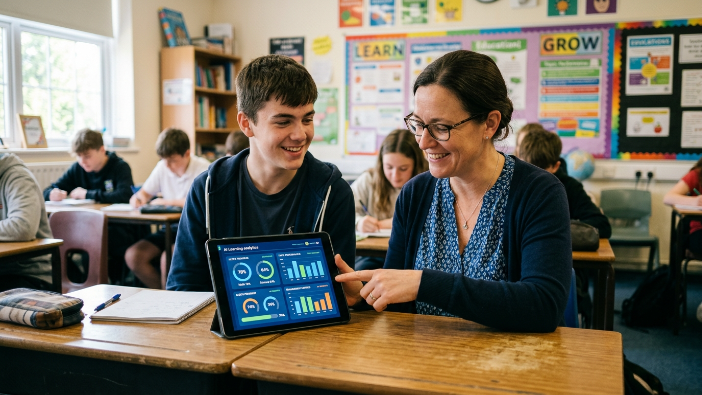
The World Economic Forum notes that AI also helps build critical thinking, digital literacy, and problem-solving skills, which are among the most sought-after abilities in today’s job market.
Which AI Tools Are Leading Personalized Learning in 2026?
Several AI-powered platforms have made personalized learning accessible across schools, universities, and workplaces. The right tool depends on your learning goal, your level, and whether you need it for school, personal growth, or professional training.
| Tool | Best For | Free Tier? | Key AI Feature |
| Khanmigo (Khan Academy) | K-12 students and self-learners | Yes (limited) | Socratic AI tutor that guides thinking |
| Duolingo Max | Language learners | Yes (basic) | AI conversation practice and adaptive drills |
| Coursera AI features | University-level and career learners | Audit option | AI course recommendations based on career goals |
| Docebo | Corporate L&D teams | No (enterprise) | AI-driven individualized learning paths |
| CYPHER Learning | Schools and businesses | No | Smart content delivery and NLP-based assessments |
| Quizlet AI | Students and exam preppers | Yes (limited) | AI-generated practice tests and explanations |
| LevelUp LMS | Corporate training managers | No | Adaptive skill path builder |
The AI-powered learning path market grew from $4.66 billion in 2025 to approximately $6 billion in 2026, at a growth rate of nearly 29%. Platforms like Pandai have scaled to over 1.3 million registered students since 2020, proving that AI-based adaptive learning systems can grow fast and serve real audiences.
When choosing a tool, look for platforms that offer real-time feedback, adaptive content delivery, and progress tracking built on learner data analytics. These three features are the backbone of any effective AI personalized learning system.
Can AI Personalized Learning Work for Corporate Training Too?
Yes, and the results in workplace learning are striking. AI-driven personalization in corporate learning and development (L&D) has shown a 30% increase in employee engagement and a 25% improvement in learning outcomes, according to McKinsey research cited by VirtualSpeech.
Companies use intelligent tutoring systems and adaptive LMS platforms to close skill gaps faster than traditional training programs allow. Instead of sending an entire team through the same onboarding course, AI builds individual learning paths based on each employee’s current skills and role..
Docebo, one of the leading corporate AI learning platforms, uses machine learning to analyze employee performance data and recommend targeted training modules aligned to job goals. CYPHER Learning takes a similar approach, using NLP-based assessment to adjust content difficulty in real time for each team member.
Corporate training programs that use AI also report reduced time spent on irrelevant content. Much of that content lands best visually, since people retain concepts faster from clear slides than dense text, and the best AI for PowerPoint tools let L&D teams turn each learning path into clean, on-brand decks in minutes. Employees get exactly what they need, when they need it, which leads to stronger retention and faster skill application on the job.” i want to remove from this links so provide me the best version
How to Start Using AI Personalized Learning Without the Spam
Understanding AI personalized learning is one thing. Actually starting is another. Most people stop at the sign-up screen because they do not want to hand over their personal email to yet another platform and spend weeks deleting marketing emails.
Here is a simple, practical way to get started:
- Identify your learning goal. Are you learning a language? Preparing for a certification? Upskilling for a promotion? Be specific. AI learning tools work best when they have a clear goal to build your learning path around.
- Pick the right platform. Use the table above to match your goal to a tool. Students and casual learners do well with Khanmigo or Quizlet AI. Language learners should start with Duolingo. Professionals need Docebo or CYPHER Learning.
- Sign up without exposing your main inbox. Most AI learning platforms require an email for registration. To protect your privacy and avoid spam, you can create a free disposable email at FreeMail AI and use it to register. You get full access to the platform without cluttering your real inbox.
- Complete the initial assessment. Most platforms start with a short quiz or placement test. Do not skip it. This is how the AI builds your baseline and starts personalizing your learning path from day one.
- Stay consistent. AI personalized learning improves the more you use it. The algorithm gets smarter about your needs the more data it collects. Even 15 to 20 minutes a day adds up fast.

Why Use a Disposable Email for AI Platform Signups?
Many AI EdTech platforms send promotional emails, weekly newsletters, and partner offers once you register. Using a temporary email lets you try any AI learning tool freely, without risking spam in your primary inbox. It also protects your personal data under privacy frameworks like FERPA and GDPR, which govern how student data should be handled in the US and EU respectively. A disposable inbox gives you one more layer of control.
A Smarter Way to Learn Starts Here
AI for personalized learning is not a futuristic concept. It is available right now, across dozens of platforms, for students, self-learners, and corporate teams alike. The technology tracks how you learn, finds your weak spots, and builds a path that actually fits you.
The only thing standing between you and smarter learning is a sign-up screen. When you are ready to explore these tools, protect your primary inbox and your personal data by using a free temporary email. It takes seconds to set up, and it keeps your real email clean while you try any platform you want.
Start exploring, stay curious, and let the AI do the heavy lifting.
Frequently Asked Questions About AI and Personalized Learning
Can a student use AI for personalized learning without a teacher’s help?
Yes. Most AI learning platforms are built for independent use. They include built-in guidance, progress tracking, and adaptive feedback that replace the need for direct teacher involvement during practice. That said, a teacher or mentor can still add value by reviewing AI-generated progress reports and providing emotional support, and running a student’s written assignments through an AI checker is another quick way to confirm the work still reflects their own understanding.
Does AI personalized learning work for learners with special needs?
Research shows AI tools can be especially helpful for learners with special needs. Platforms can switch content formats, adjust reading levels, generate audio explanations, and remove time pressure from assessments. SMU’s Learning Sciences research highlights how generative AI creates tailored materials that match unique learning styles, including for students who need extra support.
How long does it take for AI to start personalizing my learning?
Most platforms begin adapting within the first session. After your initial assessment, the AI immediately builds a learning path. It keeps improving as you use the platform. Many users notice clear personalization within two to three sessions.
Is AI personalized learning effective for learning a new language?
Yes. Duolingo Max and similar tools use AI and natural language processing to adapt vocabulary, grammar exercises, and conversation practice to your exact proficiency level. The AI tracks which words you forget fastest and schedules them for review at the right time using spaced repetition.
What is the difference between an intelligent tutoring system and a standard AI learning app?
A standard AI learning app mostly recommends content. An intelligent tutoring system (ITS) goes deeper. It simulates one-on-one tutoring by asking guiding questions, scaffolding difficult concepts, and adjusting based on how you reason through problems. Khanmigo is one well-known example of an ITS designed for students.
Can AI predict whether a student will fail before it happens?
Yes. Student performance prediction is one of the most powerful uses of AI in education. Platforms monitor early warning signals such as declining quiz scores, fewer logins, or longer response times and flag at-risk learners before they fall behind. This gives educators time to step in with targeted support.
Are all AI personalized learning platforms paid?
No. Several platforms offer free tiers that include meaningful AI features. Khanmigo, Duolingo, and Quizlet all have free options. The most advanced adaptive learning features, like full learning path customization and detailed analytics, usually require a paid plan. Trying a free tier first