

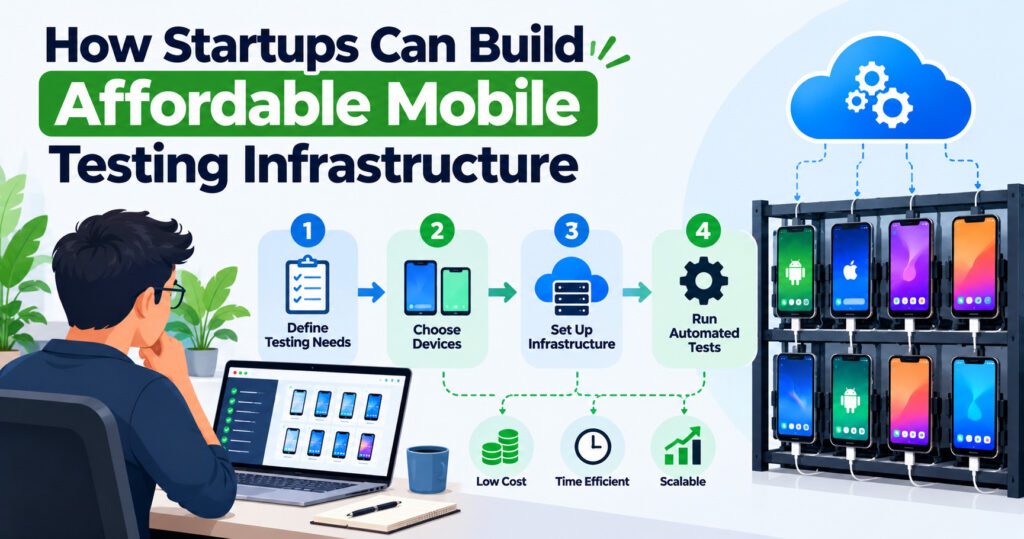
A seed-stage team with three engineers cannot buy a device lab. Yet the app still has to work on a five-year-old Android phone in Jakarta and on the newest iPhone in Berlin. That gap between budget and coverage sinks more launches than bad code does.
The good news: most of the expensive parts of mobile QA are optional. Cloud device farms, emulators, and a few cheap network tricks cover roughly 90% of what a small team actually needs. The other 10% is where founders should spend real money.
Start with emulators, but know where they lie
Emulators are free and fast, and they catch the boring bugs: layout breaks, null pointers, broken navigation. Android Studio’s emulator runs on ARM hosts now, so the old complaint about sluggish performance doesn’t hold up anymore. Run these on every commit and the team will never think about cost.
But emulators lie about three things that matter a lot: thermal throttling, real GPU behavior, and network conditions. An app that renders smoothly on a MacBook’s simulated Pixel can stutter badly on an actual budget handset with 3GB of RAM and a warm battery.
So treat emulators as a filter, not a verdict. They should catch about 80% of defects before anything touches paid hardware.
Networks break apps more often than devices do
Device fragmentation gets all the attention, but carrier networks cause just as much grief. Apps behave differently on a congested 4G cell in Manila than they do on office Wi-Fi, and geo-targeted content, ad delivery, and pricing pages often change entirely by region.
Routing test traffic through cheap mobile proxies lets a two-person team check how the app resolves in Brazil or Nigeria without booking a flight. Carrier-assigned IPs also surface ad networks and CDNs that treat mobile subscribers differently from desktop visitors.
The cost difference here is stark. A small pool of mobile IPs runs a few dollars a month, while one mistimed regional launch can burn a meaningful slice of a seed round.
Cloud device farms cover the physical gap
Buying 20 handsets means owning 20 depreciating assets that need charging, updating, and a shelf someone has to maintain. Renting them by the minute makes far more sense below Series A. Firebase Test Lab runs instrumentation and Robo tests on production devices sitting in Google data centers, and its free tier covers a startup’s early sanity checks without a credit card.
AWS Device Farm and BrowserStack fill similar roles at similar prices. The real trick is picking five devices that represent the actual user base instead of testing 40 configurations nobody owns. Play Console analytics will show which models dominate installs within the first month of release.
Mobile application testing splits into functional, usability, performance, and compatibility work, and each layer carries a different cost curve. Compatibility is the expensive one (it scales with hardware, not with code), which is exactly why it belongs in the cloud rather than in a drawer full of used Samsungs.
Spend the savings on test discipline
Cheap infrastructure only pays off if the tests are worth running. Most early teams have the ratio backwards: dozens of brittle end-to-end tests and almost no unit coverage. Google’s guidance on testing fundamentals pushes small, fast, host-side tests as the base of the pyramid, and that advice holds whether the team has four engineers or four hundred.
Flaky tests are worse than no tests at all. Engineers start ignoring red builds, and once that habit forms, the whole suite becomes decoration. Quarantine anything that fails intermittently, fix it inside one sprint, or delete it outright.
And keep the full suite under ten minutes. Past that threshold, developers stop running it locally, the feedback loop breaks, and bugs migrate to production where they cost 10 to 100 times more to fix.
One more thing worth budgeting for: a real phone in the hands of every engineer, ideally a cheap one. Nothing exposes a sluggish onboarding flow faster than using it daily on a $150 Android device.
Where this goes next
Fragmentation isn’t slowing down. Foldables, on-device AI features, and satellite connectivity are adding fresh failure modes every year, and each one arrives faster than hiring cycles do.
Startups that ship reliable mobile apps on small budgets aren’t the ones with the biggest device labs. They’re the ones who worked out early which 5% of testing genuinely needs real hardware and real networks, then automated the rest and stopped worrying about it.