

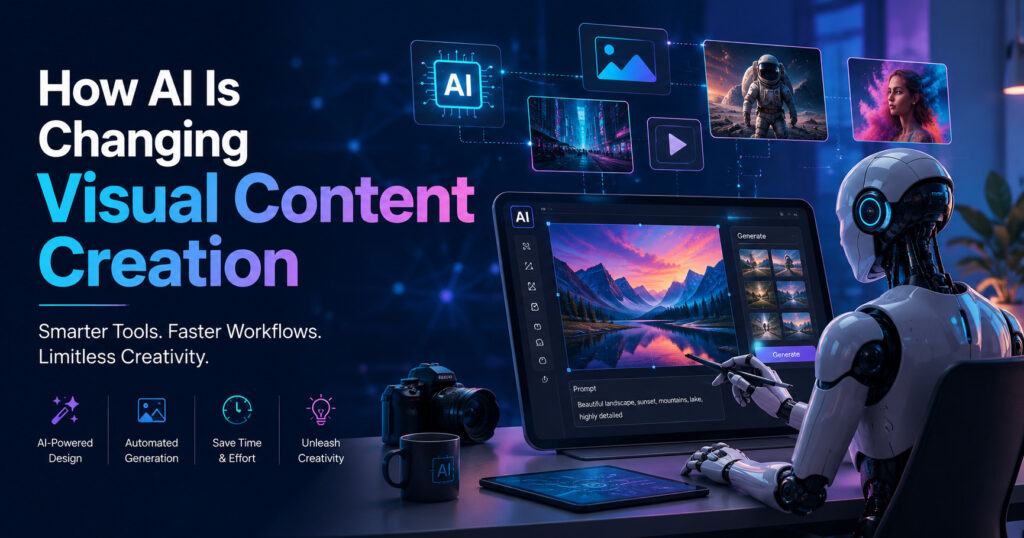
Artificial intelligence is moving beyond simple automation and becoming a practical part of the creative process. Designers, marketers, filmmakers, and content creators are using AI to explore ideas, produce visual assets, and develop video concepts faster than traditional workflows allow.
The biggest change is not simply that AI can generate content. It is that creators can now move between different types of media while developing the same idea.
From a Concept to a Complete Visual
A creative project often starts with something simple—a product idea, a character, a location, or a short description.
Traditionally, turning that idea into a finished visual could involve several people and multiple production stages. Generative AI can shorten the early stages by allowing creators to visualize different possibilities before deciding on a final direction.
For example, a marketer developing a campaign could first create product concepts, experiment with different environments, and then turn the strongest concept into a short video.
This makes the creative process more iterative.
AI Image Generation as the Starting Point
Images often serve as the foundation for a larger creative project.
An AI image generator can help creators explore different compositions, characters, environments, and visual styles from text-based descriptions.
A single concept can be interpreted in multiple ways. A product could appear in a luxury environment, a futuristic setting, or a natural lifestyle scene.
Instead of committing to one visual immediately, creators can compare several directions and determine which one best fits their campaign.
Creators can also use reverse image finder to find visually similar content, trace the source of an existing image, or explore how similar visuals are being used online.
Moving From Static Images to Video
Once a visual concept has been established, creators can begin thinking about motion.
A still image provides information about the subject and environment, while video adds movement, camera direction, timing, and storytelling.
This is where modern AI video generation becomes particularly interesting.
Creators can use an existing visual concept as inspiration for a moving scene and experiment with different camera movements, actions, and cinematic styles.
The workflow can therefore look like:
Idea → Image concept → Motion → Video sequence → Final edit
Where Seedance 2.5 Fits Into the Workflow
Modern AI video models are making this process increasingly sophisticated. Seedance 2.5 is part of the growing generation of AI video technologies that creators can explore when developing dynamic visual content.
Instead of thinking about AI video purely as a replacement for traditional filming, creators can use these models as a way to test visual ideas.
A filmmaker might have a scene in mind but want to experiment with different compositions before deciding how the final production should look.
Similarly, a marketer could explore several creative directions for the same product and identify which concept has the strongest visual impact.
Experimenting With Camera Movement
One of the most important elements of video is movement.
A scene can feel completely different depending on whether the camera:
- Slowly pushes toward the subject
- Moves around a character
- Tracks an object
- Pulls back to reveal an environment
- Remains stationary
- Uses a handheld-style movement
AI video generation allows creators to experiment with these possibilities during the concept stage.
This can be particularly useful for filmmakers and advertising teams who want to visualize a shot before investing in traditional production.
AI for Marketing Concepts
Marketing teams can also benefit from combining image and video generation.
Imagine a brand launching a new product. The team could use an AI image generator to explore several product compositions and then develop a selected concept into a short video using modern AI video technology such as Seedance 2.5.
This approach allows the team to test:
- Different visual environments
- Product presentation styles
- Camera movements
- Storytelling concepts
- Advertising formats
- Social media variations
The strongest concept can then be refined through traditional editing and production techniques.
AI and Social Media Content
Social platforms have increased the demand for fresh visual content.
Creators need to produce new images and videos regularly while maintaining a recognizable style.
AI can make experimentation more practical by allowing creators to develop multiple variations around the same idea.
For example, one campaign concept could begin as an AI-generated image and then become several short video variations designed for different social platforms.
This approach can help creators maintain consistency while adapting content to different formats.
The Importance of Creative Direction
Despite the growing capabilities of AI, human creativity remains central to the process.
AI can produce possibilities, but it doesn’t automatically know which idea best represents a brand or tells a compelling story.
Creators still need to make decisions about:
- Visual identity
- Storytelling
- Audience
- Composition
- Pacing
- Brand messaging
The best results often come from using AI as an experimentation tool while keeping humans responsible for creative direction and final decisions.
AI Doesn’t Mean Every Result Is Final
One common mistake is treating the first AI-generated result as the finished product.
Creative workflows usually involve iteration.
A creator may generate an image, adjust the concept, create another version, and then experiment with video. Even after generating a video, additional editing may be necessary to achieve the desired result.
AI is therefore most useful when treated as part of an iterative process rather than a one-click solution.
The Future of AI-Powered Creativity
The boundaries between image generation, video generation, and traditional editing are becoming less distinct.
A creator could start with an idea, visualize it with an AI image generator, transform the concept into motion, and experiment with a model such as Seedance 2.5 before refining the final result.
This could make visual production more accessible while also giving professional creators new ways to experiment.
The most significant change may be the reduction in time between having an idea and actually seeing that idea on screen.
Conclusion
AI is creating a more flexible approach to visual content production. Instead of relying on a single production method, creators can combine image generation, video generation, and traditional editing to develop ideas from multiple angles.
An AI image generator can help establish the visual foundation, while technologies such as Seedance 2.5 can help turn creative concepts into dynamic video experiences.
The technology will continue to evolve, but the core of successful creative work remains the same: a strong idea, thoughtful direction, and the ability to turn that idea into something an audience wants to see.