

Temporary email for AI tools is the smartest way to explore new technology without losing control of your data. The current boom in artificial intelligence has led to thousands of new apps. Most of these sites demand an email address before you can even try a demo. Using a burner email keeps your primary inbox clean and safe from the flood of marketing alerts.
What is a temporary email for AI tools?
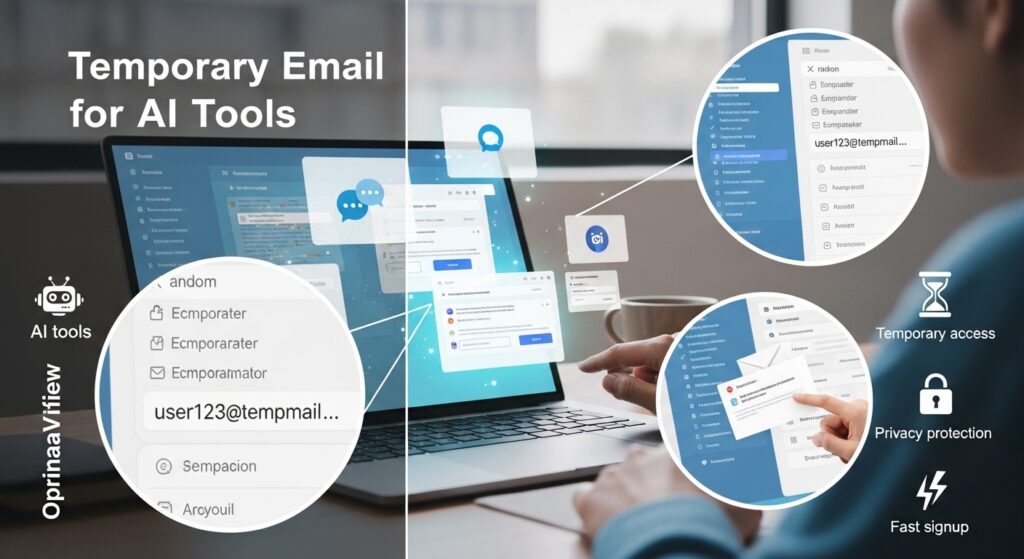
A temporary email for AI tools is a short-term, anonymous inbox that lets you access platforms like ChatGPT or Midjourney. It works by catching verification codes without linking to your real identity. Once you finish your test or trial, the address expires. This keeps your main inbox clean and safe from future marketing spam.
These services, often called burner emails, allow you to create a unique identity for every site you visit. You do not need to provide your name, phone number, or home address. You simply go to a provider like FreeMail and grab a random address. The site generates a mailbox that exists only in your current browser session. Any mail sent to that address shows up instantly on your screen.
In 2026, AI companies are hungry for data. They want to know who is using their models. When you give them your real email, you become part of their “user profile.” They can track your queries and sell your info to advertisers. A temporary email breaks this link. It gives the AI tool the data it wants while keeping your actual life private.
This tool is a favorite for people who enjoy testing the latest “GPT wrappers” or image bots. Many of these tools are small startups. They might not have great security. If their database leaks, your real email is not in it. You are using a shield that protects you from the risks of the early-stage tech market.
Why do AI platforms require email verification?
AI platforms require email verification to prevent automated bots from draining their expensive computing resources. Each AI query costs money in terms of GPU power and server time. By forcing users to verify an email, companies can track trial limits and ensure that real humans are using their services.
Free trials are the lifeblood of AI growth. But they are also targets for abuse. Without email checks, one person could script a bot to sign up for thousands of free accounts. This would crash the server and cost the company a fortune. An email check acts as a simple “speed bump.” It makes it much harder for bots to take over the platform.
How does verification help manage GPU costs?
GPU power is a limited resource in 2026. Companies must prioritize paying customers over free trial users. Email verification lets them set hard limits on how many “free tokens” a single user can have. If you reach your limit, they know who you are because of your email. This helps them balance the load on their hardware.
Why is bot prevention vital for AI?
Bots can do more than just use free credits. They can “scrape” the AI’s logic to build competing models. This is called model distillation. Companies use email verification to slow down these scraping bots. It is a security measure that protects their intellectual property and ensures the site stays fast for real people.
Why should you use a temporary email for AI tools?
You should use a temporary email for AI tools to skip marketing spam and protect your privacy while trying new software. AI startups often send many daily updates and news alerts. A burner email stops these messages from reaching your personal account. It lets you test features without a long-term data commitment.
The AI market changes every day. You might try five different “AI Writing Assistants” in a single morning. If you use your real email for all five, your inbox will be a mess by lunchtime. You will get “Welcome” emails, “We Miss You” emails, and “Check Out This New Feature” emails for months. A temporary email cuts all of that out.
Can it help you bypass trial limits?
Yes, many users use these tools to extend their testing period. If an ai photo generator gives you ten free credits, you can use a temporary email to get ten more. While some sites try to block this, it remains a common way for researchers and students to finish projects without a high monthly bill.
- No Spam: Your main inbox stays for friends and work.
- Privacy: The AI tool does not know your real name.
- Speed: You can sign up for a demo in seconds.
- Security: A hack on the AI site won’t expose your real data.
- Testing: Try every tool on the market without a trace.
How do you sign up for AI tools with a temporary email?
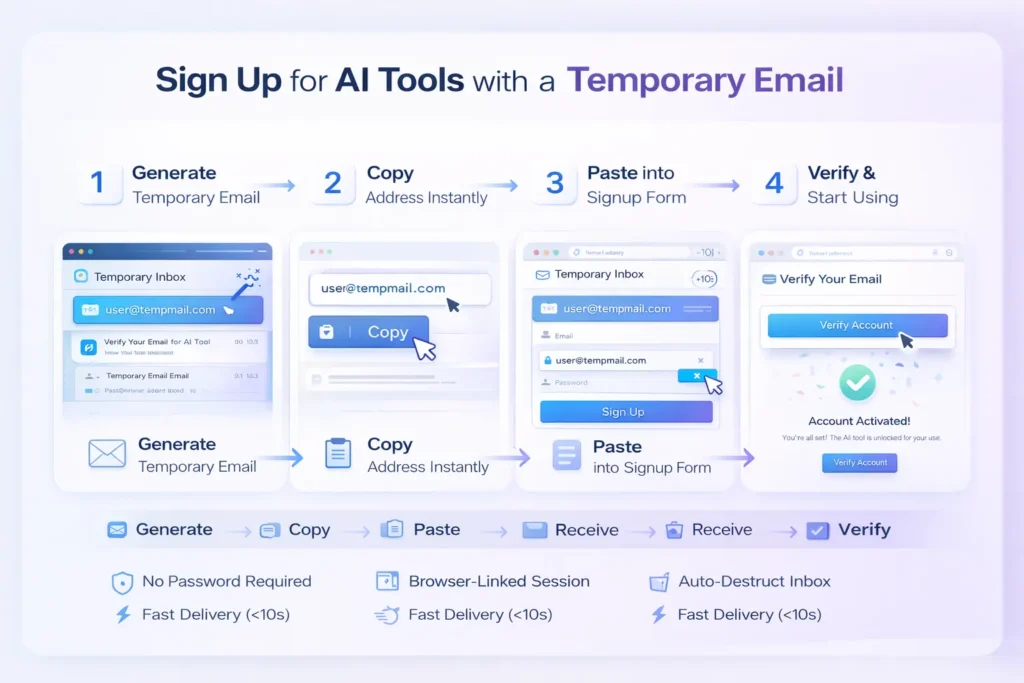
To sign up, first go to a service like FreeMail to generate a random address. Copy that address and paste it into the AI tool’s registration form. Go back to your temporary inbox and wait for the verification link or code to arrive. Click the link to activate your account and start your trial.
The process is very fast. You do not need a password for your temporary inbox. It is tied to your browser tab. If you close the tab, the inbox is gone. This makes it the perfect “disposable” tool for quick tasks. Most codes arrive in under ten seconds because these services use high-speed servers.
- Open the Generator: Go to a temp mail site.
- Copy the Address: Click the “Copy” button.
- Fill the Form: Paste the address on the AI site.
- Wait for Mail: The inbox will refresh automatically.
- Click and Go: Open the email and hit the verify button.
What should you do if the code doesn’t arrive?
If a code takes more than a minute, the AI site might have blocked that specific domain. This happens often with big names like OpenAI or Anthropic. If this occurs, just hit “Refresh” or “Change” on your burner mail site to get a new domain name. Most good services have many domains to pick from.
Which AI platforms commonly require email verification?
Most AI platforms, including writing bots, image generators, and coding assistants, require email verification before you can use them. This includes big names and small niche tools. They all want to verify that you are a real person before they let you use their expensive AI models for free.
| AI Category | Example Tools | Verification Method |
| Writing & Chat | ChatGPT, Claude, Jasper | 6-Digit Code or Link |
| Image Generation | Midjourney, DALL-E, Leonardo | Link or Discord Auth |
| Video & Motion | Sora, Runway, Pika | Email Link |
| Coding | GitHub Copilot, Replit | OAuth or Email |
| Research | Perplexity, Consensus | Verification Link |
Why do image generators have stricter rules?
Image generators use the most GPU power. Because of this, they are often the hardest on free users. Some might even ask for a phone number. But many still allow email signups. Using a temporary email for these tools is a great way to generate a few test images before you decide to buy a pro plan.
How do you bypass AI blocks on temporary emails?
You can bypass these blocks by using providers that offer fresh, private domains. Many AI companies maintain lists of common burner domains to prevent account abuse. High-quality services rotate their domain names every few days. This helps you get past filters on sites like OpenAI or Anthropic.
Some AI sites use advanced scripts to look for “MX records.” They check if the email server is a real one or just a temp mail script. If you find a block, try a service that offers “premium” or “custom” domains. These domains look like real business emails, which makes them much harder for AI sites to spot and block.
Can you use a VPN with a burner email?
Yes, pairing a VPN with a temporary email is a great way to stay invisible. A VPN hides your IP address, while the email hides your identity. This “double shield” is perfect if you are testing an AI tool from a country where it is not yet available. It helps you bypass both geographic and data filters.
- Switch Domains: Try a different extension like
.techor.io. - Clear Cookies: Do this before you try a new email.
- Incognito Mode: This stops the site from knowing you were there before.
- Private Providers: Use sites that don’t share their domain lists publicly.
Is it safe to use a burner email for AI work?
It is safe for quick tests but risky for long-term projects or sensitive data. If the AI tool stores your history, you will lose access once the email expires. Never use these for work that contains private company info. Only use them for one-time explorations or simple trials.
Safety is about what you share. If you are asking a bot to write a poem, a burner email is perfect. If you are asking it to analyze your company’s tax returns, stop. Anyone who finds your temporary address might be able to see your chat history. Treat every temporary session as if it were public.
What happens if you lose your password?
If you lose your password for an AI account linked to a burner email, you cannot get it back. The “Forgot Password” link will go to an inbox that no longer exists. This is the biggest downside. If you find an AI tool you love, switch it to a permanent alias or your real email as soon as possible.
Does the AI tool keep your data?
Yes, most AI tools keep your chat logs. Even if you use a fake email, they still have the text you typed. They use this to train their models. Using a temporary email protects your name, but it doesn’t protect the secrets you tell the bot. Always be careful about what you type into an AI prompt.
How do temporary emails affect AI “Daily Limits”?
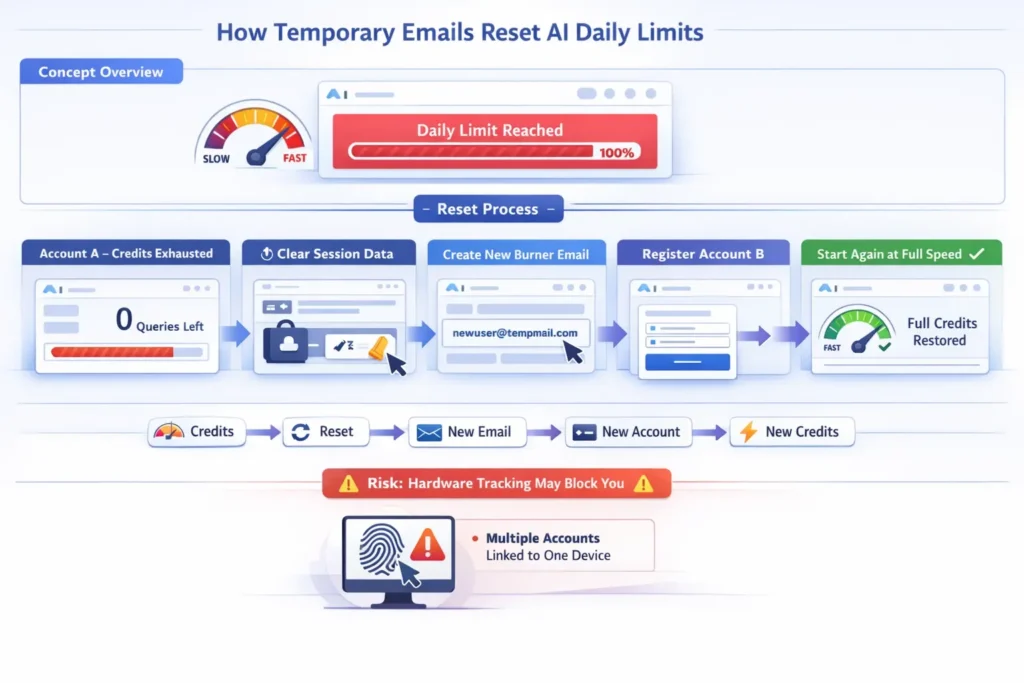
Temporary emails allow you to reset your daily limits by creating a new account once your credits run out. Many AI tools offer a set number of “fast” queries per day. Once you hit that wall, the AI gets very slow. A new burner email gives you a fresh start with full speed.
This is very helpful for developers who are testing an API or a specific prompt. If they run out of credits on their main account, they can keep working by using a temporary one. It keeps the workflow moving. But be aware that some sites track your hardware “fingerprint.” If they see ten accounts from one computer, they might block you anyway.
- Use up your credits on Account A.
- Log out and clear your browser cache.
- Generate a new email from FreeMail.ai.
- Sign up again for Account B.
- Get new credits instantly.
How to choose the best temporary email for AI testing?
Choose a service that offers fast delivery and a wide range of domain names. Look for features like “token recovery,” which might let you see your inbox again if you accidentally close the tab. A clean, ad-free interface is also a plus, as it makes the signup process much faster.
In 2026, the best tools are mobile-friendly. Many people use AI apps on their phones. If the burner mail site is hard to use on a small screen, it will slow you down. Check if the service has a browser extension. This can autofill the email for you, saving you the trouble of copying and pasting.
- Fresh Domains: Essential for getting past OpenAI and others.
- No Logs: Ensure the service doesn’t track your real IP.
- Speed: The code should arrive in seconds, not minutes.
- Attachment Support: Some AI sites send PDFs or reports.
- Easy UI: No confusing buttons or fake “Download” links.
What is the future of AI privacy in 2026?
The future of AI privacy involves more “on-device” models that do not require an email or an internet connection. Until then, temporary emails will remain the best tool for protecting your data online. We expect browsers to start building these privacy tools directly into the search bar for easier access.
As AI gets smarter, so will the ways it tracks you. We might see “AI Identity” tokens that replace emails entirely. But for now, the email address is the primary key for the web. Protecting that key is the only way to keep your digital life private. Temporary services like FreeMail will continue to be a vital part of a safe internet toolkit.
Conclusion
Temporary email addresses provide a simple and effective way to explore the fast-growing world of AI tools without exposing your personal inbox or digital identity. By using a disposable address, you can sign up for AI demos, receive verification codes, and test new platforms without committing your real email to countless mailing lists. While these emails work best for short-term trials and experimentation, they should not be used for important accounts or sensitive projects. When used wisely, temporary emails help you stay curious about new AI technology while keeping your personal data private and your inbox free from unnecessary noise.