

Spam bots collecting email addresses is one of the main reasons inboxes become flooded with unwanted messages, phishing attempts, and marketing spam. These automated programs scan billions of web pages every day searching for patterns that look like email addresses. When a bot finds a match, it stores the address in massive databases that are later used for bulk email campaigns or sold to third-party marketers.
From web scraping and data breaches to dictionary attacks and social media harvesting, spam bots use multiple techniques to gather valid email contacts across the internet. Once your email appears on one of these lists, it can spread quickly across spam networks. Understanding how spam bots find email addresses is the first step to protecting your inbox, and many users rely on a temporary email for verification to keep their real email private.
How do spam bots collect email addresses?
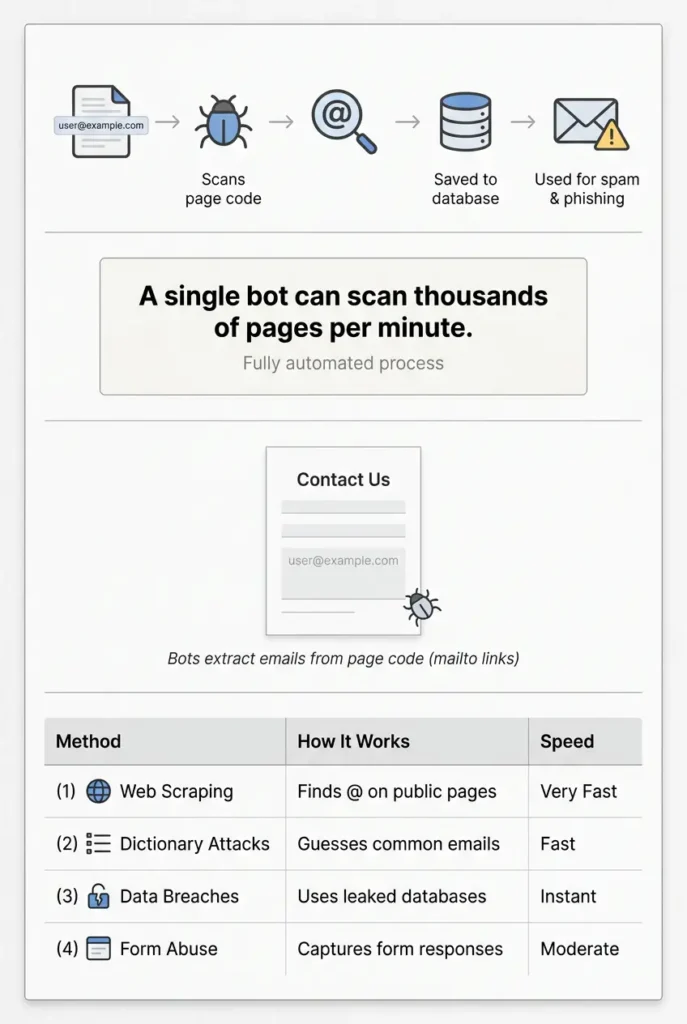
Spam bots collect email addresses by using web crawlers that read the source code of billions of pages. These scripts look for specific patterns like “username@domain.com.” When a bot identifies this pattern, it saves the address to a database. These databases are later sold to third parties for phishing or unsolicited ads.
The process is fully automated. A single bot can scan thousands of pages every minute. It does not think or feel. It simply follows a set of rules to find text that looks like an email. If you post your contact info on a public site, a bot will find it within hours. This is why many people use a disposable email address instead of posting their real contact information online.
These bots also target “Contact Us” pages. They look for mailto links in the HTML code. Even if you don’t see the email on the screen, the bot sees it in the code. This is a common trap for small business owners. They want to be reachable, but they accidentally invite thousands of bots to track their movements.
| Harvesting Method | Description | Speed |
| Web Scraping | Crawling public sites for the “@” symbol. | Very Fast |
| Dictionary Attacks | Guessing common names at popular domains. | Fast |
| Data Breaches | Buying leaked lists from hacked websites. | Instant |
| Form Abuse | Submitting data to capture response headers. | Moderate |
What are the most common email harvesting techniques?
Email harvesting techniques involve a mix of web scraping, dictionary attacks, and the purchase of leaked databases. Bots use these methods to build massive lists with millions of entries. These lists are the primary fuel for the global spam industry. Spammers refine these techniques every year to bypass new security filters and captchas.
Scraping remains the leader. Bots visit every corner of the web, from Reddit to small niche blogs. They are especially active on sites where users share their info in comments. If you write “Email me at…” in a post, you are essentially feeding a bot. The bot does not care about the context. It only cares about the data.
Dictionary attacks are more surgical. Some users try to protect their inbox by using techniques like a Gmail dot trick or creating a Gmail burner email for website signups. It might try john123@, admin@, or sales@. It sends a “ping” to see if the address exists. If the server doesn’t bounce the message, the bot knows it found a live target. This is why simple usernames are often the most targeted by junk mail.
How do data breaches fuel spam lists?
Data breaches fuel spam lists by providing verified, high-quality contact data from trusted sources. When a major site gets hacked, the stolen data often ends up on the dark web. Spammers buy these lists because they know the emails are real and active. This is why you might get spam even if you never post your email publicly.
Leaked data often includes more than just your email. It might have your name, birth date, or shopping habits. Spammers use this to make their mail look real. A “phishing” email that knows your name is much more dangerous than a generic one. This is why security experts tell you to change your passwords after a breach.
- Dark Web Markets: Where stolen lists are sold for crypto.
- Pastebin Sites: Where hackers dump data for free.
- Credential Stuffing: Using old passwords to find new emails.
- Public Registries: Using WHOIS data from domain owners.
Why is your email address valuable to bots?
Your email address is valuable because it acts as a direct link to your digital life and your wallet. Spammers use it to send ads that earn them a small commission for every click. More dangerous actors use it to deliver malware or links to fake login pages. Your inbox is a gateway that hackers want to unlock.
Bulk mailing is very cheap. A spammer can send a million emails for a few dollars. Even if only one person clicks a link, the spammer makes a profit. This “low-cost, high-volume” model is why spam never goes away. As long as it is profitable, bots will keep hunting for new addresses.
Your address also helps build a “social graph.” If a bot knows who you talk to, it can pretend to be a friend. This is called “spear phishing.” It is much more successful than standard spam. By collecting your address, the bot starts a chain of events that could lead to identity theft or financial loss.
Can bots find hidden emails in code?
Bots can find hidden emails in code by looking for specific HTML tags and Javascript strings. Many people try to hide their email by writing “name [at] domain [dot] com.” While this stops basic bots, modern scripts are smart enough to translate that back into a real address. Simple text tricks are no longer enough to stay safe.
How can you protect your data from bots?
You can protect your data from bots by using contact forms instead of plain text emails on your website. Use tools like CAPTCHA to ensure that only humans can submit info. For personal use, a secondary or “disposable” email address is the best way to keep your primary inbox clean from automated scrapers.
Obfuscation is another path. Instead of text, you can use an image of your email address. Bots cannot “read” an image easily. You can also use CSS to reverse the text on the screen. To a human, it looks normal. To a bot, it looks like gibberish. These methods add a layer of friction that makes your data less attractive to lazy bots. One of the easiest ways to avoid spam bots is to use a temporary email with inbox when signing up for new websites.
Using a “Contact Form” is the gold standard for businesses. This keeps your actual email address on the server and off the public page. A bot can fill out the form, but it can’t see where the mail is going. If you add a “honeypot” field, a hidden box that only bots will fill, you can block them before they even hit send.
Do temporary email addresses block bots?
Temporary email addresses block bots by providing a “dead end” for their tracking scripts. When you use a throwaway address for a one-time signup, the bot captures that address. However, since the address expires in a few minutes, the bot’s data becomes useless. Your real inbox stays completely invisible to the scraper.
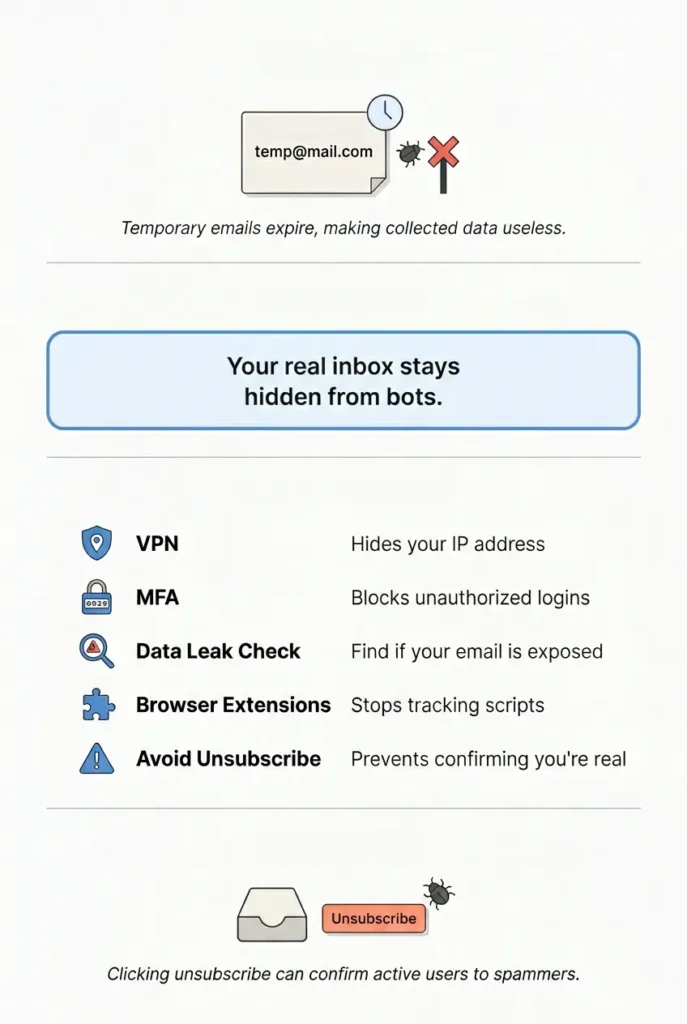
- Use a VPN: Hides your IP so bots can’t track your location.
- Enable MFA: Stops bots from logging in even if they have your mail.
- Check “Have I Been Pwned”: See if your mail is on a leaked list.
- Use Browser Extensions: Block scripts that track your movements.
- Never “Unsubscribe” from Spam: This just tells the bot you are a real person.
Many users generate disposable addresses using a temporary email generator before signing up for new services online.
What is the role of AI in bot collection?
AI plays a major role in bot collection by helping scripts solve puzzles and bypass basic filters. Modern bots use machine learning to understand the context of a page. They can now find emails hidden in complex sentences or identify contact info inside PDF files. This makes them much more “active” than old-school crawlers.
As filters get better, bots get smarter. They now mimic human typing patterns to avoid detection. They can solve “I am not a robot” checks by using AI vision. This creates a “security race” where both sides are constantly building new tools. The best way to stay ahead is to reduce the amount of public data you share.
AI also helps spammers “clean” their lists. They use scripts to remove dead addresses and focus only on the ones that open mail. This increases their success rate. If you open a spam mail, an AI bot notes it. You will then get more mail because the bot knows you are an active user. This is why ignoring junk mail is your best defense.
How do bots use social media for harvesting?
Bots use social media for harvesting by scanning public profiles and “bio” sections. Many people list their email for business reasons on Instagram or X. Bots find these in seconds. They also scan “comment threads” where people might share their contact info to enter a giveaway or a contest.
| Platform | Bot Activity Level | Common Target |
| High | Work Emails / Job Titles | |
| Very High | Comment Sections / Niche Groups | |
| High | Link in Bio / DMs | |
| Forums | Extreme | User Signatures / Profile Pages |
What are the legal risks for bot operators?
Legal risks for bot operators include heavy fines and prison time under laws like the CAN-SPAM Act in the US or GDPR in Europe. These laws state that collecting personal data without consent is a crime. However, many bot operators live in countries where these laws are not enforced. This makes it hard to stop them through legal means alone.
Enforcement is the weak point. It is easy to hide a bot’s origin using a proxy or a dark web server. Even if a bot is caught, the operator just moves to a new server and starts again. This is why technical protection is more important than legal protection for most users. You cannot rely on the law to keep your inbox clean.
Some countries have started “suing the senders” by targeting the companies that buy the stolen lists. This hits the spammers in their wallet. If no one buys the data, the bots have no reason to hunt for it. This “demand-side” enforcement is a new strategy that might help lower bot activity in the long run.
Why is reporting spam important?
Reporting spam is important because it trains the “global filter.” When you click “Report Spam,” your provider shares that data with other companies. This helps them block the bot’s server for everyone else. It is a community effort to keep the web safe. Every report makes the filter a little bit smarter.
How do “Honeypots” catch spam bots?
Honeypots catch spam bots by creating a “trap” email address that no human would ever find. Security companies place these addresses in hidden parts of a website’s code. Since no human can see the link, the only way to find the email is to be a bot. Any mail sent to that address is instantly flagged as spam.
Once a bot hits a honeypot, its IP address is added to a global blacklist. This stops the bot from sending mail to millions of other people. It is one of the most powerful tools in the fight against automated harvesting. Many large websites use “invisible” honeypots to protect their users every day.
- Invisible Fields: Forms that only bots can see and fill.
- Hidden Links: Links that are the same color as the background.
- Fake Databases: Lists of fake emails meant to waste a bot’s time.
- Slow Servers: Servers that “trap” a bot in a long loading loop.
What is the future of anti-spam technology in 2026?
The future of anti-spam technology in 2026 involves “zero-trust” email systems and AI-driven identity checks. We will likely move away from “open” email where anyone can send you a message. Instead, your inbox will only accept mail from people who can prove their identity through a blockchain or a verified token.
We are also seeing “AI Gatekeepers.” This is a script that sits in front of your inbox. It reads every incoming mail and asks, “Is this a bot?” It can even reply to the sender with a question that only a human can answer. This “Turing Test” for email will make it much harder for automated bots to reach your eyes.
Privacy will also be built into the browser. Instead of you choosing to use a temporary email, your browser will do it for you. Every time you see a signup box, the browser will offer a unique, random address. This will make the “Spam Bot” model much less profitable, as most of their data will be expired or dead within days.
Will bots ever stop collecting emails?
Bots will not stop collecting emails as long as email is the primary way we talk online. However, the “yield” for bots is going down. As people get better at protecting their data, bots have to work harder. This will likely lead to fewer, but more dangerous, bots that focus on high-value targets rather than bulk collection.
Conclusion
Spam bots rely on automated tools to scan the web, harvest email addresses, and build massive contact lists used for advertising, phishing, and malware campaigns. Techniques such as web scraping, dictionary attacks, and leaked databases make it easy for bots to collect millions of addresses within hours. While it is difficult to stop bots entirely, reducing the amount of public contact data you share and using tools like contact forms, email obfuscation, and temporary email addresses can significantly lower your exposure. As anti-spam technologies continue to evolve, staying aware of how these bots operate is one of the best ways to protect your digital identity and keep your inbox secure.